

We’re all searching for something. For some, it’s money, or the things that money can buy— a beautiful house, exotic car, vacation house, top notch education. Or maybe good health, or a few more years of life; or a family, kids; peace, security, and rest.
Whatever we desire most becomes our god. It just does. Still, deep within our soul and our psyche, this focus eclipses all else. Not a deliberate obsession…, but close.
There is a saying within Buddhism that, “The only Zen you will find on top of the mountain is the Zen you bring up with you.” [Robert M. Pirsig] Personally, I would hope that Zen, or the God I seek, would be a little grander than that. I carry too much baggage to drag my Zen along with it.
A lot of us create our god from temporal things, as delineated above. Some of us seek a God beyond this realm. Yet with so many religions claiming to be the path to god, how do you discern which one, or a combination thereof, is truly accurate?
This EMPulse series will investigate the most important of today’s religious belief systems and leave you with the task of figuring it out. FYI, this is the kind of route I took on my journey to Christian faith. It was not fun.
One of our Board members, Beverly Dowdy, a former Duke Univ. Librarian, suggested these ideas to initiate your search for god—
1. Find persons of faith that you can trust. Talk to them. See what commonalities they have that speak to you.
2. Keep an open mind but do not turn off your brain. Be ready to discard any baggage you may have accumulated about God.
3. If these people of faith participate in some kind of worship, go with them. Listen to and absorb what is going on. Ask questions.
4. If worship speaks to you, continue it. Find a place to practice it. Most people over the centuries have found that being in a sacred place is pivotal.
5. If you cannot find a sacred place, try worshiping within a local community.
6. Most people of faith pray. Ask them how.
7. Open your mind to accept intuition, intimation, or peace. Be open to what is going on through the worship or prayer.
8. Try reading some of the books that are traditionally considered holy. If they do not make sense to you, ask people of faith that you trust to explain them.
Personally, I’ve found that my walk of faith has grown over the years. What I first thought were my struggles to find God, was actually His gracious exposé of my own arrogance and superiority. Now, I find humility is a much safer stance to assume when searching for the God of the universe.
Over the next few (or not so few) inquiries we will be honorable and open in what we learn about various spiritual paths: their differences, similarities, and disparities.
So help us God.
Honor God, honor people, make a difference,
Gary
Dr. Gary Davis, President
NEXT— What are you looking for?

 Having just survived the COVID19 Pandemic (2019-2021) the world is faced with many Challenging Challenges. One of the strangest is a propensity for many of us to remain isolated.
 Ok, Ok…, after you’ve stopped laughing at the photo let’s think about this.
 When we’re young we rarely think about dying. Unless a friend is suddenly taken in an auto accident, or by cancer, or some extreme medical situation. These are rare, but poignant, reminders that, someday, we will all meet our Maker. Or, if you are an atheist, you will simply cease to exist. Or you’re just not sure about all this morbid stuff.
 Most of us would agree that trust is essential to human nature and human relationships. And, of course, to the affection and affinity we share with man’s greatest friend— our dog. What is it about dogs that draw us to them? What is it about us that draws them to us? Frankly, I don’t care. There’s just something special in the relationship between a human and their dog that is beyond description. A codependent bond not to be broken or challenged.
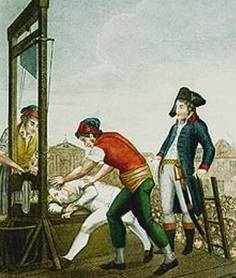 One of favorite novels of all time is Charles Dickens A TALE OF TWO CITIES. In it he describes the horrors & inequities of the French Revolution (1789-1799). But it is also a story of love and nobility. Without getting too deeply into the plot, Sydney Carton switches places with Charles Darnay so that he is the one who is executed by guillotine, thus saving Darnay. In Dicken’s novel his last words are—
 Clueless Christianity