
what’s happened to us? fear of engaging

gambar-1-27      Fear of engaging. Maybe it goes back to some fear in our childhood? Or to the Silent Generation, who could barely say anything after witnessing the horrors of the Second World War.

      One of the reasons our evangelical world first developed four-point gospel outlines (1949) was literally to put words into the mouths of those who could barely speak, or just simply didn’t want to talk anymore. It was truly a silent time in our land. [Coincidentally, the phrase daily quiet time also emerged at this time.] Or our silence could have been a result of the McCarthy investigations into possible Communist sympathizers. This laid the groundwork for the Cold War of the 50s–60s.

      Today, in 2020, Christians in the West still have difficulty, if not blatant fear, of engaging the world around us. We might not know what to say. We might not know the answers to their questions. We don’t know how to lead them to Christ. Worse yet, we may not know even one normal person (read non-Christian) to engage. We just have no point of contact with normal people in a religious way.

      So we unconsciously huddle within our Christian cultures fearing any significant contact with the World. We are afraid of being tainted, tempted, or taunted. But we do not find any of this in the New Testament.

      Instead, we find Jesus’ disciples transformed by the renewing of the Holy Spirit, bold to declare His deity and saving grace in the face of severe opposition, even unto death.

      What’s happened to us? Too many of the Christians I know are clueless when is comes to engaging anyone with the gospel of Christ. We steer clear of those conversations at all costs. Allow me to offer five ideas on how you can follow our Lord into people’s lives.

  1. Relax. Let the Spirit open doors for His witness. No need to tense up.
  2. Remember God is in control. You do not have to be. Nor do you have to get thru some pre-scribed gospel outline. Respond naturally using your heart and your mind.
  3. Place yourself in the midst where normal people gather. This may take some creativity while we’re in this COVID19 self-isolation period.
  4. Fall in love with people. The command to love hasn’t seemed to sink in. I find more meaning if we connect with people as if we’re in love with them, looking forward to our next meeting.
  5. Give God some room to work. Our job is to show up, be there, and love creatively.

      Our God is so full of surprises. Enjoy yourself and watch Him work.

Honor God, honor people…, make a difference.
Gary

Dr. Gary Davis, President

91119

4428688046_baabbdcaa4_b     Eighteen years ago America’s soil was violated in a three pronged terrorist attack that left many of us stunned. Most of us have recovered. Some of us weren’t even born. But this attack changed the way we viewed our safety, our stability, and our place in the world.

But what have we learned? We learned that our homeland is not impervious to attack. That 2,977+ Americans dies that morning. That wars are not always waged between nations but between ideologies. That ancient and extreme forms of Islam are alive and practiced today. Some barbarous. That America has some sins to be atoned. [We’re not a perfect pious country.] That many peoples around the world truly hate us and our way of life. They may have a point.

From our point of view, we created a lot of enemies that day. The reality is that we already had them.

Now let’s run ahead 18 years and look back. We are still fighting a war with certain branches of Islam. No resolution. Yet! But our God is full of surprises.

Most of us have been enemies of God for much of our lives. But God demonstrated his love for us in this: while we were still sinners Christ died for us. [Romans 5:8]  Even genuine Christians remain enemies in some areas of our lives. Hey, we’re only human! No. For too much of our lives we are worse than that. Nonetheless, Christ calls us to walk honorably before him, to care for widows and orphans, to feed the poor…, and to forgive our enemies.

It is the evil that invades our hearts and ensnares us that is the enemy of Christ; and ours too. We dare not lose sight of that.  Ever.

Many in the West don’t give much credence to good & evil. They’re just constructs of the mind and definitions we use to label us vs. them. SERIOUSLY! So men are neither good nor evil. We are neutral. Really?!? History records otherwise.

So as we commemorate this 9-11 remembrance let’s remember who the real enemy is; not Islam, not the radical right or left, not home grown terror. It is the evil that under-rides the world and the entire universe seeking to destroy us and divide us and take away any remembrance of God and his redemption.

Bastard!

If you are a genuine follower of Christ you have been set free from your rebellion and rejection of his holiness. You do not have to hate or hold grudges or ancient animosities. You can chose to live a life that makes a difference among men, that forgives wrongs done, that prevents future conflicts. Now get on with it.

Honor God, honor people…, and be a pain in Satan’s ass,

Gary

NEXTTEPID

Of Cubes and Chaos: Stepping up our Game

134294One of the oddities of our day, or maybe every era, is that genuine Christians never seem to rise to the occasion. We wait to see what happens before we respond or step in. To my way of thinking we need to step up our game. We need to be leaders within our culture and community, not waiting to see how things go and then reacting.

     One of the causes of this is that we are too wrapped up in church work. Nothing wrong with that, mind you, but if it keeps us from our primary mission of drawing people to Christ then something is seriously wrong. We create a comfortable confined faith imprisoning ourselves from the world out there. I never saw Jesus draw that us/them dichotomy.

     In the world, but not of it. Remember?

     So…, how do we step up our game?  Some thoughts—

     Start by cutting back. You are probably excessively frantic & over-committed. [Aren’t we all?]  You will never be able to have an effect on your surrounding community unless you make time for them— and that means cutting.

     Listen to people around you; friends, neighbors, work associates, waitresses. Learn from them. It may take a while before they open their lives to you, but there will come a time when you become a safe person for them. Wait for it. Wait for it.

     Up your silence before the Lord. Listen more before him than you ask for things. ‘Nough said.

     Find someone with a common mind and heart to yours; someone who shares your passion for this world and the people in it. Meet often. Talk about your discouragements too.

     Never forget that our Adversary prowls about like a roaring lion who wants to eat you up. [1 Peter 5:8]

     Finally, stick to it; stay committed. It is too easy to become distracted and exhausted when our Lord calls you to make a difference.

     There will always be challenges-to-complacency in life. Don’t give in to the illusion of safety.

Honor God, honor people…, make a difference,

Gary

Of Cubes & Chaos: Forgiveness

jesus-cross-summit-cross-37737 Another side of my Cube simply reads FORGIVE. It is important for us to remember how difficult it is to do that. We may say we forgive; but then we harbor a grudge, or a slander, or cast a shadow, for decades. We “share” a concern about the one who wronged us with others considering him/her for promotion or something; not fully trustworthy, possibly. Remember Truthiness?

     Our reality is that we haven’t actually forgiven that group or individual. So we disparage them to others. Subtle, isn’t it. Maybe not so much.

     Which is more challenging— to offer forgiveness, or to seek it? Two sides of the same coin? Over my life-span I’ve noticed that the people who are more willing to admit wrong, and seek forgiveness, are also those who forgive others more readily.

     But there will always be those who find it virtually impossible to admit wrong, or seek forgiveness whatsoever. Why? I think it has to do with their self-worth. If they admit to being wrong that somehow diminishes their personhood; it becomes a matter of personal pride.

     Some people simply cannot see themselves as wrong…, ever. That would make them less of a person; it would throw spurious doubt on their perfection. (Which they know, deep down, they are not anyway.) FYI— I was perfect once! For about 5 minutes in April of 1987. (You’d better be laughing.)

     To err is human (Duh!) To screw up is even more human. To forgive is not. It takes a special strength to confess you are wrong about something. You are going to need God on this one. Prayer matters.

     My wife and I have a principle we’ve tried to abide by our entire marriage. Always be the first to say you’re sorry; especially when you know you’re right.” 

     We admit we’re wrong much more readily now.

     “Father, forgive them; for they do not know what they are doing.”

NEXT—   paradigm positioning— where are we?

Honor God, honor people…, make a difference,
Gary

But…. an introduction

original

An excuse is a skin of a reason stuffed with a lie. ~Billy Sunday

But… . ~an introduction

     We’ve become a myriad of excuses. We need to be a world of actions! But, no, it’s easier to make excuses than to follow through on what we’ve committed to. I am as guilty of it as you. For my mornings, the graphic for this article says it all. Seriously, I don’t want coffee in the morning: I NEED coffee!

     “But…!” ummmmmm. Right.

     But we never did it that way before.

     But I was too tired.

     But my support staff did not arrive in time.

     But I ran out of time.

     But I wanted it.

     But honey… .

     But God… . [Lot’s more on this.]

     But, But, BUT!  Sometimes I feel like we’ve left off a “t.”

     We’ve become so good at making excuses that we should all have a Masters Degree in the Arts for our accomplishments.

     This series will shift radically from the problems we face with communicating with our own culture, let alone to another one, and turn our attention to a unilateral human problem— making excuses. First, we’ll look at a series of people who DID NOT make excuses. Then, we’ll study the psychology of WHY we make excuses. Finally, we’ll examine some of the excuses we make and WHY we make them.

     So if you’re one who never makes excuses, you can skip this series and wait for the next one on lies we tell ourselves…, & God.

     BUT, preliminarily, let’s define our terms.

An excusedef. transitive verb

1ato make apology for

  bto try to remove blame from

 [Mirriam-Webster Dictionary]

     So, how’s your excuse-quotient these days? Up to snuff? Most of us are so good at making excuses we are not even aware we are doing it. Tune in next time for some discouraging examples of people who pushed through!

NEXT— “But... people who offered no excuse.”

No buts…,

Gary

Framing a postChristian Gospel: a heart to heart thing part 5

heart-257157_1920“God created man in his own image. And man, being a gentleman, returned the favor.”

~Jean Jacques Rousseau (June 1712 – July 1778)

6 February 2019

The QuestionSo then, what should the Christian message (heart & mind) in a postChristian society look like?

     First, it must be exhibited in the lives of those who call themselves Christians. Genuine Christians will act differently within a postChristian society. For one, we will not withdraw from the society and seal ourselves within our Christian peer groups, small groups, or large churches. We will be immersed in the matrix of our culture, from politics to pubs, from businesses to the broken hearted, from philosophical forums to the Supreme Court. In short, true postChristian-Christians will be active members in our communities. And we will be involved, openly & matter-of-factly as Christians, with little apology for our faith. For our faith will in no way resemble the narrow-minded, withdrawn hibernation of the last era of western Christendom; that era is dead and gone; and needs to be gone.

Instead, a postChristian faith will speak of the greatness of our God and how important it is to live by the principles He has set down for His creation. It will exhibit a kind of Christianity that encourages people to flourish and grow. Christians in this new era will be a positive contributing force for Christ, working alongside those of other faiths, even postmodern atheists, for the glory of God and the enrichment of the peoples of this earth.[i] True evangelism takes place when it becomes the unconscious expression of a new life in Christ.  It makes a difference in peoples’ lives through the kind of life lived out, publicly, by Jesus’ followers. The gospel will be communicated heart to heart through service, commitment, caring, and a cohesive Christ-honoring presence in peoples’ lives.

     Second, the WORDS of the gospel will become complimentary to the LIFE of the gospel exhibited in the lives of Christ’s followers. Preach the gospel at all times; when necessary, use words was how Saint Francis put it. Remember, the WORDS of the gospel merely explain what the God of glory has done to bring the human race back into a relationship with Him through Christ’s work on the cross…, and subsequently, through His Holy Spirit living within us. As necessary as they are, the WORDS of our message are empty without a practical demonstration of their Truth through the way we live. [Do not misconstrue this to mean simply— live morally. It is more than that. It is a summons to live Godly, based on the precepts set down in the New Testament by Jesus Christ.] The WORDS of the gospel will take the postChristian perspective back to the raison d’etre for the Christian message— namely, that this human race, and each of us individually, should live in harmony with the God who created us. This is the nature of our Salvation, to be rooted in the fulfillment of Christ’s work at Creation through His sacrifice on the Cross. Repentance and forgiveness have no context outside the restoration and fulfillment in Jesus’ work at Calvary.

     Thirdly, the core of the Christian message must abound with LOVE. Simple enough!? Not really. This is a problem. Why? Because we often say we love people (normal people), but in reality we hardly know them at all. We have little social contact with people who never go to church but rarely are we involved in their lives enough. We simply do not know them. Love grows in relationships when people become open and honest with one another about their inner lives; when agreements are adhered to; when trust is constant and never betrayed. It might be helpful if we morph the idea of loving another into the romantic mode— falling in love with them. The language of romance holds far more concrete images than does the idea of loving another person in a platonic, spiritual, evangelistic kind of way. It engages our emotions as well as our verbal communication and spiritual concern. It ignites our passion and deep desire to be with the other person. It encourages our heart desire to give everything to the other person for the sake of Jesus Christ. You know what being in love does to you. It makes you alive again!

Maybe our problem is that we don’t allow Jesus to love us passionately; therefore, we cannot love another passionately. It is questionable whether a genuine follower of Jesus Christ who will not allow God to love him/her fully would ever be able to love anyone else, Christian or otherwise. This is an issue which our postChristian church in the West must yet grapple. We still speak of love more than we exercise it. Talk’s cheap— action’s everything. Let’s get it on!

NEXT TIME~ Framing a postChristian Gospel:  talk’s cheap—action’s everythingpart 6.

Embedded,

Gary

[i] In my own interactions with “normal” people I have been constantly surprised by their preconditioned response to the word “Christian” and their surprise when they discover that a genuine Christian has been in their midst all along, talking from his own Biblical presuppositional base.

ADVENT #3— JOY!  ~the shepherd’s candle.

16 December 2018

      Merry Christmas!

            If you’ve watched the opening video…, you have watched it, right?!? Anyway, after you HAVE watched it, you’ve already grasped the point of Advent candle #3— our joy is to be expressed, not only on a hill outside of Bethlehem on a star lit night, but in the midst of the marketplace, the town square, among people who need to see, and hear, our joy this Christmastime.

            How many Christians have you met that portray the Christian life as a life of sacrifice, drudgery, or somber obedience. In too many ways have we hid our light under a bushel, encased in our silent personalities, afraid to let it shine? Or maybe your Christian faith is a personal matter, between you and the Lord: if so, then you would be disobeying His commandment to go out into our world and make disciples.” [Matthew 28:18-20.]  Though we may carry a quiet faith, a personal faith, it is by no means to be a surreptitious one; “they will know you by your love…. “  It is at least that. Yes?

            Our Western, especially American, culture can rob us of our joy in so many ways. For one, we can make Christmas about everything except Christ. Oh, we may replace Him with the baby Jesus, and the sweet manger scene. Jolly ol’ Santa Claus with his bag of toys & delights. Or we may supplant Him completely with buying & giving, shopping, rushing around to get one-last-thing. We’re like that.

            Let me ask you something— Where does your joy come from? Is it like the shepherds’ surprise and wonder at the splendor of myriad of angels singing “Glory to God in the highest, and on earth, peace among men, with whom He is well pleased!”  Or does it come from buying your kids (or grandkids) one super-duper awesome Christmas gift? Maybe it comes from receiving something this Christmas that you truly didn’t expect to get. Don’t get me wrong; all this is great, and fun, and joy producing in oodles of delight, with candy kisses thrown in. I like that too.  J

            Still, I want most of my joy this Christmas season to come from Jesus. The birth of the Omnipotent God into our meager realm, to live, to thrive, and, eventually, to die: that I might live!  HALLELUJAH!

Behold our King,
Gary
Dr. Gary Davis, President
www.CluelessChristianity.com  

NEXT TIME~ An ADVENT of PEACE!

Empulse #12 A Christian Message for a postChristian Heart

kermit_the_frogSarah had come to faith in Christ during  college. After two years in the campus group she showed up in our home out of frustration. She was visibly distraught. Her Christian staff worker had told her she “just needed to trust Jesus.” “That,” she said, “just was too simplistic.” She was aggravated, angry, and very near the detonation point. As we sat that evening in front of our wood stove she collected herself to tell my wife and me a story we could hardly believe.

            Sarah[i] had grown up in a proper family in a rural area in New York; mother, father, two sisters and one brother, older. On the surface everything appeared to be status quo. But just below the surface lay insidious evil. Sarah’s older brother had been raping her every day of her life since she was eleven years old. One of her sisters found her in tears one day after one of her brother’s assaults. In the process of trying to shield her brother, Sarah’s sister Jennifer[ii] guessed what had been going on and told Sarah that she, too, was also being raped by their brother every day. When they confronted their brother he threatened to commit suicide. Sarah and Jennifer told Bob[iii] that he had to tell their parents within the week or they were going to the police.

            The two sisters were resolute in their determination and insisted that Bob follow through and tell their parents what he had done to them. Instead, to their shock, Bob committed suicide. He left a suicide note for his parents blaming Sarah for everything (leaving out any mention of Jennifer).  Sarah began to sob, scream, curse, and go completely out of control as she told us that her parents believed what her brother had written in his farewell letter. They told her that she would just have to admit her complicity in the ongoing, five year “affair” she had had with her older brother. After Bob’s funeral, Sarah’s and Jennifer’s older sister told them that she too had been raped by him, repeatedly; but they did not want to speak about it, ever again.

            It was now close to midnight. Starr and I were having trouble staying awake. As I put another log in the wood stove, Sarah cried, “How can I ever ‘just trust in Jesus!?!’ He suffered and died for my sins once and for all…, and it was done with. I died every day of my life for seven years. He has no idea what I went through.”

            Sarah’s story is not the only one of its kind. In my role as a counselor I have heard similar stories more times than I would have imagined.  There is truly a lot of pain out there. Not that the pain in our era is any greater or more severe than at any time. Each epoch inflicts its own form of tribulation and torture on its populace. Wars, genocides, rapes, wholesale slaughter of entire peoples and other gruesome agonies have found their way into our history books.  They remain glibly reported events of a distant past. But for those who lived through them, who suffered through assault, or war, or witnessed genocide, the actuality was excruciatingly devastating and left lifelong scars. Life was lost to an evil enemy from whom there was no escape; there seemed no end to suffering. But people always held out hope— hope of rescue, hope of survival, hope in their God. Hope that, in the end, things could be worked out.

Until now.

As we have shifted into this postChristian era any spiritual basis for hope has been totally obliterated.  It has been supplanted by forms of pragmatism, hedonism, self-absorbed isolationism, or a simple denial of the harshness of personal and global tragedy.  People are also disappointed in a god who is not there. Hope has become a contrived notion of a cynical society, held out like a carrot on a stick. Hope in a god, any god, is perceived as a naïve pretense couched in the spiritual jargon of religion.  Empty words.

So how can the message of hope that is offered by Jesus Christ be heard, understood, and believed in such a truth-weary & broken culture?

This is the question that we will now seek to answer. And the answer will cross many lines of safety, many given definers of the gospel and how to present the truth claims of the faith.

            On a personal note, this part of the series is not easy for me to write. I know Sarah, and others like her, who have sought hope in the Christian gospel and Christian community, and found only glib patronages.

Offering hope, in a deforested war zone.

Gary

Dr. Gary Davis, President

www.CluelessChristianity.com  

NEXT TIME~ A Christian Message for a postChristian Heart: part 2

[i] Not her real name.

[ii] Not her real name either.

[iii] Not his real name.

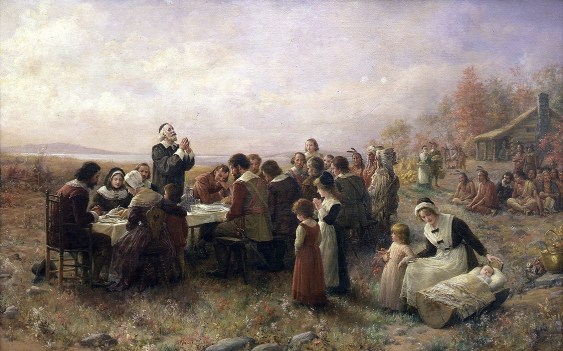
Give Thanks

thanksgiving-brownscombe

What are you thankful for? Before you answer let me reflect on “being thankful” for a bit.

            Most of us have so much we grow comfortable with what we have and assume we will always have the means to replenish or buy more. Canada just observed Remembrance Day about 11 days ago. Armistice Day was just commemorated across Europe. In the US we have Veterans Day: a day becoming more solemn even though world conflicts lessen.

            Now, in the US, our Thanksgiving is upon us. Question: What are you thankful for? Here are a few things I am thankful for—

  1. You! Because you take the time to read what I write. For your love and friendship.
  2. My wife of almost 48 years— Starr.
  3. Josh & Blair; Jax & Caleb.
  4. Bethany & Jeff; ‘Bekah, Duke, & John.
  5. My mom & dad. Technically, they’re both dead; but not in my heart.
  6. My wacked-out sister Carol Norton. I love you sis! J
  7. William H. VanArtsdalen, Jr.— who keeps a roof over our heads.
  8. An ability to write. Still.
  9. A clear mind. A clear mind. A clear mind. And umm, oh— a memory.
  10. Being forgiven. I cannot imagine who I would have been without the grace of Christ that stalked me.
  11. Health— mostly.
  12. My incredible education!
  13. Usefulness for some Christians: more useful to many of the normal people around me.
  14. NEED’s Board of Directors scattered all over the world.
  15. Melanie Lamere— my right-hand man in New England.
  16. Ian Montgomery— my comrade-in-arms. The other half of the devious-duo.
  17. 40 Years in New England. Autumns.
  18. 1 year in Colorado. Mountains.
  19. Financial backers who believe in what I am doing. You’re all crazy.
  20. A perspective on life that the best is yet to come. I’m not done yet.

Giving thanks,

Gary
Dr. Gary Davis, President
www.CluelessChristianity.com  

Getting from Here to There Part 2

church

Now about the corporate expression of our faith— within the church: it is not enough to live your Christian life in isolation— the Lone Ranger Christian, going it alone in the evil world. Christ called us to be a body of believers…, His Body. We stand or fall together. But if individual Christians re-gear their faith and the church does not, then we will have what sociologists call a paradigm conundrum. Individual Christians will be expressing their faith in one mode while the church still expresses its beliefs in another, older format— one that was appropriate when developed (1654 or 1945, take your pick) but has since lost its significance to the postChristian heart.

What follows are suggestions that the church-at-large needs to consider if it is to make sense—  both to twenty-first century Christians and to the rising tide of millennials/mosaics.

  1. The church will have to Rethink the Nature of Theology itself. Please do not take this as a rejection of any or all theological constructions of the past 500 – 1,600 years. It is not. But the last major rubric of theology was constructed during the Protestant Reformation in 1517, when priest Martin Luther posted his Ninety-five Theses, a critique of many of the practices of the Roman Catholic Church, on the door of the Castle Church in Wittenberg, Germany. In similar ways we will need to construct a theology based on a new examination of Scripture, in the context of specific cultures, rather than simply another polishing of a theology based on a previous structure. Polishing American Colonial furniture doesn’t make it Danish modern.

The life of Christ and His redemptive work on the cross are our model for living the Christian life, today, throughout history, and across cultural variances. My guess is that this new Biblical Theology will arise in a people-group-specific, image-based format, and somewhat generationally-considerate. What will that look like in reality? Who knows?!? I’ll leave that to my successors.

  1. Redesigned corporate spirituality— The church will need to try on a new suit of clothes, spiritually speaking. It will need to try to express the Christian faith in multiple formats. What has been accepted as traditional will have to make room for newer forms of expression, previously foreign to our Christian traditions. And it will have to embrace these new expressions even if it feels terribly risky to do so. Remember, though, that we are in transition (versus a phase), in a time of paradigm shift; things are in flux. The Truth will remain constant while its expressions can vary with generation, region of the world, and culture.

            But please take note— we will have to allow for multiple forms of expression within the same local church as well, even within the same congregation. Decide to learn from those who express their faith in manners different from your own. Extend your comfort level to embrace expressions that call you to God in new ways. Our society isn’t what it used to be. Church shouldn’t be what it used to be either. New wine; new wine-skins… .

  1. Immersion vs. isolation…, not an option— One aspect of being a church is that we will no longer have a choice of opting out of our culture or its societal issues. The church of Jesus Christ must take a lead in healing our society’s sicknesses, from media to medical treatments, to definitions of life, death, and what it means to be a healthy human being. We have too long held back for fear of rejection or recrimination; it is time we took a stand. One thing we must not do is supplant our Savior’s role as Judge. That is not our place. Our place is to come along side of our fellow sinners and serve as their guide to freedom and life! The church in the first century understood this; so also must we. Jesus immersed himself in the lives of those around him, making little distinction between his followers and those who needed him. He served both: He loved both: He saved both.

Will the church be accepted readily upon first re-entry back into the society?  Not likely. Trust in any relationship is something that must be first gained, then if lost, regained with great commitment and agony. The church has a lot of negative history to overcome that our world remembers with a vengeance. But we can no longer afford the luxury of isolation, of feeling good about ourselves as long as we don’t have anything to do with the world outside. That, if anything, is true blasphemy. Jesus did not go to the cross so we could go to church.

  1. Cooperative— Remember that classic movie, Miracle on 34th Street? Kris Kringle was encouraging people at Macy’s to look for what they needed that Christmas at Gimbals’, across the street. Management, as first, was enraged; then they saw the light: customers were surprised and delighted to see this new cooperation-over-competition between the two stores. Since the Reformation the church in the West has been more about separation than about cooperation. The modern era saw western denominations first forming and then defining themselves injuxtaposition to one another. But we must learn to cooperate across denominational lines, despite different worship styles and theological preferences. Labels need to go away.  They must move aside for a new nomenclature— genuinely Biblical, Christ centered, locally missional, accepting, and alive to life.
  2. Sacrificial Servants— For the church in North America to truly have an impact on its culture it must shift its mentality and present itself as a sacrificial servant of the society, not as a judge of its illnesses. When people are sick, they need a doctor, not a critic. We must learn to give graciously to our world— much more graciously than we give to build our modern cathedrals of comfort. We must learn to give up rather than to calculate next year’s pledge units. We must also provide places where the normal people of our society can find solace and safety, and see Jesus Christ embodied in those who go by His name.  Another Gordian knot to be cut.
  3. One Lord, one Faith, one Language…— In the same way that individual Christians need to learn to express their faith in common everyday language, so also does the church need to learn to use the metaphors, idioms, and common expressions of the day to express Biblical Truths. Oddly, the stories of the Bible can stand on their own with little amplification about their context. We must learn to be culture sensitive. The only place most of us use Christianeze is in church or when trying to explain our faith to someone else (a.k.a. evangelism).

            Many years ago comedians Lou Abbot and Budd Costello performed a baseball Vaudeville dialog titled Who’s on First?[i] It was a classic example of miscommunication due to a misunderstanding of the use and definition of words. “Who’s on First? What’s on Second. I-don’t-know’s on Third.” Their dialogue was funny: the Christian miscommunication block to a confused world is not funny. We dare not have an in-house language which only Christians can understand, vs. a normal language that we use to talk with the world around us. How much easier would it be if we had one language pattern that everybody could understand? Think of it, you could talk about your faith in church the way you would naturally talk about it in the rest of your life; no stomach knots, no translating, no shifting language/emotional gears. Just breathe.

  1.  We need Leaders who will go out on a limb. One of my favorite quotes comes from Mark Twain— “Why not go out on a limb!? That’s where the fruit is.” The last shift that the church in postChristian society will have to make is one of leadership. Our leaders will actually need toLEAD! Too many Christian leaders have become conciliatory politicians, mediating their way to church peace or to a better position with more prestige and/or money. Others have become theological authoritarians, sweeping their will and interpretation of Scripture over their congregations. Why? Because theology is safe…, you can nail-down just about everything.

Genuine leadership, not merely positional leadership, is a risk. It goes with the territory. Just get used to it. There was an ad from a brokerage firm in NYC that used to read—  The only real risk in life is not taking one. May Christian leaders in North America become a risky bunch!

*   *   *   *

            So, where do we go from here? To the trenches of life, to the committee meetings and shopping malls, to the days and family gatherings with ol’ lip-sticked Aunt Maude who always kisses her grandchildren on the cheek? We go back to living. I cannot convince you of the exuberance that comes when you start to morph your life, your church, or your family to a postChristian faith. It’s quite a ride! Risky…, with the outcome yet to be written. Honor God, honor people…, make a difference.

Hopefully, making a difference.

Gary