
Beyond Words – Take 3 – Cultivating a Biblical Mindset

BEYOND WORDS: Cultivating a Biblical Mindset— Take 3

One of the great delusions within the Western Church is that we know our Scriptures. We do not. We know a few feel good verses or sections that we can summon up as proof texts or evangelistic references, but, by-in-large, most of us draw a blank when it comes to the warp ‘n woof of the great expanse of Biblical history and how it overlays the rest of world history.

Cultivating a Biblical mindset takes effort. It takes thinking. It involves an understanding of history and how Biblical Truths weave their way throughout.

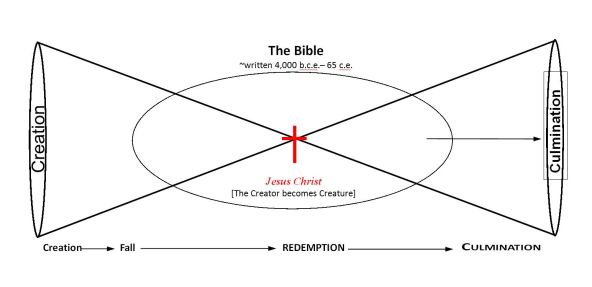
Imagine all of History, recorded & unrecorded, from the Beginning of Time through Final Culmination. BIG PICTURE. We know just a minuscule slice of it. Scripture describes an actual Creation in Hebrew poetic verse—brilliant! It then tells us about the important events and people that God knew we couldn’t figure out by just looking around. How much of this unique revelation do you really understand? It’s important.

Again, a picture may be worth a thousand words—
gary, davis, needinc, chrisitan, bible, mindset

Think of History, all of History, as cradling the birth of our story of Creation—Fall—Redemption—and Culmination, when all things will come together under the majesty of Jesus Christ. Scripture holds the principles by which we are to live in this world, and the practical implications of those principles to our daily lives in our interactions with others.

To grasp the depth and expanse of God’s gift to us we must immerse ourselves into the Bible. Not pulling out certain verses for comfort or combat—but to learn to live within its culture, walk its roads, and hear the heartbeats of the great men & women who walked with God before us. But we must also learn human history: not that of our own country, but of all countries. Become a student-of-history and you will see your own situation more clearly.

Slow down. The more you can integrate your life within the paths of Holy Writ the simpler it will be to express and communicate your faith.

For what it’s worth,

Gary

Why?

Gary, Davis, College, church, northampton, lament, prayer, why, depression, anxietyA few weeks ago I heard a sermon in our local church that really resonated with me. The series is taking prayer and our relationship with God and bringing it down to an almost childlike level. This sermon was especially poignant, as it spoke to the questions: Is it ok to be mad at God? Why do I feel so miserable? When will it get better? What do I say to my friend who is really struggling right now? I encourage you to click on the link below and listen, then ask yourself if you know how to truly lament.

Why?

Be a Hero

gary, davis, hero, purple, heart, Looking over a dog-eared, parchment-like copy of When Dreams & Heroes Die: a portrait of today’s college student, (by Arthur Levine, 1980), I was taken back to a quite different time in our history. It wasn’t so much the time difference, or the cultural/time-distance warp, as it was the way Levine analyzed the characteristics of that period’s college culture. Boomers, busters, Gen-X, Gen-Y, yada, yada, yada. ALL of us have experienced the sadness of childhood disappointment of “heroes” who have disappointed us, let us down, deceived us, or who lost our trust through betrayed belief.

Heroes become real human beings with real failures, real flaws; some dissolve into the fantasies of their foundation, real illusions with no connection to real life; comic book/computer game avatars which have no association with the reality of actual beings. Yet, to be sure, there are real heroes: and most of us hold onto dreams that we truly want to become realities. Dreams are good, in fact, great! NOT to dream is to resign oneself to the humdrum of a dreary life, to personal anonymity and an interior death. It is to become a non-person, a mere cog-in-the-wheel, grinding out a life’s work as an automaton.

It is a reality of life—heroes do die, let us down, disappoint us: dreams also die; we settle for 2nd best, 3rd best, etc. Some of us give up our dreams altogether. And we have lost all (or most) of our heroes to time, fantasy, or failure. We have arrived at the blank wall of the convoluted definition, without role-models to provide us with points-of-reference or moral character.

Allow me to offer an alternative scenario. Could our loss of dreams and heroes actually be a trigger for us to rise to the occasion? Is it time for you to become the hero? To become the role-model for those who already look to you as someone they would seek to emulate? Is it time for you to help people dream their dreams? Fulfill their dreams?

Instead of hanging onto your fantasy-heroes of the past, your dreams for significance, maybe it’s time you became the hero for so many others, or even one other. Actually, maybe you already are significant; not in your eyes, but in the eyes of this generation’s emerging leaders.

So review what you’ve accomplished in your life. Is it enough? What more is there that you must do to make a difference for God and for humanity? BUT…, but— Who will be your protégée; what legacy will you leave in the people in whom you’ve invested? What’s your plan? Don’t have one? Why not? WHO are the people God has given to you to nurture to greatness? HOW do you care for them, train them, feed their souls?

BE the hero: make the dreams work! So help you God if you shy away from this great responsibility, this great honor.

Have a nice week.

Gary

Hidden

051048048057054055054050124053048048124052048048Why are we hiding? Or— What is it we try to hide? Too many of us exert a lot of energy trying to hide, or trying to hide something about ourselves that, if revealed, would expose us.

The artistry of Bev Doolitle (1947-   ) depicts objects hidden to the casual observer. We are so much like the horses in her paintings. If people were to look intently at our life, what is it we would try to hide? I’ve worked with some people whose biggest fear in getting married was being known. I tried to assure them that being known, and still loved, was the best part of being married; I’m not sure they bought it.

What drives us to hide things? Insecurity, fear, shame, dishonesty? Or worse, why do we hide ourselves? Of course, if you’ve been betrayed or used, there is some warrant for it. You don’t want to be hurt that deeply again.

The issue, basically, is one of safety. We ALL want to feel safe. So we hide the parts of us that would expose us. This is wise…, to a point. But our need for safety can also choke the spirit within us. It can bind us in a box with just slits through which we take in the outside world.

Would you like to escape your box and take in more of the outside world? Here are some ideas—

  • Spend time with people. Reflecting off of them will give you insights into yourself. You’ll surprise them; they’ll surprise you.
  • Try something that engages your soul. Doesn’t matter what. Just not too much over the line. Deeper discussion, life challenging experiences. Hold back on sky-diving.
  • Build one-safe-friendship. Create a confident.
  • Create a private novel about the kind of life you’d like to live. Then, slowly, start to live it.

Hiding takes a lot of energy. Think what you might be accomplishing if you didn’t have to work so hard at hiding your true self. Think of the energy you could invest in developing new dreams, new skills or new relationships. Be intentional. Remaining hidden, if pursued over a long period of time, results in further isolation; and that creates further fear of being known.

You do not need to stay hidden. Make the decision to be known.

For what it’s worth,

Gary

Resilience

????????????????????????????????????????????????????????????????????????Resilience

Bouncing back. Getting up again. Beaten down and rising from
the ashes like the Phoenix. Overcoming failure and discouragement. Going for it again.

Why are some of us good

at it and others not so much?

Resilience is not necessarily based on generation, gender, cultural affinity, location or situation. It seems to be ingrained in certain people; they just have what it takes.

For others, who have been beaten down repeatedly, it becomes a matter of fortitude and determination. Sheer will-power. They have to fight not only their surrounding circumstances, but themselves as well. That is no simple matter. So what does it take to become resilient?

First, it requires that you make a decision; maybe two. 1) That you will not let this thing, whatever it is, overwhelm you. You will not let it win. And, 2) that you will fight, FIGHT, to overcome it. If these decisions are not made right up front, you do not stand a chance.

Second, you will need to surround yourself with friends of equal mind, kindred spirits, who share your dreams and goals in life. Do NOT hold back from seeking their advice, solace, and wisdom.

Third, you will want to set timely goals or check-points along the way for evaluating your recovery. How well am I bouncing back? Have trusted friends also give you feedback on how you’re doing. Be assured that setbacks will assail you; that’s life. But you are not back at Square-One. It’s just a setback.

Finally, and I hesitate to suggest this because so many of us use this as a scapegoat for being responsible- try PRAYING. (not for relief but for strength and wisdom) There’s something that cleanses the heart, mind, & soul through prayer. So, Christian or otherwise, try talking to the ceiling: you may just be pushing beyond it.

Resilience is every bit as much a matter of faith as it is fortitude. It is a determination within your soul that has its expression in the lives we live. Don’t hold back.

You can teach yourself to bounce back. Keep practicing. One day it will come more naturally.

Now, where’s my Pogo Stick,

  Gary

Rosa Parks, Tim Tebow, and Cultural Condemnation

rosa parks, civil rights, tim tebow, olivia culpo, communication, loveOn a cold December day, today, 60 years ago, Rosa Parks (Feb. 4, 1913 – Oct. 24, 2005), an African American, in Montgomery, Alabama, refused to give up her seat to a white man in the colored section when the whites-only-section was filled. For this simple act, she was arrested and branded as a criminal. It is without dispute that her courage sparked what we now call the Civil Rights Movement.


Our world today would find this action ludicrous. Yet, in American culture of 1955, this was an act of defiance; defiance that declared I am an American too, with rights and responsibilities just like you. And all she did was stand up, or, sit-down, for her right to a seat on a bus. For this, she raised the ire and spite of much of our country.


Just this past Thanksgiving, a former Bronco’s QB, Tim Tebow, stood up for his right to refuse to have sex with his now former girlfriend, Olivia Culpo, this year’s reigning Miss Universe. Once again, our nation rises in protest as his Christian faith takes a stand on pre-marital abstinence, in opposition to our pervasive, permissive cultural standard. For this, Tebow has raised the ire and ridicule of a large part of our country.


So…, have we really come so far? Comments welcome.


For what it’s worth,

  Gary

Crippling Fear

flickr_-_sukanto_debnath_-_-1How many of us live with a gnawing fear of failure? Some of us are claustrophobic (fear of small spaces); others have acrophobia (fear of heights). Then, of course, there’s always snakes, in-laws, falling, and computers. I coined a phobia once—Christophobia! Fear of Christians.
The list of Phobia’s goes on ad infinitum. Too many of us pile one fear upon another, compounding the depth and extent of a once simple fear, now, a muddled mess of fears.

As the horde of our fears combine, they produce in us a reaction— an invisible shield of protection. This is a wall we put up to guard against further “attacks,” whether real or imagined, from the world outside. Unfortunately, over time, our inner walls start to crumble, and we find ourselves less protected than we once supposed. This breakdown of our protective barriers can lead to further fear, a crippling fear.

It is no simple matter to deal with crippling fear, let alone to overcome it. If not addressed it can eventually overwhelm you and take your life. This is a serious, irrational illness.

It is said that perfect love casts out fear. [1 John 4:18]  Short of God’s love for us I haven’t found much perfect love on this planet. Truthfully, sometimes even God’s love for us doesn’t drive out the fear that we grasp. But maybe that’s the problem—we really don’t want to let go of our fear. Somehow it has melded with the deepest part of our core and integrated into our identity. So now, it holds us.

Thus are we drawn into a war within ourselves; and it will not be an easy war to fight. Crippling fear knows just when and where to attack at every turn.

You will need help. Here are some simple tools I have used in my own fight with fear.

1.      Anger. [Yelling at God.]

2.      Prayer. [Listening to God.]

3.      Music.

4.      Scripture. Lots of it.

5.      One incredible friend (ok…, more than one).

6.      Counselors (again, more than one).

7.      Medication.

8.      Letting go of things I cannot change.

9.      Listing my fears.

10.  Single Malt Scotch (with that one good friend).

I don’t know if my list has been helpful: you may need to write your own. Whatever you do, DO NOT let this damn fear consume your life!

For what it’s worth,

  Gary

Trouble Transitions

Gary, Davis, Christianity, Change, Trouble, Transitions          Far too frequently we hear the cry that our society needs more change agents. The implication is that the way things are presently just isn’t good enough. Pick a field— politics, business, transportation, medicine, religion (especially Christianity), finances, yadayadayada. Everything needs some form of change.

            The problem with change is that it invariably dumps us into a transitional time where even more things become unclear, unsteady, and iffy. O joy. Just what we need— more instability. Well, actually, we do.

Transitions in any segment of life move us out of the predictability, safety and definitions within one life-phase into an arena of uncertainty, a transition.

Transitions aren’t necessarily marked by growth. Though most people would hope they grow within a transition, many people, and businesses flounder, unable to set a new direction, given the changing global circumstances or personal situation. But without the cloudiness of a transition, things would stay too-much-same.

When you think about it, the cycle of phases and transitions, phases and transitions, is constant throughout your own life, or the life of a company, or country. The shifts are marked by what Malcom Gladwell has declared as tipping points— literally, those events or experiences that push us right over the edge and force us to consider something else in the future…, or tomorrow, or next week.

So when you consider becoming a change agent also consider how it will affect you, personally, your business, your family, and the greater good. Do you want to create the circumstances that lead you and those with you into a transition?

Transitions are uncertain times. Just make sure you are ready for the fog that lies ahead. But, by all means, keep moving forward. Besides think of all the fun constant predictability takes out of the adventure we call life?!?

For what it’s worth,

  Gary

Pope Francis in America

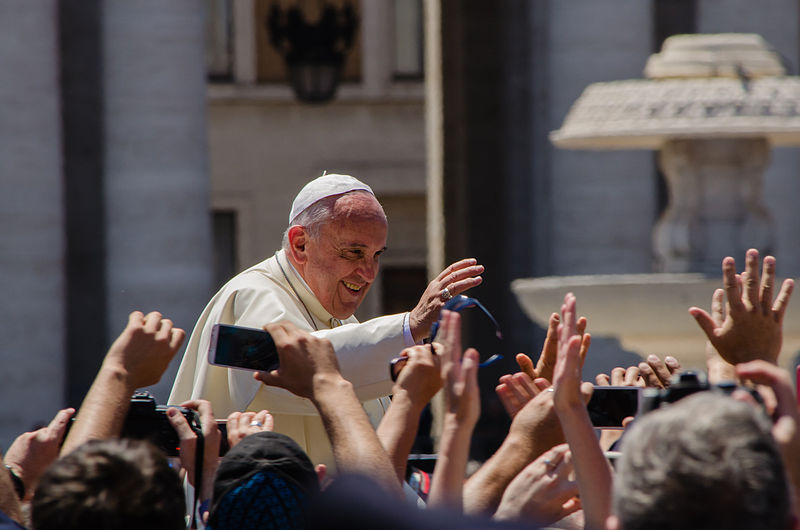
Pope Francis, Gary Davis, 365Christianity, Christians, Clueless, Culture, Alfredo BorbaAs only the fourth Pope to set foot on American soil, Pope Francis has sparked an interest in not only the Christian faith, but in all religion across this land. Questions like, What do I believe? Do I really believe what I say I believe? What parts of those beliefs affect my life on a daily basis? And on a larger scale, What is our responsibility to the poor, the displaced, the strangers in our midst, and those of other faiths? Or, yet again, What is our responsibility to climate change? How can we handle the economic inequity across the globe?

 On September 23rd, in his speech before a joint session of Congress (http://time.com/4048176/pope-francis-us-visit-congress-transcript/), Francis graciously summarized & tackled two major areas of concern we need to address— CULTURAL ENGAGEMENT and CULTURAL WASTE.

 On the matter of Cultural Engagement, he encouraged all Christians, everyone in the United States, and everywhere, to solve the world crises in immigration, of refugees in the Middle East and Europe, to seek solutions to seemingly unending regional conflicts, and to learn that differing cultural perspectives can actually serve to improve the human race rather than to further divide it. We all must engage people who are different from us, for our own sake. Otherwise our differences will lead to misunderstanding and misunderstanding to mistreatment and war. We must end our isolationism.

 On the matter of Cultural Waste, Pope Francis’ deep concern was not only what we all are doing to our environment through national industrial pollution and waste byproducts, his concern was primarily with our attitude toward the humanity of humans. He called for an end to treating illegal immigrants as numbers, and called for an attitude where they are simply people, seeking a better life. He called for governments worldwide to find a solution to the massive migration of people from the Middle East and Northern Africa fleeing for their lives and for safety to European and Western borders. We dare not turn our backs on them because of their massive considerable numbers; they are people.

 His admonitions should move all of us to contact our Congressmen and Representatives to STOP ignoring these tragedies as if time will simply take care of them. It will not. WE must take care of them as if God is demanding that we do it. I couldn’t agree more.

What are you being called on to do to make a difference?

Tolerance, Not what you think it means

Gary, davis, reverberation, wilhelm, friedrich, hamlet, thesis, antithesis, tolerance


Georg W
ilhelm Friedrich Hegel was a German born 19th Century philosopher who speculated on the nature of Being and Nothingness (“To Be or Not To Be…? Hamlet?). He concluded that for every thesis, a statement about some idea, there is an opposing antithesis, an opposing idea. These two opposing positions would battle it out and result, most of the time, in a synthesis of the two. Hegel used this formulation only once, but it formed the basis for many of his subsequent hypotheses.

So today, 200 years on, what does this have to do with anything?!?

In these last few weeks/months/years our society has become so reactionary that people are neglecting the common courtesy of thinking before they act. Too many of us are jus’ letting” it all hang out, blowing up, accusing each other, not even listening to the other group’s full thesis. Thus do tempers Georg Wilhelm Friedrich Hegel  1770 - 1831  flare, stereotypes flourish, and a kind of seething hatred takes over, further widening the gap between people and positions. Winning is all that matters. Being right. It’s always tit for tat: thesis vs. antithesis. We never seem to grow into a synthesis beyond all our posturing.

The recent Supreme Court rulings for gay-marriages, Bruce Jenner becoming Caitlyn Jenner, and our President striking a nuclear pact with Iran, Confederate Flag waving, have all contributed to the further polarization of the Left & the Right, Conservative vs. Liberal, Bible Belt/Wheat Belt vs. East/West Coasts & our larger cities. E pluribus unum still means Out of many, One; but we are hardly definable by that precept any longer

It would be more accurate to admit that we are a nation of individualists, of special interest groups, of political parties & sub-parties, of religious and non-religious groups all seeking dominance in the dance of democracy. One group wins over another, then another group triumphs: thesis- anti-thesis; we never arrive at a synthesis for the common good.

It’s time we brought divergent groups, parties, & whoever to the table of human decency and admitted we live in a pluralistic society. We are bound together not to fight only for our own rights, but to fight for each other’s right to exist and to have a voice. We owe it to one another to learn NOT to tolerate one another, but to defend each other, to care about the prosperity and happiness of people who are not like us. We may not be “under God” any longer (probably never were), but at the very least we owe it to ourselves and to our children to work on a resolution to all the brawling for self-aggrandizing superiority.

IF we do not, this reactionary positioning will have reverberations well into many future generations.

Synthesis.

God help us all

  Gary