
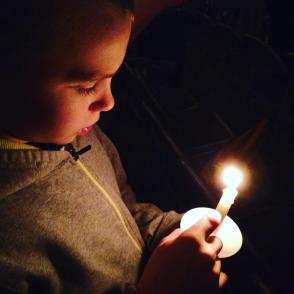
 Over the past few months I have let some of the saints of the Church lead in my devotional life. One such person is Frederick William Faber (1814-1863). He is best known for his Lives of the Saints. But from his work The Creator and the Creature, there is one line which will not let my heart wander far.
“Holiness is an unselfing (of) ourselves… .”
When you think about it, that makes sense. How can Christ fill us with himself if we are supersaturated with ourselves?!? Any form of meditation, which is a quest for inner peace, calls upon us to empty ourselves…, and stay that way. I find that course quite dangerous. If I empty myself of myself, and do not refill that void with Jesus Christ, then I open myself to all sorts of devious invasions.
For much of my life I believed that holiness was a thing to pursue, something that was a goal in the Christian life. Then again, it is also a platform granted to us by the Father through Jesus Christ. This is how God sees us the moment we put our trust in his son.
Frederick Faber’s idea of holiness being an unselfing of ourselves is new to me. I am going to have to give it some thought. Yet as I probe within I find that unselfing is exactly what must take place. In Scripture we come across thoughts like “I must decrease; he must increase,” (John 3:27-36). We need to reexamine our priorities and reflect on what our supreme goal in life actually is; that which fills our time, that places our desires and dreams under Christ’s command.
The ancient Greek maxim— You DO what you want, really is your definer of what is most important to you. Every six months to a year take an inventory of how you spend your time. Actually, start NOW. This should tell you where your heart is: money, sports, possessions, mission. Any revelations?
One of the things I’ve noticed about myself through the years is that what I thought I needed, moved to the what I wanted category. Then I found that I wanted less and less in life. It was a good move. Still is.
We all live at different levels in life— wealthy, poor, average, extravagant, sacrificing, giving. None of these definers is any more significant that the other. It is all a matter of what our God has designed you for.
Whatever that is will call on you to continue in the process of unselfing yourself.
Honor God, honor people…, make a difference,
Gary
NEXT— The fear of the Lord….
 Late last month a friend of mine, David Rupert, released a book— YES. In it he recounts his journey to Living a Life of YES. It is a great book and you should read it…, and BUY it! Starving authors all agree heartedly.
 Eighteen years ago America’s soil was violated in a three pronged terrorist attack that left many of us stunned. Most of us have recovered. Some of us weren’t even born. But this attack changed the way we viewed our safety, our stability, and our place in the world.
 Since the American Holiday, Labor Day, is fast approaching it might be in all of our interests to take a look at our TIME and how we handle it. Therefore I thought this image of the inner workings of a timepiece would be an apropos starting point.
 One of the most repeated phrases in our Scriptures is “The Word of the Lord came to … .” [e.g. – Jeremiah 1:1-19, Ezekiel 1:3, 21:18, ]. It seems that God spoke to many of His prophets and leaders far more directly than He does today. Maybe our generation is just too dense to hear God. Or could it be that we have the Scriptures revealed to us?
 “Man is never truly himself except when he is actively creating something.” ~Dorothy Sayers
 If you’ve been challenged by this call to develop a postChristian Gospel, please know that it has been something I’ve been struggling with for quite some time. Remaining true to the Biblical/historical constructs of our faith, and to the Church, while trying to acclimate our message into yet another cultural context is no easy matter. Wycliffe Bible Translators face this challenge with every new language group they encounter; as did early Western Christian missionaries trying to introduce Western Christian constructs to Eastern and African cultures). Our difficulty is in recognizing that our postChristian era has developed its own culture and language group, based on its basic premise that there are no absolute truths; there is no meta-narrative to explain all of reality; there is no one singular system of belief that can encompass the grand diversity of human experience. At this point, of course, genuine Christians must disagree and still engage with the prevailing points of view.
 Clueless Christianity