
We need to get this. We need to put out the effort and start thinking about being a Christian in this society, instead of running commando raids into it and coming back and debriefing.
Never, ever DO evangelism, instead look at the way Jesus moved among the people. Did He explain “the Gospel” the same way to each individual? No, it was dependent upon who He was talking to. Go and Do likewise.
Category: Communcation
Finding the Entrance to Hell
 Contrary to popular belief the entrance to hell is NOT Newark Airport; nor is it in a hidden parking lot at LAX; nor does the entrance to hell exit in Hinesville, GA Though these are all probable possibilities, their designations as such is not even close, even if closely feeling like it.
For a culture that increasingly does not believe in God or an afterlife there sure seems to be a lot of belief in angels and demons, and in a literal Devil. God was deleted from our interest list when He infringed on our personal preferences and pleasure. Bad God, bad God! That being said, it must be noted that Jesus is making a comeback in the movie industry. Good Jesus, good Jesus. At least someone is making money
We do not like to think about the possibility of hell existing as our soul’s final resting place. We are not even sure how to describe hell, if it actually exists. For help, I point you to Dante Alighieri’s (1265-1321) Divina Commedia, the medieval worldview’s allegory of the afterlife. (Read it in English.) Some of us are deeply concerned about not going there. WE construct rules and practices to obey so that we DO NOT go there: most of us merely toss the idea aside as antiquated imagination. Thus do we play with it in the media. Hummm.
However, allow me to suggest that, though few of us are actively looking for the entrance to hell, unless you are already at Newark Airport, we certainly try to live like hell. Don’t believe me? Here’s my list on whether or not you are seeking, or heading to, hell.
1. You put yourself and your interests first—all the time.
2. You ignore the advice and/or criticism of people who really know you.
3. You live by your own standards; circumstances, or the needs of others, be damned.
4. You don’t give a rip about our world’s poor or needy.
5. You don’t listen: your opinion or agenda are all that matter.
6. You are stingy, tight-fisted and penny-pinching.
7. You are kind to others only if there is something in it for you.
8. You talk a good game, but do little to back up your words with action (ATNA).
9. You never, never ever sacrifice.
10. You rarely feel anything. It’s safer that way.
If any of these descriptions define you, you are well on your way to finding the entrance to hell.
For what it’s worth,
Gary
Beyond being in control
 Staying in control is probably the #1 value of most people in Western Society. Being out of control is scary; it is always lurking just below the surface of our consciousness. Personal security, personal independence, and personal significance are our TOP priorities (after food and shelter.) We have this innate fear of being out-of-control.
Some people take it too far; becoming micro-managers at work and a home. They must be hands-on and on-top of everything. If this attitude becomes embedded in a person’s psyche it creates issues of trust and insecurity. Even close friends do not want to be around them. Sometimes, it causes people to hide their true selves from those outside and to cocoon within a private world of fantasy or fear. This is not good for the soul.
However, there is another path to be taken for those who draw their strength and define their identity from somewhere beyond this present realm. It is for those who have decided that being in-control isn’t as safe and secure as they once thought. It is for those who are tired of working so feverishly to have power over everything around them. It is for those who are ready to let go.
Moving beyond being in control is frightening and terrifying. It means that you are consciously removing yourself from the button, the control switch, from being the central figure around whom all others must revolve. You must become such a person who will put your faith, your trust, in others, and, quite frankly, in God.
Why is it that we rise to our point of success in life, only to find a ceiling of doubt and emptiness at the top? The reason is that we were not meant to climb this ladder in isolation, as individuals; we were designed to do it in relationships: first, in relationships with those around us, and second, in relationship with the God who made us. This is not rocket-surgery; it is an obvious observance.
We must move beyond being in control to trust, to delegation, both of responsibility and authority, and to letting go. [Listen— Paul Cardall. Letting Go. http://www.youtube.com/watch?v=bUONnfHb7a8 ]. It is in letting go of control that we lose our tightness, our fears, our need for dominance, and put on the cloak of grace.
If you truly want to lead, then you must move beyond being in control and learn to let go.
For what it’s worth,
Gary
My coming out

My Coming-Out
No, no, not that kind of “coming-out.” Something much more basic. But WHY now? Well…—
Over the course of EMPulse releases I’ve received numerous questions asking, “Who are you?” My kids would tersely answer, “Dad’s weird.” Nonetheless, I believe it is time for a tad more revelation about— me.
I am Gary West Davis, son of Earl Carlton Davis & Florence Adelaide Davis, brother to Carol (Norton) Davis, (a fact she regularly denies). I was born in inner-city Baltimore in the days when my dad worked for the railroad, my mom, for the new Social Security Administration. I, like all the other kids, joined a teenage gang. No big thing; we were all in one.
When dad received an appointment from President Eisenhower to head up a Congregational Sub-Committee on the Future of the Maritime Seaways we moved to the Baltimore suburbs so he could commute to D.C. more easily. For the first time in my life I experienced a suburban high-school. THAT was a real eye-opener. I could even go the bathroom in school without fear of being beaten up by a rival gang. Nice.
It was during these days in HS that I began to be concerned about our society, the world situation, and my place in it all. So I joined The Young Socialist Society (read Communist Party). I did things in those days of which I am not proud. But I wanted to make a difference. I wanted social change.
At the same time I was investigating the Christian faith, mostly because of the cute girls I found at church. But I turned my back on God when an overly-pious friend told me that real Christians don’t go to movies. He was clueless! I left the church for the next 3 years.
It was during my studies in Philosophy at college when I again confronted Christianity on an intellectual level. After 2 years of trying everything under the sun, I had no more arguments against the Christian life-philosophy. I gave up with the words,“I give up! I can’t fight You.” Thus began my life-long discovery of what this Christian thing, and the rest of life, is all about.
During my 3 years in seminary a local pastor took me on and challenged me on every aspect of my life. Fortunately, he was ruthless and didn’t put up with any of my crap. Thank God.
Today, after five graduate degrees, I find myself a writer, a trans-cultural communications consultant, and a counselor helping people get from A to B. Through it all I have pursued life with a passion that few have the privilege to do so. And it’s far from over!
I have THREE CORE VALUES. First, my relationship with myself; my personal integrity. I maintain it with great gusto. Second, my relationship with my family; my incredible wife, Starr, and my two kids, Joshua and Bethany, and now their families. And Third, my relationship with the God who made me— Jesus Christ. My devotion to Him is not up for discussion. [Yes, philosophically, some doubts remain; but only concerning certainty vs. certitude. Experientially, it’s a whole other story.]
So as you read any future, or past, EMPulse releases, remember that I am a man of passion, of relationships, especially when it comes to those in need, and of a deep devotion to my Lord. I still love single-malt Scotch, Volvos, and giving monthly gifts to my wife. So ends my coming-out; for now. More dirt later.
For what it’s worth,
Gary
Depression
 Depression is a silent killer. You don’t even have to die to experience its death. You live the death just under your skin, suffocating your soul, 24/7. It is an insidious infection that never lets up.
Sure, you have moments of elation, rest, momentary peacefulness, or escape. I’ve struggled with it for years. When I first married, my new bride would describe me as morbidly introspective. Nice.
Yet on the surface I was upbeat, forward looking, powerful, and optimistic. Underneath, I always wondered if I measured up to peoples’ expectations. I was sure I didn’t.
So I performed better. And better. And… tried harder and harder… .
Robin Williams recent suicide brought it all back to me—the acting, the humor, the insecurity-amidst-confidence; and especially the fear of being known. I even wrote an article on it.
What drives such a successful man to draw an end to his life? In a word— despair. Def.- The conclusion that life holds no more for you. That managing life is now beyond your ability and/or desire. During my journey as a counselor three individuals have committed suicide under my care; one, premeditated, the other two, on the spur of the moment. I’ve always wondered if I could have prevented these needless deaths. My depression spiraled downward to the deepest depths.
If you could have walked through Robin Williams’ depression with him, what would you have said? What hope would you have offered? What reason to continue living? What great purpose would have fulfilled his life? Certainly his success as an actor and comedian did not bring him the fulfillment he so desperately hungered for.
Many fellow Christians might have offered him the reasons he sought in a relationship with Jesus Christ. But do you realize how strange that could have sounded to someone who had no hope, who sat outside the perimeters of God’s protection? It would have sounded farcical.
So many of us, Christians and normal people alike, place our hope in our personal security, our financial stability, and in our own abilities and self-confidence. I don’t think this is enough.
There is a great deal to be said for reestablishing a relationship with the God who made us. And for cleaning out the garbage of our lives. And for clearing the air with our friends.
I grieve Robin Williams death. He left us, unnecessarily, too soon.
For what it’s worth,
Gary
Differences
 No, really, sometimes it really does feel like this. People are just…, different. Maybe you’ve experienced differences in your marriage, with your teenagers (duh), or with those who say they are related to you. Certainly you’ve felt some people at work were “different.” You thought they were like this, and they turned out to be like that. Or…, something!
We are all different from other people. Sure, we may have the same character traits, financial status, eye color, body types, etc. But people are different; that is what makes our human lives so intriguing. We are never quite exactly the same. Different.
When people are different individually they can be stronger together, as a group. Their differences can bond them to support one another in a team relationship. More can be accomplished the moredifferent people, and their skills, come together to make our world a better place. Differences— joining together. Unless, of course, you believe that people who are different should all stay together in their own little group, sealed off from those who are different from them. Hummm.
Personally, I enjoy people who are different from me. I learn from them. I learn a lot. I do not have all the answers; it is through others who are different from me that I come up with new and differentquestions. And that’s a good thing. It leads to new perspectives, new answers.
That being said, I must admit that I enjoy the comradery of those who think in terms of cross-cultural communication, paradigm shifts, regional colloquialisms, and international blending. So I’m weird. What kind of people do you like to be around? Are they all the same…, or different?
My friends are a little of both. A weird bunch, to be sure. But still, I enjoy them.
So when you are deciding which crowd you want to hang with, don’t pick just one. Join different kinds of groups. Join up with people who are much older than you, and with those who are quite younger than you. In doing so you will learn from the wise, and remember how to play again from those who come after you.
I know I keep going back to the Bible, but it’s my heritage. Christians were first named Christians because no one knew what to call this hodgepodge, diverse, seemingly incompatible group of strangers who loved each other. The name stuck.
There probably isn’t a designation for the kinds of groups I associate with: maybe wackos.
For what it’s worth,
Gary
Control Issues
 Control Issues— re-basing the basics. This may sound funny, but I’ve often wondered if this propensity to want things nailed down theologically (beliefs), and the commiserate fear of emotion wasmore a reflection of many men’sdesires to preserve control over life’s myriad situations. Not control, in an exclusively bad sense, but control for its own sake, for some men’s personal sense of safety and identity. Often, as I enter into conversation with a pastor or someone I have just met, I find myself in a kind of out-of-body experience where I look down on the conversation from above and try to find the answer to a question— “Where does this person feel safe?” If you really want to get to know a person, try to discern where they feel safe. If you examine the last 400 or so years of Western Christendom you will find that there was an intense desire to nail down as much as possible theologically. Some nailing was definitely needed as the Church had become almost indistinguishable from the world around it. But after 400 years, the nailing seems to have become an obsession. The Roman Catholic Church is the one true church; the Church of Christ is the one true church, the Jehovah’s Witnesses are the one true church, the Mormons are the one true church. Why is it we have this drive to claim that we alone are right? Calvinism is the only complete theological construct: Dispensational theology has the corner on the End-times and the expanse of human history. Why is it that we have come to believe that our theological construct, our theological position on baptism, the Second Coming, or church government must be the most right one!? Could it be that these are issues of control? It may well be more than that; maybe it’s control for the sake of a personal, positional sense of safety. Most of us do have a keen sense of self-preservation built into us. When it comes to the church, maybe it is some men’s need for personal/positional safety that underlies the need to be in command. Controlling belief, which is quantifiable, and thus measurable, is easier to manage than human emotion. But fear of emotion because it is an unreliable reflector of an inner reality is as crazy as believing that making a statement about one’s beliefs is more reliable. In reality, it is the combination of our heart and mind that explicate this Christian condition within an individual. But there is one ingredient more— action.
When I was in the midst of my teens I remember my mother saying to me “What you do speaks so loudly I can’t hear what you are saying.” I know she was probably quoting her mother, but her point was obvious. In the office where I work we have all kinds of little witticisms that remind us of what we are trying to accomplish. One of these quips is— Talk’s cheap: action’s everything. In many churches I find that is exactly what we do … we talk a lot. Remember THE DECADE OF EVANGELISM? 1990-2000. Of course you don’t. Why? What happened in 1990? We discussed whether the last decade of the century really began in 1990 or 1991. And what happened in 1991? 1992? 1993? Very little. The Decade of Evangelism just faded away. All talk, not much action.
To this writer there seems to be a tremendous emphasis in the church on understanding what you need to believe and very little emphasis on DOING anything with it. This is an imbalance; but it is not the kind of non-balanced faith I am talking about. If anything, Christians are a long way down the road in clarifying, refining, honing, and re-clarifying what it is we believe. It just has not seemed to translate into very much action. Especially any that has any positive influence on the lives of those around us— those who are unaware that we are followers of Christ, those who have never seen a Bible (let alone opened one), and never darkened the door of a church. It’s time we revisited Jesus and read the stories about how He lived, where He spent His time, and how He related to those with whom He came into contact. Consider Jesus in two situations— one where He is teaching, and another as He faces one of life’s typical conundrums— the conflict between completing a task…, and being side-tracked along the way. First, an example of Jesus’ teaching.
1 And seeing the multitudes, He went up on a mountain, and when He was seated His disciples came to Him. 2Then He opened His mouth and taught them, saying:
3“Blessed are the poor in spirit, for theirs is the kingdom of heaven.
4Blessed are those who mourn, for they shall be comforted.
5Blessed are the meek, for they shall inherit the earth.
6Blessed are those who hunger and thirst for righteousness, for they shall be filled.
7Blessed are the merciful, for they shall obtain mercy.
8Blessed are the pure in heart, for they shall see God.
9Blessed are the peacemakers, for they shall be called sons of God.
10Blessed are those who are persecuted for righteousness’ sake, for theirs is the kingdom of heaven.
11“Blessed are you when they revile and persecute you, and say all kinds of evil against you falsely for My sake. 12 Rejoice and be exceedingly glad, for great is your reward in heaven, for so they persecuted the prophets who were before you.
13 “You are the salt of the earth; but if the salt loses its flavor, how shall it be seasoned? It is then good for nothing but to be thrown out and trampled underfoot by men. 14“You are the light of the world. A city that is set on a hill cannot be hidden. 15Nor do they light a lamp and put it under a basket, but on a lampstand, and it gives light to all who are in the house. 16Let your light so shine before men, that they may see your good works and glorify your Father in heaven.
~ Matthew 5: 1-16
Look at the setting in this passage of Scripture. It is outside, on top of a mountain, or at least on its slopes. It was probably warm, scenic, serene. Now look at Jesus’ style. It was not a “lecture hall.” Jesus was not debating or setting forth an argument. He was with those who trusted Him and would listen to what He had to say. And what did He do? He spoke to them where they were in life— poor in spirit, sorrowful, timid about life, hungry for God, in need of mercy, and so on. He was addressing the weak and painting a picture for them of what it would be like to make a difference in the lives of their friends and in their society. He gave them hope, He gave them a challenge to be the light of the world. To be bold— to shine!
The next scene is quite different. Jesus had just crossed a lake when He was approached by Jairus, a trusted leader of the people. It went like this—
21 Now when Jesus had crossed over again by boat to the other side, a great multitude gathered to Him; and He was by the sea. 22And behold, one of the rulers of the synagogue came, Jairus by name. And when he saw Him, he fell at His feet 23and begged Him earnestly, saying, “My little daughter lies at the point of death. Come and lay Your hands on her, that she may be healed, and she will live.” 24So Jesus went with him, and a great multitude followed Him and thronged Him.
25Now a certain woman had a flow of blood for twelve years, 26and had suffered many things from many physicians. She had spent all that she had and was no better, but rather grew worse. 27When she heard about Jesus, she came behind Him in the crowd and touched His garment. 28For she said, “If only I may touch His clothes, I shall be made well.”
29Immediately the fountain of her blood was dried up, and she felt in her body that she was healed of the affliction. 30And Jesus, immediately knowing in Himself that power had gone out of Him, turned around in the crowd and said, “Who touched My clothes?”
31But His disciples said to Him, “You see the multitude thronging You, and You say, “Who touched Me?”‘
32And He looked around to see her who had done this thing. 33But the woman, fearing and trembling, knowing what had happened to her, came and fell down before Him and told Him the whole truth. 34And He said to her, “Daughter, your faith has made you well. Go in peace, and be healed of your affliction.”
35While He was still speaking, some came from the ruler of the synagogue’s house who said, “Your daughter is dead. Why trouble the Teacher any further?”
36As soon as Jesus heard the word that was spoken, He said to the ruler of the synagogue, “Do not be afraid; only believe.” 37And He permitted no one to follow Him except Peter, James, and John the brother of James. 38Then He came to the house of the ruler of the synagogue, and saw a tumult and those who wept and wailed loudly. 39When He came in, He said to them, “Why make this commotion and weep? The child is not dead, but sleeping.”
40And they ridiculed Him. But when He had put them all outside, He took the father and the mother of the child, and those who were with Him, and entered where the child was lying. 41Then He took the child by the hand, and said to her, “Talitha, cumi,” which is translated, “Little girl, I say to you, arise.” 42Immediately the girl arose and walked, for she was twelve years of age. And they were overcome with great amazement. 43But He commanded them strictly that no one should know it, and said that something should be given her to eat.
~ Mark 5:21-43.
Jesus had set his course toward the house of Jairus. Yet this ostensible interruption by an insignificant woman gives us more to consider than the simple completion of a task. [I’ve often wondered…, was this planned? Hummm.]
I’ll not attempt extensive analysis of these passages, but taken together, they bring to light two seeming extremes in Jesus’ way of communicating. The Matthew passage contains the opening lines of Jesus’ SERMON ON THE MOUNT. In this passage Jesus is teaching. He is reviewing some of the life-principles that God has designed to give people hope when things no longer make sense. Remember, Judea was suffering under Roman occupation during the time of Jesus’ life. There were many Jews who were imprisoned and executed, so the cultural mood was somber, frustrating, fraught with anger and despair. Jesus’ message offered hope of the most compassionate kind. At the end of the Matthew section, Jesus uses three images to remind His followers what they should be like— the salt of the earth, a light on a lamp-stand, and a city built on a hill. If you would allow me a digression …, those who are genuine followers of Jesus Christ are to be salt to preserve life and add flavor to it; we are to be light, to clarify the way to God; and we are to be like a city built on a hill that cannot be hidden, so as to provide a haven for hope and a goal to be reached. How did Jesus envision that others would see these things in us? Through the sense of safety and stability that grows in us when we accept what God offers us—
- Are you poor in spirit, discouraged—you will come alive in heaven.
- Do you mourn at the loss of loved ones—you will know God’s comfort.
- Are you timid, afraid—the earth is yours.
- Do you hunger for righteousness within—it is yours!
- If you’ve shown mercy—it will be granted to you as well.
- Are you pure in heart—seeing God is your great gift.
- Do you bring peace between warring peoples—you will be seen as my sons, says the Lord.
- Are you being persecuted for Christ’s sake—great is your reward.
Do these words bring you hope, today, as you read them? Then you can understand some of what Jesus’ first followers felt as they heard them. There was hope. His teaching made sense, even though it meant being merciful to those who had raped your daughter or executed your father. How else are people going to see that followers of Christ are different other than through our lives and in the ways we wrestle with life’s common hardships?
Viral Infection
 ‘Tis the season for summer colds; viri, if you please. In the last couple of weeks I have had two of them— one in my sinuses, the other on my laptop. Actually, ONE in my body, and 555 on my laptop. I was at the point of despair. I could not be productive because of “malware, viruses, Trojans (probably a few Spartans too), and worms,” and I could not breathe or think clearly because of the, er, mucus. It was disgusting, to say the least. Now, all is well!
Why is it that such small widdle infections shut down our bodies and render our electronic selves null and void?!? It’s just not fair! I want to live a vibrant, productive life; not one run down from some microbe impossible to see even under an electron microscope (die, you sucker!), let alone by some hacker’s idea of fun. (May the computer-gods have mercy on their foul deeds.)
But isn’t that just the way it goes sometimes? We make these great plans for our day, our life, then we wake up one morning with a runny nose; or our computer gives us so many pop-ups and redirects that we just want to chuck it against a wall!?! Does infuriating ring a bell?
It has always astonished me that the evolution theorists don’t seem to be talking to the chaos theorists. Left to develop on their own, things do NOT improve: they get worse, like a teenagers room. Left untreated my virus would run its course and run me down. Selah. Left unchecked, my computer virus would render my faithful widdle waptop useless. Selah.
Things are not getting better.
Certainly, we have great advances in medical technology, protecting the environment, improving the quality of life, even in constructing faster and more versatile computers. But, overall, would you say our world is a better place? My runny nose and CNN seem to indicate otherwise.
Don’t get me wrong, these modern technologies and discoveries make my life easier and more productive every day, except for the recent 555 invasion. But we seem to have regressed to a phase of human development where individual power, national and/or religious rights, and the struggle for world dominance has supplanted civil, humanitarian respect for our fellow inhabitants of this planet.
Some people cry out “Why can’t we all just get along?!? Good question. The answer isn’t so pleasant. Want it? At its core? Here’s my version—
We have turned our backs to the principles God set down at Creation
and decided we knew how to run things better than He does.
Thus, virus infections in both man and machine.
Just brilliant!
Gary
Of Passion & Propositions
Growing a non-balanced faith.
When I was in the final stages of producing my doctoral dissertation I ate out a lot. Escapism, most likely. During one such luncheon at Panda East, a fine Chinese restaurant in Amherst, MA, I opened a fortune cookie which read— Nothing worthwhile is ever accomplished without passion. I thought of some of the great names throughout history for whom this proverb has proven true— Hammurabi, Moses, Alexander the Great, Jesus, Christopher Columbus, John Harrison, Albert Einstein, Orville and Wilbur Wright, Vladimir Ilyich Lenin, Thomas Edison, Mother Teresa, Ronald Reagan, Osama bin Ladin, even Barrack Obama— all were driven by passion and tenacity to accomplish something beyond themselves. Yet, the church in North America seems driven by balance— balance in life, in our families, in faith, in our behavior— moderation in all things, no rocking the boat, no swimming against the current. Straight-forward, rational explanations of life should suffice to renew the mind and focus our resolve. It is almost as if being out of balance, off-center, or slightly extreme in any way is viewed as the real threat to the church and to the stability of our individual faith.
But if Truth is primarily personal (though certainly not exclusively), found in the Person of Jesus Christ, there are some very critical implications. It impacts our Christian lives, balanced or otherwise, and how we demonstrate our faith to others. If point and counter-point propositional arguments no longer dominate the apologetic of our faith, or even sustain the curiosity of the normal Western cultural person, then maybe it’s time to express our faith in ways not so idealistic or rational…, or not even so balanced.
As you continue reading you will detect a couple shifts. The first shift is one of approach. We move from the historical analysis of the previous chapters to a thoughtful consideration of our present day dilemmas; from the BIG strokes throughout history, to a specific manifestation of one era, one geographic location, one time, one individual—Jesus Christ. For in His life we can find the bridge between the preModern, Modern, and postModern perspectives on what it means to live in context within a specific culture. What I hope to do is to convince you of the importance of living your Christian life as Jesus lived His— in the context of whatever world you find yourself in. Right up front I want to admit that this chapter (okay, the whole book) is a polemic (that’s argument) for us to grow a non-balanced faith, a passionate faith, an exuberant faith that is in love with Jesus Christ and with the people around us. The personality of our faith must outshine itspropositions to give its Truth a proper context.
The second shift you will experience is simply one of writing style. The first chapters were data-weighted, historical, linear/sequential, and logical (A=B, B=C, therefore A=C, remember?). They were analytical; they stated a problem, built a case, substantiated an argument. We feel safest in the world of rational thought and logical argument. Most Christians feel safer in a world where rational argument, logic and words prevail. Why? Because the Western articulation of our faith was formulated not in the preModern Era that had an understanding of the spirit, of mystery and the heart, but in the Modern era, where logical consistency, scientific verification, and systematic cohesiveness prevailed. But modernism’s presuppositional perceptions do not ring as true within this postmodern era; nor do modernism’s assumed stances of the Bible as primarily a systematic presentation of Truth (excluding, of course, the incredible logic/debate style of the Apostle Paul). The language of the Bible is, predominantly, one of story, of history, of pictures and images; and they each tell a story, they bespeak of a passion for God and of a passion for life. They lay down laws for the functioning of a society. They raise real-life problems that required real-life solutions. They burst forth in song in praise of God Almighty. They give us a glimpse of the struggles of the early Christian movement through the Gospels, through circulated correspondence, and individual epistles. Far too long have we limited the expression of our faith to the logical/sequential analysis of the Euro-western hemisphere of theological constructs. We have raised the Truth of the Bible above its context-in-life. A saying I come across constantly is— “right beliefs produce right actions.” Have you heard it, read it? Sounds right on, doesn’t it? But in real-life it doesn’t quite work out that way. You and I know many individuals who claim the name of Christ, who believe the right stuff (or at least say they do), and whose lives reflect little of Christian character, compassion, or concern for the Truth.
Contrarily, there is the opposite, popular belief— you can’t trust your emotions. As if emotions are less reliable than logical/sequential thinking. The assumption is that emotions are fickle, not as locked down as logical, rational thought process. The logical thought process can be locked down more than emotion. Emotions, by definition, shift more readily than belief systems. But what good is one without the other!? It would be comparable to releasing a chemical analysis of kissing. So now you understand the complexity of kissing better; and this is helpful…, why!?! Where do we come up with this stuff—for a need for cohesiveness, control over minutia, consistency, for a need to believe that people always act on their convictions? [Sociologists have tested it – they don’t. Even in church attendance.] I don’t…, always, do you? Remember, we all sin; we are all, at best, consistently inconsistent. Did this idea come from some male-ego approach that emotions are exclusively feminine and can’t be trusted? Men supposedly are the “logical thinkers.” Somehow this makes us more stable, more consistent. O please, spare me the stereotypes. Let’s face it, men are afraid to be out of control; and it is easier to be in control of thought than it is our emotions.
Read on Here
I Have the POWER!
 “I have the POWER!”— When our son Joshua was very young he enjoyed watching a TV cartoon called HE-Man™, a hulky warrior type who fought to rid the universe of evil. He did so by cooperating with the ultimate source of power in the universe, taking it into himself through his really cool warrior’s sword. To gain access to this power, He-Man would stand on some high pinnacle and cry aloud “I have the power!” and a bolt of lightning would surge out of the air into his body through his up-stretched sword. Then he would go off to banish the world of its invaders. Our son Josh would mimic He-Man’s behavior by lifting his modern wooden-plank sword into the air while shouting “I have the power.”
Not incongruously, the Bible also compares the Word of God to a sword— a two edged sword capable of dividing soul and spirit.
For the word of God is living and active. Sharper than any double-edged sword, it penetrates even to dividing soul and spirit, joints and marrow; it judges the thoughts and attitudes of the heart.[i]
But is it the Word of God, the Bible, or is it the Word of God, Jesus Christ to which this passage refers? Is it even important we know? The point is that the Word of God, propositional or personal, has power to clarify reality; it/He has the right to weigh our thoughts, our actions, and to exact judgment upon us.
But what if an individual doesn’t accept the Bible as the Word of God? What if the Bible’s assumptions about reality are not his/hers? Can the words of the Bible have impact on that person? That’s where the other side of Truth comes in— its personal side. It is the Person of Jesus Christ who brings life to an individual, not the Bible; it is the Person of Jesus Christ who empowers a person to turn to Him for life, not the Bible. Yet one influence cannot have sufficient affect without the other— Christ, the Word of God, empowers: the Bible, the Word of God, clarifies what has just taken place. If anything, the Christian life is about being empowered by God to live a life that is in keeping with the principles for life God has set down for us— the Bible.
So which came first, the chicken or the egg? No matter— have eggs for breakfast, chicken for dinner. You need both. (Personally, I like a little salsa with my eggs. Life needs a little spicing up.) And the Christian life, if not empowered by God, is reduced to mere words. Faith without spice. Religion without life. Life without spice— no way.
So on one hand we have the Bible, the propositional explanations of what God is doing everywhere. [Note— Written in stories, songs (Psalms), historical documents (Pentateuch, Prophets, Gospels), poetry, personal correspondence (Epistles), & summaries.] On the other hand we have Jesus Christ, the embodiment of the Godhead here on earth; the Word becoming flesh, taking on human form. The two together can empower people to embrace intelligent, meaningful lives, contributing to the needs of the saints and healing the heartaches and pain of the world. We dare not merely distribute Bibles as if they will magically empower people to live God-honoring lives: we cannot subjectively will someone to experience the presence of Christ without some explanation as to what is going on inside them. We need both. But whereas faith without works is dead (doesn’t work) neither do explanations of Truth empower a person without the power and presence of the Person of Christ in their life. In the end, Truth is primarily embodied in the Person of Jesus Christ. But without the Bible shedding light on this reality the Truth cannot be known.
But there is yet one more ingredient to consider in our mix of Truth with life— Passion! Read on.
[i] Hebrews 4:12, NIV Bible
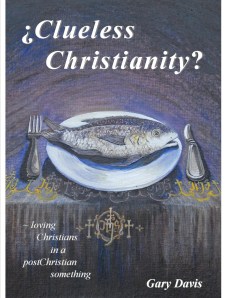
 Clueless Christianity