
collateral damage

Dr, Gary, Davis, Needinc, Clueless, Christianity, Christian, refugee, war, damage, collateralOne of the givens of war is collateral damagethe incidental destruction of property and human life not intended as part of a tactical military maneuver; also known as- the casualties of war. Each side in the conflict will report and dramatize the extent of collateral damage inflicted by the other side as if the intended targets were indeed the innocents. The propaganda and misinformation war waged alongside of the military conflict will always seek to claim moral justification for its retaliation by producing the most graphic images. The truth is
that too many innocent people are used as military shields, as propaganda tools, and, sadly, as actual targets. IF they have any military value whatsoever, they are expendable. Casualties of war.

Similarly, some of us have no idea of the collateral damage we leave in our wake. Some, to be sure, are glibly blind to the havoc they cause. They are simply stupid people who need to be confronted with their stupidity. It is those who have no issue with littering casualties along the way as long as they can achieve their personal goals that are at issue here. Why is it that some of us believe we have the right to use others, to step on them to climb one more rung up the ladder, to wound them deeply, and then to dispose of them as little more than rotting rubbish!?! And then they continue their climb up the ladder, suffering no moral or ethical pangs in what they have done.

Common decency and courtesy would seem to dictate that a simple apology containing some degree of civil or humane restitution would be in order. Yet if it remains with the abuser to put forth the contrition, to take the lower place, you may well have to provide your own snowballs in hell. Thus, just or not, it will most probably fall to you to take the lower place, and accordingly to rise to the level of bringing some reconciliation to the situation— even though you remain the collaterally damaged and discarded one   . Ever heard this adage?

If you place yourself on top, there’s only one direction you can go.

If you place yourself on the bottom, there’s only one direction you can go.

            Never, ever be the one who inflicts collateral damage on others!


Have a nice week,

Gary

love3

Love, Dr, Gary Davis, ChristianHow do I love thee, let me count the ways…” “Better to have loved and lost…” “I am my beloveds, and my beloved is mine.” ”She walks in beauty like the night…”  To presume to pen any original inspiration on the issue of love is, at a profound level, most audacious; at a fool-hearty level it is at least impudent.  Not to write at all is to relinquish earnest passion and attentive consideration to the past. I, for one, am not disposed to do that just yet. For love has roused anew in our progeny from ancient times and will do so long after we have crossed that sacred line of our lives.

Though there are endless examples of verse, song, physical expression, psychological and/or chemical analysis of love, it remains one of the rare universals that bind our race together. Nations have gone to war for the love of a woman; they have also gone to war over betrayal of love. One world renowned counselor/educator, Dr. Gary Chapman has even identified The 5 Love Languages.

Affirmation through Words

Acts of Service

Personal Touch

Receiving Gifts

Quality Time

[You can decide where taking-out-the-trash, changing-juicy-poopy-diapers, and cleaning-the-cat-litter-box go.]

There are at least three shapes of love that must be woven together for any kind of love to remain stable— love3, or, love cubed.

1.      Feeling— Being drawn to the other; whether by a boy, a girl, a car, a dress, a beautiful island, or a life purpose. Your heart is stirred, your passions aroused, and feelings stirred.

2.      Action— Whatever the object of your affection, you want to do something to show your love. If between a man & a woman, flowers and dinner; something to demonstrate your interest in them as a person. If a car, wax it, detail it— to the polishing of the wheel-wells. To aspire to achieve your life’s purpose is to focus your energies (& actions) toward that end. This is genuine love— feeling in action!

3.      Commitment— But Feeling & Action are not enough. There must be Commitment for the first two to stand the tests of time. You must ask yourself, How committed are you to this person? For better or for worse, in sickness & in health, ‘till death do us part? How long will I hang on to this old clunker? How serious am I about achieving my goals and making a difference in this world?

There is a short poem in the Hebrew Psalms (15) that asks a question— Who may stand on God’s Holy Hill, in His Temple, before His face? One of the answers it gives is, He who swears to his own hurt and does not change. He keeps his word and follows through. Good advice for any lover these days, eh!?!  Love3.

Have a nice week,

Gary

That’s Not Your Story

Story, Gary, Davis, Christian
In C.S. Lewis’ children’s book, The Horse and His Boy, there is an exchange between Aslan, the Lion-God of a mythical (?) land called Narnia, and Shasta, wherein Aslan reveals some of the things he has done. Shasta is stunned and asks, “But what for?” (seeking inside information about his friend Aravis.)  “Child,” said the Voice, “I am telling you your story, not hers.  I tell no one any story but his own.”(p.147)

Stories. We all have them; each one of us. Each story is unlike any other; each one of us different from any other. There may be touch-points, similarities, or surprise commonalities, but we each are still unique. So why is it that we are persistently trying to write or live someone else’s story?!? How do we become so discontent with our story?

Could it be a sense of failure, of never being good enough (for your father or mother); maybe we fear our reality and want to be in someone else’s reality. Or could it be envy— that we want what someone else has and think we deserve it more? Of course, if we are living a miserable life, in a deplorable job, in a dead-end, abusive or bland relationship, almost anyone else’s life would seem more desirable. When we are young we want a story that is epic, heroic, and exciting. Most of us live far less adventurous existences.  Nonetheless, far too many of us, for whatever reasons, lust after a life we do not have; we yearn for a story written for another.

Some of us want to participate in the Grand Story—the Metanarrative. Today, the more common opinion issuing from postChristian oracles is, “There is NO Grand Story! So forget it. Go ahead. Write your own story! Other people’s stories be damned. Steal them if you want!” Not unexpectedly, the more we usurp other people’s stories, the more convoluted and confused we become. We become actors in a theatre, playing which ever role suits us for the moment. But these are not our stories; they are only playacting. Conversely, if we do not return to our story, over time, we will lose sight of how it was meant to be written.

So, what IS your Story? Do you know it? How’s the writing going? Your story is yours, uniquely. But are you also allowing room for other story-writers to place their stories beside yours? Please, for your sake, make sure you read their stories; it will deepen your comprehension of your own story if you do. You will also come to appreciate your place in God’s creation-story far better if you do.

Keep in mind that you are not the only writer in your story. On one level, there are many contributing authors who influence your writing from the side— kids, encouragers, detractors, other visionaries, even those who exacerbate you. Yet on another level, you are also a contributing author to a much bigger Story.

Write sagaciously…, and with vigor!

Have a nice week,

Gary

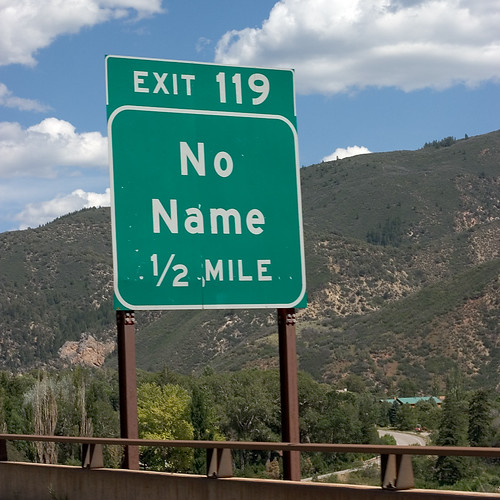
No Name, Exit 119

no name, exit 119

Driving West on I-70 through the Rocky Mountains in the state of Colorado you would eventually be distracted from the glorious surroundings by Exit sign 119. It reads simply “No Name…, ½ mile.” The first time I saw it I was convinced it was a very sophisticated college joke. My son assured me it was no joke. He explained it was named after No Name Creek, now with a population of 123. When my curiosity finally got the best of me a couple years later I exited Exit 119 to see what was there.

I never saw a single soul.

Life is often described as a journey. It has many curves & dead ends; we all have accidents of one kind or another along the way. The journey holds good times too; vacations-to-remember, great relationships, weddings, births, and many, many celebrations. Hard times too. That’s just life. When our son turned 18 he informed us “I’m 18 now and life should be the way I want it to be.” I replied, “Good luck with that.” He knows better now, as do we all.

Yet I wonder, as do you if you’re honest, about those No Name exits. The exits you never took; the lane changes, the career shifts, risks avoided, relationships never nurtured. The what if’s. How might things have altered had you made one decision differently? How might an outcome changed had you apologized, admitted you were wrong, or insisted on doing the right, honorable thing? We all wish we could change some things in our past. WE CANNOT. But…, we can change the future!

Some of us will need to avoid exiting our current life’s journey:  we get off track to easily. Other of us will need to take a couple no name exits to rest, to breathe more regularly to regain our life’s heart-beat. Too many of us take no name exits either because we refuse to believe we can handle the hard stuff, or because we do not want to face the road ahead. Bad moves, both. And others are barreling ahead at such a velocity that any course correction, no matter how slight, could wind up being catastrophic.

So I admonish you, take heed to the direction of your life journey. Too fast? Too slow? Too fearful? Too self-assured? Some No Name Exits may be just what you need. Or, maybe not.

And please, for Christ’s sake (literally: and for yours), don’t be afraid to ask for directions!

Have a nice week,

Gary

so what !?!

Dr, Gary, Davis, Needinc, Clueless, Christianity, Christian,An article in a recent US newspaper struck me as quite perspicuous. It was titled “God, Religion Atheism. So What!?!” It seems that many government and private market forms, when asking for religious identification encompass a variation on this article’s title— “Christian, Jewish, Muslim, NONE.” The article pointed out that more and more, Americans are selecting NONE as their category of choice. It’s not that we are not religious; we just don’t want to identify with any “organized religion.” (From my observations there’s good news then; religion isn’t that organized anymore.)  The article certainly did not reveal anything new when it noted that there is a growing number of us who not only have NO religious affiliation, but believe that there is no god, no higher principles, no magnificent scheme, no metanarrative, no purpose-for-living to which they should dedicate their energy and allegiance. Their life’s significance and direction are set solely by their own desires, skills, decisions, and preferences. It is the enjoyment of life’s predilections & pleasures that determine their direction. They are NOT concerned with fitting in with some divine purpose or search for meaning. Selah.

From the vantage point of a person (ok, me) who has lived as a servant of the Most HIGH GOD this seems an evasion of both societal and spiritual participation; choosing, instead, to place the desires of the moment and a penchant for personal fulfillment above any need to be included or concerned in the lives of the people of this planet. It is not arrogant self-centeredness:  it is irresponsible self-absorption. It flies in the face of all the sacrifices and efforts made to forestall a global Armageddon. Government isn’t all bad: but at least it’s trying. Religious people don’t always agree: but at least they are endeavouring to make a difference.

The non-religious, non-caring, so-whats!?! of our culture are wrong. Inherent within us all, cognizant of it or not, lies a deep sense of purpose and meaning for life. Their arrogance asserting a belief in self as the ultimate determiner of meaning is unfathomable. None of us would be here today had not some of us dedicated our lives to making a difference. Then again, a world without God is as devoid of meaning as it gets; created or imputed meaning leaves much to be desired. The world and the universe do not revolve around us. It is not about So what!?!  It is about what if, I can, I’m sorry, together, & making a difference.  So be it!

Have a nice week,

Gary

Temporal Distortion

Salvadore Dali’s 1931 painting The Persistence of Memory challenges us to reconsider the solidity of time. Dali saw time as “soft” vs something that is “hard.” Einstein postulated that time would slow down as a traveler reached the speed of light. This is a type of temporal distortion. So although the velocity of light is a constant, the measurement of time becomes a variable. It distorts.

In a sense, the faster humans go, the more our sense of time distorts. We try to pack so much into a day, a week, month or year, until we confuse the value of the time we have. We begin to live in separate “universes,” crossing between them as needed, to keep pace with ourselves and the impossible schedules we attempt to keep. The result is that we lose the ability to properly perceive ourselves in the real universe: we also lose our ability to perceive the real universe accurately as well. Our vision becomes skewed proportionately with the velocity of our lives. More simply— run ahead of reality, miss the small stuff. Critical details are not so designated capriciously. They are important to grasp in the grand scheme of things.

Our personal, temporal velocity will distort our grasp of real reality.

Time is measured out to each of us to use with delicate touch. None of us know how much of it we have in this life-span. So, in an effort to prevent a distortion of it, I offer these challenges to you—

In broad strokes, chart the next year; vacations, holidays, work commitments, family times. Do the same in more detail for the next month, for this upcoming week. Then ask these questions of yourself—

  1. What is important to you? What % of time does that get?
  2. What is the balance of time between work and family? Remember, it’s quality and quantity time.
  3. How long does it take you to STOP? [You do stop, don’t you?] Relaxing cradles refreshment within.
  4. How much time do you spend staring at the ceiling when you go to bed at night? Get help. OR, just STOP your day one hour earlier. One hour earlier. “Sleep…, don’t leave home without it.

Do not be deceived. Temporal Distortion does lead to warped comprehension in adjacent areas of life. Given enough time distortion evolves into perversion; and perversion lapses into blindness to the truth of any reality other than the one solely inhabited by you. God set up this universe to run smoothly according to His principles of time & space, of relationships within reality. Don’t mess with it. Adjust your life to run in time with the Universal Clock; and I don’t mean the one in Greenwich.

Have a nice week,

Gary

Holy

Holy cow! Holy mackerel! Holy Father. Holy Toledo! Holy moly! Holy @#%$! Holy Spirit. Holy Bible. Holy ground. Holy terror (usually reserved for toddlers). Holy Grail. Holy Qur’an. Holy rollers. Holy Sutras.

Holy. The word is sprinkled throughout our vocabulary. In different forms it is found in most of the world’s languages. It appeared first in ancient Semitic form as Q-D-Š  (–), to designate something set aside for sacred use. The Hebrew qudosh (קֹדֶשׁ) was used in reference to holiness. In modern English we have a remnant of the original QDŠ through the Greek in the form of kudos. Yes, kudos, from an ancient Semitic root.

But what does holy mean? What does it look like? Looking within ourselves we can see that which is not holy, not good, not right. Yea, verily, many of us are certainly good; but holy? Not likely. Examining human history grants us further illustrations of that which is not holy. Ask any parent and they will inform you about their two year old from hell. Ask any parent of a teenager about half-truths, deception, secrecy, and “attitude.” Or sit in on a session of Congress, or a corporate “merger,” or international negotiation to avert a crisis. Holy would not be the first descriptor that would come to mind. On a deeper level, humanity seems rife with a characteristic we all understand and perceive to be definitively e-v-i-l. And evil needs no definition (the Plague, Vlad the Impaler, the Holocaust, Hiroshima/Nagasaki, Mao Zedong, Idi Amin, transAfrican genocide & starvation; whether we believe it to be of human or spiritual origin, there is little doubt in the human history, and within the human psyche, these individuals and events were (are) truly evil. The opposite of all that would be considered holy, in both nature and effect.

So how do we comprehend the holy? How do we even begin to define it? It is not evil: it is untainted, pure, safe, and complete unto itself. Through our world’s religions we can look at various definitions and interpretations of holiness, but can we ever really examine something that appears to be completely outside our realm of experience? Whatever it is, it is something totally other than what is normally familiar to us.

Or is it?

Is there, imbedded deep within our innate human consciousness, a sense, a knowledge, of that which we call holy? How is it that we possess a sense of reverence for holy things, holy places across the globe? Why do we consider certain practices or rituals holy? At one time or another we have all known fleeting glimpses of a holiness beyond ourselves which we intrinsically recognize within our souls. How can this be?

Allow me to suggest that there is within us all a holy presence who is intimately familiar with us, who seeks us, and desires that we seek him as well. Do not shy away from this quiet voice within. It just may be He who offers you a way beyond the rest of the evil we bear, and which we encounter each and every day of our lives. Maybe it is time we thought of holiness as more of a foundation, offered us as a basis for our lives than as an eventual reward for being good.

Have a nice week,

Gary

New


Do you like new things? New babies (a-w-w-w), new clothes, a new car, a new job, or a new start. All cradle the sense of a new beginning, another chance. Unless you are an antique dealer you probably like something new. New signifies freshness, unspoiled, unused by another, not tainted, innovative, bright. New things grant the possessor hope, expectation, joy, confidence, a sense of completion (if only momentary), and power (if only illusory). New is good for us, if not always advisable. New always costs more than we think it does.

So when you find yourself jealous of someone else who has something new, and you don’t…, give it up. Whatever they have that is new, that you do not have, is good for them; it may not necessarily be good for you. Instead rejoice with them! Celebrate the new baby, the new job, the new car, whatever it is!  [I know that surreptitiously, underneath the celebration, you secretly still wish it was you possessing the new_____.  But…, really, are you that covetous, that greedy, that envious, that you cannot let it go; that you cannot genuinely join in their merriment, their elation!?!]  It is part of life’s enjoyment to rejoice with other people in their joys. Joy, joy, joy, joy!

Even the Lord God of the Creator has said “These things have I spoken unto you, that my joy may be in you, and that your joy may be made full.” (John 15:11, Bible). If the Lord of the Universe wants to give us His joy so that our joy may be made full, shouldn’t we be able to join in the joy of someone else’s new ______?

O yeah, HAPPY NEW YEAR!

Have a nice week,

Gary

Courage

Dr, Gary, Davis, Needinc, Clueless, Christianity, Christian, courage, sacrifice, foundationSocrates, Chin, Hammurabi, Abram, Moses, David, Alexander the Great, Cleopatra, Eric the Great, Charlemagne, Odo the Great, Elizabeth I, Peter the Great, Susan B Anthony, Clara Barton, Gandhi, Abraham Lincoln, Annie Sullivan, Mother Teresa, Dwight D. Eisenhower, Martin Luther King, Jr., Aung San Suu Kyi, Sgt. Dakota Meyer. Every one of these individuals possesses a quality every person on earth must acquire— courage. In our present era we talk more about our rights than about our responsibilities; we are more concerned about bottom-lines than life-lines for others. We have become more a people of self-preservation than of self-sacrifice.

Self-protection and self-gratification are not, mind you, the definers of all of us; certainly not of those in the opening inventory. There are still some who put others before themselves. Why do they do this? They possess qualities that others deem weaknesses, or foolish. Qualities like, graciousness, forgiveness, humility, and courage. These qualities are not often rewarded in the civic arena. In fact, they go mostly unnoticed. Acts of kindness & courage are most often done in secret; actions which come to light only at a later date (if at all).

Amidst the stresses swirling about in our postModern/postChristian society it takes courage for many of us just to get out of bed to face another day. Things are not as simple as they once were. The smorgasbord of choices and decisions we must make every day— what to do with our time & priorities, our commitments, our financial restrictions, our emotional highs & lows, our energies & exhaustion, notwithstanding the ethical & moral dilemmas we encounter, are overwhelming.

Unless we each hold some guiding principles, some basic beliefs about life, faith, and trust in something (Someone) beyond ourselves, we will be quite confounded as to how to grapple with it all. You see, courage rests on a foundation of belief, which rests on a certain realties beyond individual mere self-preservation. Call it faith in God, belief in a “higher-power,” or even a “…if it is God’s will.” Courage rarely issues forth from a basis of superiority; rather, it arises from a sense of one’s own humility in the grand scheme of things, in believing that there are powerful forces at work in our world, that there is a greater plan in place, than my own puny little existence.

In the ancient Greek Temple of Apollo at Delphi, inscribed above the forecourt was the Socratic maxim— γνθισεαυτόν. “Know thyself.” We would all do well to take a measure of ourselves within, before our fellow man (and women), and before the God who made us. For it is only from a true knowledge of who we truly are that true courage can take root and be called upon when the time is at hand.

Have a nice week,

Gary

Prometheus


The ancient Greek legend of Prometheus, one of the gods who sided with Zeus in the rebellion of the Titans, fascinates historians and art lovers to this day. The abridged version is that Prometheus was punished by Zeus for giving his creation, humans, fire, so that they would have a chance of survival in this newly created earth. Prometheus was chained to a rock on a high cliff where an eagle would eat out his intestines, stomach, liver, etc. every day into eternity. Then miraculously, Prometheus’ innards would grow back overnight, only to be devoured again once the following day. This was Prometheus’ punishment for disobedience.

In our era we dain to punish anyone for wrong-doing. (Excepting hardened criminals.) The very definition of “wrong-doing” is constantly in flux, as is any final word on right or wrong. Outside governmental, territorial, and local law there is little prescription to determine right from wrong, or good from evil. Those definers have given way to societal acceptability, majority rule, and the prevalent wave of moral opinion. How dare anyone judge my personal preferences in business practices, moral absolutes (or not), ethical decisions, or sexual/sexuality definitions!?! What’s true for me may not be true for you; but that doesn’t make it any less-true—for me.

Thus, in our homes, our schools, and in our courts, punishment comes in second to last, just short of the death penalty. This position stems from the belief that people are basically good. Given the choice between doing what it right for the good of the many, versus doing what is best for themselves, they will do what is best for society. Read any book on World History and you will come to a somewhat different conclusion. Punishment is just when it is rightfully deserved. The determiners of justice, in our society, are “a jury of our peers.” They are also our parents, our classmates, and those with whom share work responsibilities. Not measuring up is one thing; crossing the lines of trust and propriety are quite another.

When, throughout your life, have you deserved punishment for wrong-doing and did not receive it. If this happens enough you will come to believe that you can get away with anything. You cannot. Justice and Punishment always catch up. Believe it.

So why is it that a Holy God puts up with us!?! If any species on this planet has defied Him consistently, it is us. Why has the axe not fallen on our necks every day? What is He waiting for!?!

Enter forgiveness.

Not, mind you, without genuine remorse for deeds done— or left undone. Neither without a change of life, or at the least, the desire to live differently, more honorably, before God and men, with a sense of humbleness for our forgiveness.

So if you do not want to have your guts eating away at you day after day, or being gnawed on by a really large bird, maybe it’s time you owned up to the punishment you rightly deserve—and pray for the forgiveness you surely do not deserve. You might be surprised how ready other people, and God, are to set things right. You just have to do your part too.

Have a nice week,

Gary