My Preference – my Presc-ciousss!

Dr, Gary, Davis, Clueless, Christianity, NEEDinc, preferences, selfish, selfishness, precious, How much do personal preferences cause perennial problems between people?!? OK, the alliteration is iffy; but the issue it illuminates is a serious one. At times it seems that too many of us place our personal proclivities and preferences above the good of-the-many. It’s what I want that matters; not what you want. My desires come first.

Really?!?

Some of us just cannot seem to get along with anyone. Why? Because we refuse to cut any slack to anyone to who does not meet our standards of excellence; who will not see things any other way but their own; who refuse to admit that their personal preference is is only one way. They will not admit they could be wrong or that someone else might be right.

Really!?!

How dare we make our personal preferences the standard by which we judge everything else?!? So if you disagree with me, forgetaboutit. I need have nothing more to do with you.

Really?!?

NO ONE individual has all the strengths needed to master a craft, to complete a complex task, or to bring a dream or plan to fruition. We ALL need one another to make society, or family, or church, or business, work.

So can we lay aside our preferences and begin to build something together?!? Too many of us hoard our abilities and preferences like J.R.R Tolkien’s Gollum with his Presc-ciousss; his Ring-of-Power, which, in the end was the power that possessed him and destroyed him.

Far too often, our preferences take over our very core-values and destroy us. We believe that our way is the only right way, and we break friendships and commitments with those who feel otherwise. Some things, to be sure, are worth fighting for; but hanging onto our particular preferences is not one of them. True strength, true power, is the natural byproduct of people with different strengths, and preferences, coming together to build something greater.

Are up for that? Or would you rather hang on for dear life to your personal preferences…, your presc-ciousss?


Jus’ sayin’,

  Gary

Ripples

Dr, gary, Davis, Clueless, Christian, Christianity, effects, affected, relationshipsRemember sitting on a summer beach letting the water roll in— letting it wash over you in its salty brine? Did your eyes follow the surf as its ripples returned to the sea in currents and eddies? Never the same twice, but always the same ripples…, returning to the sea.

I often ponder the similarities between those ocean ripples and the effects I might have on another person. How do the ripples of my life choices affect the currents, the ebb and flow of the lives I touch? Hopefully, the way I live and relate with others builds them in their lives; hopefully, their lives start to reflect some of the same ripples that have trickled through my life.

For I am the result of countless friends, mentors, critiques, counselors, and even enemies. I have not been one to swim under the ripples that pushed toward me; rather, I have learned to flow with them, for a while, until I learn whatever lesson is carried by that ripple.

That being said, it must also be added that sometimes those ripples had to build to the level of a tsunami for me to ride along with it. We all fight the tides of life that threaten us, that want to push us off our course, and I was no exception. Now…, not so much. This has probably come from being churned up in the surf far too many times.

Whatever stage of life wherein you find yourself, whatever dire or laudable circumstance, you are making ripples for everyone you know. What kinds of ripples are you leaving in your wake? Do they buoy up a person, or just about drown them? Does your family enjoy and respect you, or fear your return from work? Do your employees see you as a hard task-master or someone who empowers them to greater performance and joyful sacrifice? As you meet passersby do you smile at them, or appear stern and even threatening?

You need to know the kinds of effects you have on the people that surround you. Is it building and uplifting, giving them the thrill of a surfer riding the waves? Or are your ripples more like the pounding surf in a hurricane, bringing destruction wherever its waves land?

The kinds of ripples you leave in your wake are your legacy to your family, your grandchildren, your community, and to this planet. Leave good ones! For what it’s worth,

  Gary

I am a Christian

Dr, Gary, Davis, Clueless, Christian, Christianity, Maya Angelou, Carol, Wimmer,


While erroneously attributed to Maya Angelou, this poem speaks for itself.

When I say, “I am a Christian”
I’m not shouting, “I’ve been saved!”
I’m whispering, “I get lost sometimes
That’s why I chose this way”

When I say, “I am a Christian”
I don’t speak with human pride
I’m confessing that I stumble –
needing God to be my guide

When I say, “I am a Christian”
I’m not trying to be strong
I’m professing that I’m weak
and pray for strength to carry on

When I say, “I am a Christian”
I’m not bragging of success
I’m admitting that I’ve failed
and cannot ever pay the debt

When I say, “I am a Christian”
I don’t think I know it all
I submit to my confusion
asking humbly to be taught

When I say, “I am a Christian”
I’m not claiming to be perfect
My flaws are far too visible
but God believes I’m worth it

When I say, “I am a Christian”
I still feel the sting of pain
I have my share of heartache
which is why I seek God’s name

When I say, “I am a Christian”
I do not wish to judge
I have no authority
I only know I’m loved

Copyright 1988 Carol Wimmer

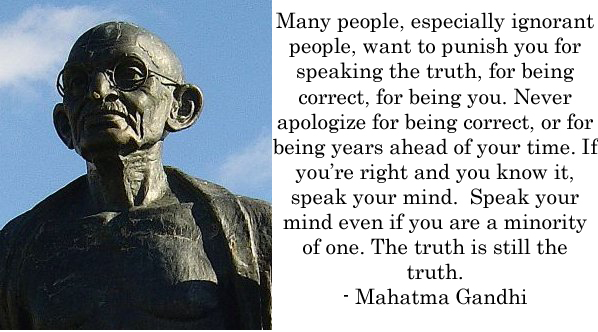
Speak your mind

Dr, Gary, Davis, Gandhi, speak up, truth, brave, courage, opinion, Clueless, Christianity, NEEDinc, Quasi anima tua?  Speak your mind! So few of us do. Those who know who they are do— cautiously, graciously. Those who are ignorant and uncouth do; usually with little thought to the effect their candor might have on others. Those who parade their arrogance about also speak their mind— what there is of it. Some, to be sure, have something to say and should speak their mind. I believe you are such a person.

But Truth, though difficult to hear or comprehend at times, especially in regard to science or religion, is oft composed of the most blatant, kindest words. To package it any other way would be to dilute it, to treat it as of little significance, or simply to dismiss it as inconsequential.

We at www.needinc.org and www.workingoutyourcrap.com, are purveyors of truth…, and Truth. We want to face the difficult issues of our time with bravery and humility, wisdom and wit, steadfastness and skepticism, openness and curiosity. WE are not afraid of what we might find: we look forward to the challenges to our beliefs and opinions. We hope you hold a few solid opinions and well thought-through beliefs as well. Listening to learn, to understand is always preferable to aiming nukes at each other, starting religious wars, or stereotypically scorning one another.

So please, PLEASE, post some comments on our WEBsites so more people can disagree with us. We don’t want to merely write BLOGS and Posts just to add to the verbosity of the WEB. Rather, we want to engage different minds, divergent opinions, and find people who are willing to make the effort to tell us how much they disagree with us. OR, it would be nice if some of you even liked us, actually agreed with us— and then commented on our sites. PLEASE!

I’m not usually a groveler; and I never suck-up to anyone to get recognition. NEVER! But I would kill to get your feedback! Not you, of course; because then how would you ever write any feedback for us. Oh, never mind! This is getting confusing.

Just SPEAK YOUR MIND! ON OUR WEBSITE! Or I’m coming to get you!

There now, don’t you feel better?  I do. J

With humility,

  Gary

Ready-Fire-Aim

Clueless, Christianity, Christian, Book, Dr, Gary, DavisLife facts from 1902: things that make you go hummm.

  1. The average life expectancy in the US was forty-seven years.
  2. Only 14 Percent of the homes in the US had a bathtub.
  3. Only 8 percent of the homes had a telephone. A three-minute call from Denver to New York City cost eleven dollars.
  4. There were only 8,000 cars in the US and only 144 miles of paved roads.
  5. The average wage in the US was 22 cents an hour.
  6. The average US worker made between $200 and $400 per year.
  7. More than 95 percent of all births in the US took place at home.
  8. Ninety percent of all US physicians had no college education.
  9. Sugar cost four cents a pound. Eggs were fourteen cents a dozen. Coffee cost fifteen cents a pound.
  10. Most women only washed their hair once a month and used borax or egg yolks for shampoo.
  11. The five leading causes of death in the US were:

1)      Pneumonia and influenza

2)      Tuberculous

3)      Diarrhea (most likely from contaminated food)

4)      Heart Disease

5)      Stroke

  1. The population of Las Vegas, Nevada was 30 people.
  2. Crossword puzzles, canned beer, and iced tea hadn’t been invented.
  3. One in ten US adults couldn’t read or write. Only 6 percent of all Americans had graduated from high school.
  4. Marijuana, heroin, and morphine were available over the counter at corner drugstores. According to one pharmacist, “Heroin clears the complexion, gives buoyancy to the mind, regulates the stomach and the bowels, and is, in fact, a perfect guardian of health.”
  5. Eighteen percent of households in the US had at least one full-time servant or domestic.
  6. There were only about 230 reported murders in the entire US. [i]

So, given the religious fun & fancies of the last 10,000 years, not to mention the incredible innovations that have taken place in the last 100 years, the question we are facing on this postmodern/postChristian, text2text, family-redefining, iPoding, Wii-ing, touch-screen, Skyping globe is— Who are we? or— What are the definers of life and reality in a world (western culture, in this case) with so many value systems coexisting side by side?  In other words, how do we make sense of all the changes of the last years of the twentieth century and the few we have played with so far in the twenty-first?  That is what this chapter will address.

Let’s start with a metaphor from the early days of the wornderful world of computers. Can you say Ctrl+Alt+Del?[ii] You remember what that means, don’t you?  (Or not.) It’s an old computer key combination for releasing a hard drive freeze up, a crash, a lock up…, call it what you will; personally, I remember it as *&@#$ frustrating.  [Well, admit it. You feel it even if you don’t say it. It’s part of human nature to be frustrated by all things electronic.]  We’ve all experienced that irritating situation where we are working along, just like we always do, and, for whatever reason, our computer’s hard drive hits a wall, beyond which it will not work.  Ctrl+Alt+Del.  You have to REBOOT! And if you haven’t bothered to save your work, or exit your application, or backup your work, well, bye-bye!  Back to square one.

The point is that things don’t always work the way they are intended. [Perhaps Microsoft intends their operating systems to work like this, but probably not. (Why people buy Macs?] So much has changed in the world it requires a focused determination (or constant immersion) just to keep up. In the Western World (Europe, North America, parts of the Pacific Rim) the rate of change has accelerated to the point that we literally cannot keep up. For example, it used to be that if you ordered a computer from a distributor (DELL, GATEWAY, HP) by the time you paid it off it would be obsolete. Now, the joke goes (but not so far from the truth), that by the time it arrives it is obsolete. We are outpacing ourselves on a daily basis. The way we did something yesterday (made a phone call, turned on the TV, cooked dinner, “commuted” to work[iii]) is not the way we do it today.

In the mid-twentieth century products and goods were made to last; they could be counted on to be around for 5-10, even 15 years. They broke; you repaired them. Now it is use it & lose it. Material goods in the West are expendable; sometimes, so are the people. Company loyalty, holding onto your job, or having a single career for life have all been supplanted by upward mobility, “down-sizing,” farming jobs overseas, and multitalented entrepreneurialism (read “I want to do what I want to do.”).

For better or for worse, we have moved light-years past the modes of living at the turn of the nineteenth into the twentieth century. Imagine that world for a moment. Industrialization had taken over the cities, the family, and the father. Electricity was just becoming available to the masses. Most Americans used kerosene lamps for light.  The automobile was crowding out the horse and buggy. Train travel was the rapid transit of the day; subways and trolleys were uniting workplace and home with greater efficiency. Back on the farm even the earliest mechanization of planting and harvesting was revolutionizing the agricultural process. The massive expansion of North America’s roads enabled farmers to get their produce to more markets faster; the railroad transported goods and produce to yet further a-field markets, expanding trade and creating a hunger for exotic goods and tastes.  On a world scale, old tribal conflicts were replaced by a new sense of nationalism. Europe had solidified under national monarchs. And it seemed that those American states had finally made it as a world power, even after the bloodiest of Civil and territorial wars. The world seemed poised for the entry of the greatest century ever, the Twentieth Century! Most Americans were giddy with what they had been told the new century would bring— science and technology freeing ordinary people from the demands of physical labor. And what an exceptional a century it would be— both in greatness and in tragedy.


[i]  [http://www.goofball.com/jokes/facts/death_life_difference_The_Year_Is_1902

[ii] For you Mac/Apple Computer users, this is an unknown. You should be thankful you can utilize such a reliable CPU. Of course, having everything proprietary does limit one’s ability for diversification.

[iii] Commuting to work 1950-1960- take a bus. Commuting to work 1970- drive yourself. Commuting to work 1980- Car-pool it. Commuting to work 1990-2000- grab yourself a latte, sit down at your laptop, log-on… in your bunny slippers.

Christians in North America

  • Clueless, Christianity, Christian, Book, Dr, Gary, DavisHow should Christians view their fellow North Americans? Taking all this into consideration, how should Christians in North America look at their society? To start, we need to remember that a great deal of our world has changed. Christians are no longer the dominant influence forming either political platforms or societal mores, however much they would like to be. To live as if this is not so would be to deny a new reality that has overtaken the Western World. There is little understanding of genuine Christian faith. Once this hits home it must affect how we view our friends, neighbors, and work associates.

At the very least, to relate to them in any way at all, we need first to BE in their world. That may sound like stating the obvious; most of us work in the marketplaces of life 5-6 days a week. But do we work there as Christians? In general, we do not, except maybe privately, secretly hiding our faith (out of fear?) because we might not know the answers to some of their questions. If we were more transparent about our faith, I dare say Christian influence would jump exponentially. Instead, we’ve become closet Christians in the living rooms of the world.  Many of us isolate ourselves within an evangelical or main line church world, venturing into “the world” as Christians, as infrequently as possible. We may work in this world, earn a living, raise our kids, shop for food and clothes, pump gas, go on vacations and vote for the candidate of our choice; we just don’t interface with the people we meet as transparent Christians—more as non-descript Christians, with little or no Christian definition or expression to our lives. This is not good. It is almost as if we are afraid of being identified as Christians; it is almost as if being “Christian” brands us with a kind of societal stigmata. And, to a great extent, given the revelations of recent “Christian” evangelists, preachers, and other leaders, there is some truth in this.

But what if we were REAL in our Christian faith; what if we talked casually about our faith, answers to prayer, and about the difficulties we have sometimes with our faith, our lives, or our church? What if we talked about being upset over something our kids did that infuriated us, or the inner embarrassment and frustration we feel over our divorce as a bad expression of our faith? What if we were REAL in our relationships with people? What do you think; is that okay? Is it okay to, dare I use the word, fail, in our life of faith sometimes? Dare we tell people who are not Christians about our failures? I tend to think that people who are not believers in Christ will find our transparency surprisingly refreshing. Why? Because they are looking for faith to be real, to reflect the way we all deal with the issues of everyday life. They are looking for a faith that reflects a real relationship with a real God who does something for people in the real world. They are looking for TRUTH to be reflected in the joys, struggles, failures and triumphs of everyday life. If it doesn’t do that, on what level are we living our Christian faith out anyway? Does your faith hang in a sort of limbo above the struggles and successes of everyday life, only to drop down to earth when you feel that the definition of something works? Come on, now… is that really your faith? To me, that’s excluding God from life so that we can feel good about what we’ve accomplished. Then, when things don’t work out, we turn on God as if he has failed us. Not goodagain.

Frankly, I find no replacement for genuine Christians, living transparently before their friends, neighbors, work associates, and relatives. I do not mean before their Christian friends, Christian neighbors, Christian work associates, and Christian relatives:  I mean the people who never darken the door of a church, who have never had a Christian thought. Don’t believe they’re not out there; don’t kid yourself. You just can’t see them; but they are there. We need to open our eyes to see the world around us in a new light—the light of the glory of Christ, clarifying our lives and opening a window to God in the lives of those who cannot see him. Oh, bye the bye, that window is YOU. So, if you’re NOT there, in their world, what do you think they see of God the Father? Get the point? For us to have any Christian effect on any of our friends the first thing we need to do is actually have friends who are not Christians. We need to cultivate friendships with the “normal” people around us. But we need to do so not as a set up for the presentation of some gospel outline, but so they will be able to see the God we love present in us in the daily issues of life. And, frankly, with all the advances in transportation, communication, medicine, technology, and the realigning of the residential/marketplace, it still comes down to people.  It comes down to Christians, walking along side of people, normal people, so they can see with their own eyes what real Christianity is all about.

Playing God

Dr, Gary, Davis, Needinc, Clueless, Christianity, Christian, God, Playing, reality, pride, self-centered, atheist, beliefPlaying God. How many of us do this unconsciously every day of our lives. Of course, if you are an atheist, you cannot play; there is no one to impersonate. But if you are anything else you have probably wanted to be God in some situation or another. Sometimes, for the good—as in saving a life or preventing a disaster:  other times, for your own selfish control—you just want things to go your way. Everyone else be damned. This last reason is the most likely explanation why you are not God. You’re not that good at playing Him. It’s always too much all about you.

            Too many of us believe that playing God is about exerting absolute power over things. Some of the men I know try to do this in their immediate families with varying degrees of disastrous results. Fathers want to be dictators or drill sergeants, yelling out commands with unquestioned authority. Thank God He isn’t like that. To the contrary; he actually tells us what He wants from us, so there will be no question.  Psalm 51:16, 17 puts it best—

You do not delight in sacrifice, or I would bring it;

You do not take pleasure in burnt offerings.

The sacrifice you desire is a broken spirit.

You will not reject a broken and repentant heart, O God.

Basically, outward shows of worship do not compare in any way with an inner understanding of our place in the universe. But why broken?” Really?!? Do any of us truly need to ask? Our propensity to play God is only usurped by our arrogant assumption to become God, at least of our own little realm.

            So thus do we come to play God with everything and everyone around us. Our species has a natural proclivity to assert ourselves. We are restless. We cannot wait for definition or direction; we must determine our own direction with only a casual glance to the impression we may leave on this planet, in the universe, or on other creatures. It truly has become all about us.

            We become the God we reject and complain when others will not play the game our way. And so follows war, cultural degradation, family dissolution, and a re-writing (in many forms) of the internally inscribed moral-code; for there is no one left to constrain us…; but us.

            Really!

            Though I am but one man, one human, of one species among many, I do have a sense that I am part of something far greater than myself. And though I do dare to play god at times, in my own little universe, I am always mindful that I am but a small player in a grand scheme, designed by Someone much more omnipotent than myself.

            So the next time you are tempted to assert your manhood, or your womanhood, or your position or authority over another, do so from the perspective that you are no greater than the God of the Universe dares allow you: and prostrate yourself before Him. Next to me.

  Gary

Chicken in a Crock Pot – Who Knew?

Dr, Gary, Davis, Lydia, Chicken, Crock pot, Disability, wheelchair, cerebral palsy, help, Guest Blog, from http://lydslookonlife.wordpress.com

“How can I help?” Did you ever ask yourself this question when someone you love and care about is hurting? For you English teachers out there who are twitching a bit right about now and thinking, “It’s ‘How MAY I help’”, I know how you feel. I experience the same kind of twitching when I hear someone use a double negative – “I DON’T got NOTHING.” I really do ask myself, “How CAN I help?” because I am a person with a disability. I am a woman with cerebral palsy, my right side is weaker than my left and I use a wheelchair to get around. In my younger days, I was able to walk and cook and do all sorts of “independent living skills” which “normal” people enjoy doing and take for granted. In fact, I used to teach “independent living skills” at a private school for disabled children and adults. However, once I hit the “magic number” 50 and beyond, I have lost my ability to walk and stand for long periods of time. But, I have not lost the desire to help others in need.


I recently asked myself, “How can I help?” when my sister had to put her beloved dog to sleep, because he had lymphoma. For almost ten years, (the good) Damon was my sister’s shadow and walking companion. My sister’s grief penetrated my heart and became my grief. I wanted to do something and I wanted to figure it out myself and not ask her to figure out what I could do for her. That would only add to her burden.


I am a person who believes in God. I also believe in talking to God and asking Him for guidance and help. Most people call what I do prayer, if you want to be more descriptive about it, I am talking with God. After I talk to Him, I then wait for Him to answer me. I believe God does talk back, maybe not in an audible voice, but He does answer my “prayers.” Some may call it a “gut feeling” or an “epiphany” or plain old “common sense.” But, I believe God gave me a great idea. Why not make a whole chicken in a crock pot? What a brilliant idea! “Thanks God! I think I can do it with your help,” I said. I had made chicken in a crock pot once before years ago, but this time it would be a little trickier. Now I am in a wheelchair and can not stand for more than ten minutes at a time. Before Jane and her husband went on a long bike ride to “get away from it all” for a while, I told her I wanted to make her and her husband a chicken dinner and I just needed her to put my crock pot on the countertop next to the sink, and I also asked her if she had an onion and stalk of celery, because I was out. My sister lives right above me, in a two family house, so she came down with the onion and celery and moved my crock pot next to the sink. Before she left, she asked me if I was sure I wanted to do this. I said “Yes.” While she and her husband went biking, I “prayerfully” made “CHICKEN IN A POT” with the aid of a rolling cart. I was able to stand long enough to cut up the onion and celery, with a break in between, and I was able to get the chicken from the refrigerator to the sink and stand long enough to wash it and plop it in the crock pot. I used the “gizzards” to make chicken broth and used the rolling cart to get the broth from stove to the crock pot and the same with the “rustic” cut-up onion and celery. Everything went into the crock pot without any spillage, except for a few pieces of onion and celery. I turned on the crock pot and it was good to go. When my work was done, with “a wing and a prayer” (Actually, it was “a leg and a prayer, since I lifted the chicken by the leg from sink to pot). I thanked the Lord for His help and treated myself to the gizzards (I know. For some, eating boiled chicken gizzards is gross, but they are quite tasty.)


“CHICKEN IN A POT” Recipe


1 to 2 carrots, sliced (I didn’t have carrots)

1 to 2 onions, sliced

1 to 2 celery stocks, sliced

2 ½ to 3-pound whole broiler/fryer chicken

1  teaspoon salt [optional]

½ teaspoon course black pepper [or more]

½ cup water, chicken broth or white wine [save the wine to drink with the meal]

½ to 1 teaspoon basil


Put vegetables in bottom of CROCK POT. Add whole chicken. Top with salt, pepper, liquid. Sprinkle basil over top [I also added a few shakes of garlic powder]. Cover and cook on Low 8 to 10 hours. (High: 3 ½ to 5 hours, using 1 cup of liquid).


When Jane and Mark came home from their long bike ride, they came home to the pleasant aroma of chicken (comfort food) cooking downstairs. Jane cooked some rice and green beans and we all enjoyed eating a delicious chicken dinner. We had enough leftovers to make chicken soup and chicken salad.


After work the next day, Jane came down to see me and gave me a big hug. She told me that what I did for her, making that chicken, meant so much to her. She knew how much effort and energy it took for me to do what I did for her. She knew that her “good old sister” was back. You see, last year I suffered with clinical depression for about nine months, partly because of losing so much of my physical abilities and independence. After months of trying different medications and treatments and, yes, much prayer, I finally “found the old Lydia” again. My sister told me, when I made the chicken dinner for her, she knew her fun loving, caring sister was back, and that made her very happy.


Who knew? Personally, I believe God did.


“Do to others as you would have them do to you” (Luke 6:31, The Christian Bible).


(If you want to read more of my writing, check out http://lydslookonlife.wordpress.com.)



St. Patrick, the man, not the myth


Sr, Gary, Davis, Clueless, Christian, St PatrickSaint Patrick
 (Latin: Patricius, Irish: Naomh Pádraig) was a Roman Britain-born Christian missionary and is the patron saint of Ireland along with Brigid of Kildare and Columba. When he was about sixteen he was captured by Irish raiders and taken as a slave to Ireland, where he lived for six years before escaping and returning to his family.

“He entered the church, as his father and grandfather had before him, becoming a deacon and a bishop. He later returned to Ireland as a missionary in the north and west of the island, but little is known about the places where he worked and no link can be made between Patrick and any [particular] church. By the eighth century he had become the patron saint of Ireland. The Irish monastery system evolved after the time of Patrick; but the Irish church did not develop the diocesan model that Patrick and other early missionaries had tried to establish. Uncritical acceptance of the Annals of Ulster would imply that he lived from 378 to 493, dying on March 17th, and ministered in modern day northern Ireland from 433 onwards.” (Wikipedia)

Patrick understood people; he understood Ireland. Instead of confronting the native Druid religion, Patrick incorporated their worship of the sun into the Christian faith as worship of the Son. He used their bonfire celebrations as part of the Easter celebrations. He used the ancient Druid symbol of Spring, the Shamrock, to explain the three Persons of the Trinity— Father, Son, and Holy Spirit. He endeavored to build a community of believers, a parish structure, rather than the pyramid hierarchical structure he had experienced in Rome.

Patrick knew the importance of blending the worship of Jesus Christ with the warp ‘n woof of daily life. He understood people have roots in their culture and communities…, and needed roots that would reach far deeper to the God who made them. So he brought Christ to them in a language and culture that they already knew.

So, when, and if, you reach out to God, try to do so in a way that is fitting with your culture, your language, in your community. You’ll be amazed at how well Jesus understands you already. You’ll still be Irish, or Ghanian, or Jewish…, but different.

Er-in go bragh (look it up.)

Gary

Why my heart aches

There have been too many times in life where my heart has been crushed by the suffering of others. Their experiences and anguish were hard to hear. I can’t imagine how they lived through those times. Some had gathered the fortitude and faith to persevere; others, not so much.

What the human spirit, heart, and body can endure always amazes me. I remember a woman, a teacher, once came to me with grey hair. The day before her hair had been auburn. The beating she had endured the previous night had been so terrifying that it turned her hair grey in a matter of minutes. Her husband is now in jail. How did she endure such terror?

Another person I know has almost lost her mind and any will to live because of a brutal rape. Another woman came to me after her 6th abortion. Sixth! She wasn’t sure who she was anymore; she wasn’t sure she could ever have children.

Other friends have lived through “less” traumatic experiences— the suicide of a husband, the loss of a job, living on the grace of others after months of unemployment, the loss of their child. My heart aches for these people.

Over the years, I have been able to move from sympathetic to empathetic, allowing me some distance to garner wisdom and perspective on their horror. It is hard to help another when we are in the thick of it with them. When there, we can offer comfort; but little else. We have not the strength.

On a grander scale, my heart aches for this world— the natural catastrophes, the fires, floods, and earthquakes; but also the human devastations— genocides, regional wars, terrorists attacks, the manipulation of the balance of trade, the prices of oil and grains, and forced poverty and human sex trafficking. The injustices I read online every hour. All of this weighs on me heavily.

How should I, should we, respond to this mess?

My first thought is to become a part of the solution. To make a difference! To be one-of-many who count the cost and throw themselves into the fracas. Who, instead of protecting our own interests, look to the needs and well-being of those truly in need.

Sure, my heart still aches. But at least I am doing something. How about you?

‘Nough said,

Gary