Rethinking Thinking

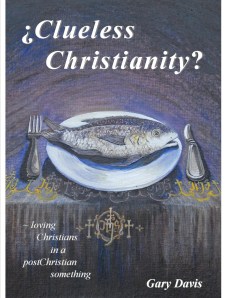
Clueless, Christianity, Christian, Book, Dr, Gary, DavisRethinking Thinking:

                                    the non-propositional nature of truth.

By now you’re probably thinking—

Okay, are you suggesting that the way Christians have thought about their faith for hundreds of years no longer fits this postmodern culture? And what about this non-propositional Truth stuff? This is getting more than a little weird.

Actually, Christians throughout history have articulated their faith differently, depending upon individual cultural setting. Some are more experiential than theological; some are more communally based than hierarchical; some have a minimal understanding of the theology of their faithbut hold a deep commitment to Christ in what they do know. So as we rethink the thinking about our faith in North American culture, we must to be careful to not create an historical assumption that things “have always been the same.” We must to be willing to reexamine our present-day view of the Christian faith and how it is expressed and understood. Over time I have learned to not be so attached to my words. I even joke about it— “Hey I could be wrong; I haven’t made my mistake for this year yet!” Nonetheless, to challenge the process of thinking does seem, even to me, a tad arrogant. I do so with a great sense of personal fear and large regret that a great era has gone and could be lost forever. The Modern Era has given the world so much—from consolidated nations [mostly], to incredible scientific discoveries and never imagined medical breakthroughs, to established theological constructs for our faith, to world trade, and to space exploration. During the Modern era the battle between religion and science won and lost, lost and won, on both sides.

….

Think about it—  If you updated this thinking and applied it to any religion, what you might find is a religion not entirely devoid of rational thought, but one where rational explanations of reality, took their proper place in back of actual experiences. It then interpreted them in light of religious thought, revelation, or tradition.[i]  For the past 350-500 years Western Christianity has been a reflection of modern, logical thought patterns. These thought patterns focused on “defending the faith,” debating the opposition, and developing a cohesive world-and-life view which overshadowed the vibrant work of God in our midst. We have raised the Bible to such a divine level as to virtually eclipse the God of the Bible with the words that tell us about him! The wine glass has replaced the glory of the Wine.

Please hear me out on this point. Evangelicals are “people of the Book,” we proudly proclaim. Not, mind you, that I am not a student of the Bible myself. It is the grass-roots of my faith sticking through my toes. It is the one, solely reliable source for Christians to learn about their faith, its foundations in Judaism, its founding, its history, and its implications for living before the God Who made us in this world He created. It is Truth revealed in writing. The Bible is no less, I repeat, than God telling us things He knew we would not be able to figure out from merely looking around. It sets forth the precepts, principles, and practice of what it means to truly be a follower of Jesus Christ. It is 66 individual books, letters, historical documents, collections of poetry, and future prophesies woven together over 4,000 years by 40 ± writers with one central theme— the redemption and fulfillment of the human race by the God who created us. That’s no small feat. The Bible’s internal consistencies, cohesiveness and congruency alone attest to its veracity. It is a book like no other ever written.

But as much as the Bible portrays the mighty works of God throughout history it is not the end-all of end-alls. When I was in college I majored in philosophy (duh). My specialization was language philosophy. I learned that, in any language, words have referents. That is, the word points to the object, the idea, the subject. It is NOT the object itself, it is the sign, the symbol, or the pictogram which represents the object. For example, when I say cow, your mind forms an image of the real thing. I do not know whether your mind’s cow is black, brown, Guernsey or what. That would require you to ask “What kind of cow?” But you would have the basic cow image-idea down pat. Applying this simple linguistic principle to the Bible, it can be stated that the Bible, with its historical sections, poetry, prophesies, and letters, is the tag that points us to God. It describes God for us; it clarifies His conditions for us to live on this planet, it sets forth His rules of protection for human relationships; it informs us of the consequences of our actions, here and later; it sets forth Truth as God defines it.

So, in one sense, the Bible, the Word of God, is the Truth; but in another sense it is only the Truth-Tag, the reference, the word, that points us all to the object of the Word— Jesus Christ, God Himself. “And the Word became flesh and dwelt among us.”[ii] In the modern era, with a common acceptance of logical-sequential thought, this simple observation was not particularly important; but in a postmodern era, where the logical process has moved from its basis in sequential word-tag-reference explanations of stuff to a basis in life-experience and our responses to them, this distinction becomes eminently critical. To the point, the nature of Truth itself is shifting from a rational/logical-sequential propositional-base to an individual-experience one.  Truth is moving from an exclusively propositional position to one that is far more personal, far more individualistic. NOT, as some would have us believe, a personal, individualistic rendition of reality; but, rather, a position reflective of one’s personality and preferences. Lost yet? This is important to grasp so hang on.

To keep reading, you can find the book on Amazon and Amazon Kindle.


[i] Applying postmodern thought to religion is not entirely precise. It is actually postmodern thought applied ONLY to Christianity. No other traditional religion (Islam, Hinduism, Budhism, Judism) would allow postmodern thought to be applied to it. They are not concerned with the effects postmodernism has on them as yet. They stand outside the circle of influence of the shift. Some retain their traditions fiercely; others simply hang in a sort of limbo, culturally. But their children will have some concern. There will be little difference between a postmodern Jew, Muslim, Budhist, or Hindu. Will there be that much distinction for the postmodern Christian? Hummmm.

[ii] John 1:14. NIV Bible.

My Preference – my Presc-ciousss!

Dr, Gary, Davis, Clueless, Christianity, NEEDinc, preferences, selfish, selfishness, precious, How much do personal preferences cause perennial problems between people?!? OK, the alliteration is iffy; but the issue it illuminates is a serious one. At times it seems that too many of us place our personal proclivities and preferences above the good of-the-many. It’s what I want that matters; not what you want. My desires come first.

Really?!?

Some of us just cannot seem to get along with anyone. Why? Because we refuse to cut any slack to anyone to who does not meet our standards of excellence; who will not see things any other way but their own; who refuse to admit that their personal preference is is only one way. They will not admit they could be wrong or that someone else might be right.

Really!?!

How dare we make our personal preferences the standard by which we judge everything else?!? So if you disagree with me, forgetaboutit. I need have nothing more to do with you.

Really?!?

NO ONE individual has all the strengths needed to master a craft, to complete a complex task, or to bring a dream or plan to fruition. We ALL need one another to make society, or family, or church, or business, work.

So can we lay aside our preferences and begin to build something together?!? Too many of us hoard our abilities and preferences like J.R.R Tolkien’s Gollum with his Presc-ciousss; his Ring-of-Power, which, in the end was the power that possessed him and destroyed him.

Far too often, our preferences take over our very core-values and destroy us. We believe that our way is the only right way, and we break friendships and commitments with those who feel otherwise. Some things, to be sure, are worth fighting for; but hanging onto our particular preferences is not one of them. True strength, true power, is the natural byproduct of people with different strengths, and preferences, coming together to build something greater.

Are up for that? Or would you rather hang on for dear life to your personal preferences…, your presc-ciousss?


Jus’ sayin’,

  Gary

I am a Christian

Dr, Gary, Davis, Clueless, Christian, Christianity, Maya Angelou, Carol, Wimmer,


While erroneously attributed to Maya Angelou, this poem speaks for itself.

When I say, “I am a Christian”
I’m not shouting, “I’ve been saved!”
I’m whispering, “I get lost sometimes
That’s why I chose this way”

When I say, “I am a Christian”
I don’t speak with human pride
I’m confessing that I stumble –
needing God to be my guide

When I say, “I am a Christian”
I’m not trying to be strong
I’m professing that I’m weak
and pray for strength to carry on

When I say, “I am a Christian”
I’m not bragging of success
I’m admitting that I’ve failed
and cannot ever pay the debt

When I say, “I am a Christian”
I don’t think I know it all
I submit to my confusion
asking humbly to be taught

When I say, “I am a Christian”
I’m not claiming to be perfect
My flaws are far too visible
but God believes I’m worth it

When I say, “I am a Christian”
I still feel the sting of pain
I have my share of heartache
which is why I seek God’s name

When I say, “I am a Christian”
I do not wish to judge
I have no authority
I only know I’m loved

Copyright 1988 Carol Wimmer

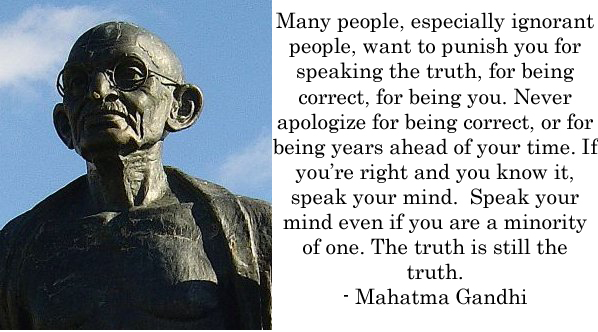
Speak your mind

Dr, Gary, Davis, Gandhi, speak up, truth, brave, courage, opinion, Clueless, Christianity, NEEDinc, Quasi anima tua?  Speak your mind! So few of us do. Those who know who they are do— cautiously, graciously. Those who are ignorant and uncouth do; usually with little thought to the effect their candor might have on others. Those who parade their arrogance about also speak their mind— what there is of it. Some, to be sure, have something to say and should speak their mind. I believe you are such a person.

But Truth, though difficult to hear or comprehend at times, especially in regard to science or religion, is oft composed of the most blatant, kindest words. To package it any other way would be to dilute it, to treat it as of little significance, or simply to dismiss it as inconsequential.

We at www.needinc.org and www.workingoutyourcrap.com, are purveyors of truth…, and Truth. We want to face the difficult issues of our time with bravery and humility, wisdom and wit, steadfastness and skepticism, openness and curiosity. WE are not afraid of what we might find: we look forward to the challenges to our beliefs and opinions. We hope you hold a few solid opinions and well thought-through beliefs as well. Listening to learn, to understand is always preferable to aiming nukes at each other, starting religious wars, or stereotypically scorning one another.

So please, PLEASE, post some comments on our WEBsites so more people can disagree with us. We don’t want to merely write BLOGS and Posts just to add to the verbosity of the WEB. Rather, we want to engage different minds, divergent opinions, and find people who are willing to make the effort to tell us how much they disagree with us. OR, it would be nice if some of you even liked us, actually agreed with us— and then commented on our sites. PLEASE!

I’m not usually a groveler; and I never suck-up to anyone to get recognition. NEVER! But I would kill to get your feedback! Not you, of course; because then how would you ever write any feedback for us. Oh, never mind! This is getting confusing.

Just SPEAK YOUR MIND! ON OUR WEBSITE! Or I’m coming to get you!

There now, don’t you feel better?  I do. J

With humility,

  Gary

Bring it!

Dr, Gary, Davis, attitude, failure, stubborn, Clueless, Christianity, NEEDinc, Really?  You want some a dis?  You want a piece of me?!? Bring it! Ah, the joys of the competitive brag! Nothing like it to spar some grand fisticuffs or a friendly challenge (or, not so friendly).

            Bring it! is also an expression used in business between definitely not-so-friendly rivals. People believe this kind of attitude will up the scales of productivity and competitive edge. Probably. Maybe. Or not.

            The point is that, for some of us, Bringing It is a way of live, an attitude of life. We like a good challenge. We rise to the occasion when someone says “We just can’t do that. It won’t work.” There is something built into our DNA that responds “Thank you.” And then we get about the business of making things work.

            But some of us have this attitude of— But what if I’m wrong? What if they’re right about me? What if I fail? Really?!? You’ll never know unless you try. As I said in my blog titled MY FAILURESIt’s taken most of my life, but I’ve finally perfected failure to an art-form. And I have learned from my failures. One of the greatest lessons I have learned is that FAILURE is simply an indication that I have not yet figured out what I am designed to DO best. So…, go for it…, again.

            The challenges we face in life span the diversity of graduating kindergarten to getting your first real job, from getting married to changing your first, ever, diaper, from discovering your passion to founding your first company. But these tests all have the same things in common— courage, risk, fear, determination, know how (except for the diaper thing) and commitment. Whether you believe in yourself or not, you will come to a point in life where you will make decisions that change everything. You will.

            If you shy away from these momentous moments you will admit defeat and settle for whatever comes your way. Do you really want to do that?

            Sometimes we all find ourselves in what is known as survival mode, survival mentality. Just get through this— the wedding, child-birth, the termination, a loss of income, the fear of being unknown. But to remain there is life-sucking suicide. You will still breathe the air and take up space; but that is about all. You will take what comes your way and remain there until you die. WOW! What a way to live!

            Might I instead suggest you look failure in the face, kick your courage into top gear, rise above your fear, and with a defiant voice cry out loud —

Bring it!

  Gary

Christians in North America

  • Clueless, Christianity, Christian, Book, Dr, Gary, DavisHow should Christians view their fellow North Americans? Taking all this into consideration, how should Christians in North America look at their society? To start, we need to remember that a great deal of our world has changed. Christians are no longer the dominant influence forming either political platforms or societal mores, however much they would like to be. To live as if this is not so would be to deny a new reality that has overtaken the Western World. There is little understanding of genuine Christian faith. Once this hits home it must affect how we view our friends, neighbors, and work associates.

At the very least, to relate to them in any way at all, we need first to BE in their world. That may sound like stating the obvious; most of us work in the marketplaces of life 5-6 days a week. But do we work there as Christians? In general, we do not, except maybe privately, secretly hiding our faith (out of fear?) because we might not know the answers to some of their questions. If we were more transparent about our faith, I dare say Christian influence would jump exponentially. Instead, we’ve become closet Christians in the living rooms of the world.  Many of us isolate ourselves within an evangelical or main line church world, venturing into “the world” as Christians, as infrequently as possible. We may work in this world, earn a living, raise our kids, shop for food and clothes, pump gas, go on vacations and vote for the candidate of our choice; we just don’t interface with the people we meet as transparent Christians—more as non-descript Christians, with little or no Christian definition or expression to our lives. This is not good. It is almost as if we are afraid of being identified as Christians; it is almost as if being “Christian” brands us with a kind of societal stigmata. And, to a great extent, given the revelations of recent “Christian” evangelists, preachers, and other leaders, there is some truth in this.

But what if we were REAL in our Christian faith; what if we talked casually about our faith, answers to prayer, and about the difficulties we have sometimes with our faith, our lives, or our church? What if we talked about being upset over something our kids did that infuriated us, or the inner embarrassment and frustration we feel over our divorce as a bad expression of our faith? What if we were REAL in our relationships with people? What do you think; is that okay? Is it okay to, dare I use the word, fail, in our life of faith sometimes? Dare we tell people who are not Christians about our failures? I tend to think that people who are not believers in Christ will find our transparency surprisingly refreshing. Why? Because they are looking for faith to be real, to reflect the way we all deal with the issues of everyday life. They are looking for a faith that reflects a real relationship with a real God who does something for people in the real world. They are looking for TRUTH to be reflected in the joys, struggles, failures and triumphs of everyday life. If it doesn’t do that, on what level are we living our Christian faith out anyway? Does your faith hang in a sort of limbo above the struggles and successes of everyday life, only to drop down to earth when you feel that the definition of something works? Come on, now… is that really your faith? To me, that’s excluding God from life so that we can feel good about what we’ve accomplished. Then, when things don’t work out, we turn on God as if he has failed us. Not goodagain.

Frankly, I find no replacement for genuine Christians, living transparently before their friends, neighbors, work associates, and relatives. I do not mean before their Christian friends, Christian neighbors, Christian work associates, and Christian relatives:  I mean the people who never darken the door of a church, who have never had a Christian thought. Don’t believe they’re not out there; don’t kid yourself. You just can’t see them; but they are there. We need to open our eyes to see the world around us in a new light—the light of the glory of Christ, clarifying our lives and opening a window to God in the lives of those who cannot see him. Oh, bye the bye, that window is YOU. So, if you’re NOT there, in their world, what do you think they see of God the Father? Get the point? For us to have any Christian effect on any of our friends the first thing we need to do is actually have friends who are not Christians. We need to cultivate friendships with the “normal” people around us. But we need to do so not as a set up for the presentation of some gospel outline, but so they will be able to see the God we love present in us in the daily issues of life. And, frankly, with all the advances in transportation, communication, medicine, technology, and the realigning of the residential/marketplace, it still comes down to people.  It comes down to Christians, walking along side of people, normal people, so they can see with their own eyes what real Christianity is all about.

New maps-Old roads

New Maps-Old Roads

Clueless, Christianity, Christian, Book, Dr, Gary, DavisMy last few months as a senior in college I worked as the Athletic Director for the local YMCA. Since it was a somewhat smaller Y, I was responsible for just about everything. But it did have one perk I had not quite counted upon—the summer tour! So, the summer between college days and my first year of grad school found me working as a swimming coach for the YMCA on tour throughout North America. Our team hit national and local parks and swimming clubs across the United States, Canada, and Mexico.  We competed with local outcroppings of the Y and anybody else who wanted to swim against us. One of the places we toured was Jackson Hole, Wyoming. Now, growing up as an inner city kid in Baltimore, MD, I could never have imagined a place so majestic, so alive, so grand. Jackson Hole got to me. I fell in love with the town, the people, and, of course, Grand Teton National Park. I vowed that I would return yearly!

For the most part I was able to do so, until the onslaught of kids eight years into our marriage. But in our early marriage Starr (my dangerous wife) and I made the 2,400 mile trek from the East Coast to the Tetons an annual pilgrimage. For a couple of years we tried to see if we could find my our way to Wyoming without ever opening a road map. I was guided by my heart, by my passion for the West, by my memory, and by a small piece of paper with route numbers. Yup, you got it, never missed a turn; well, okay, maybe a few where we had to back track.

Until, one day, the Wyoming Department of Roads put in a NEW road, then redirected and renamed the old ones. I was forced into unfamiliar territory. You guessed it; we got totally lost. Old roads now had new route numbers; and there were now new roads where before there had been only buffalo and antelope. Now I’m not one of these guys who is afraid to ask directions. By humorist Dave Barry’s standards I may not be a “real guy,” but at least I don’t stay lost long, either. I ask for help.  Saves time and frustration.

You need to do the same.  When you’re lost…, ask directions.

The point of this chapter is this— unless you are consciously living your life continually immersed within contemporary culture, you need help finding your way. It is harder to find your way when new roads overrun the old ones. Simply put, you need a new map. Your cultural map is out of date; you think the old route, but find new signs that make you go “HUH?” You’re on the wrong road, even though you want it to be the right one. What happened, you think?  You’ve been buffaloed (sorry, old Wyoming joke).

Like it? You can find the rest at Amazon. Available in Kindle and Paperback.

We’re not in Kansas anymore

We’ve decided to share some of my book with you. So on Thursdays, for the next few months, you get a taste of what I’ve written. Feel free to tell me what you think. Or click the link at the bottom and get the whole thing for yourself, and your Christian friends, who really need to hear this.

Clueless, Christianity, Christian, Book, Dr, Gary, DavisWe’re not in Kansas anymore.

Now think back with me for a bit.  In the 1939 movie The Wizard of Oz, two shifts took place; one revolutionized the film industry forever. The first shift stunned audiences as a modest black-and-white Dorothy (Judy Garland) was transformed into a living color Dorothy in the magical Land of Oz. There, she met the scarecrow, the tin-man and the lion, also in living color. The second shift slipped into the movie with a bit more subtlety. Dorothy’s first words, as she scanned the horizon of this strange new land called Oz were “I don’t think we’re in Kansas anymore, Toto!”  Truer words could not have been spoken. North American audiences were wowed at the vibrancy of color movies for the first time. And Dorothy’s scripted words heralded an era that would become prophecy fulfilled some 30 years later.

Look around you today and you find a world substantially different than the one you grew up in. Whether you grew up in the 60s, 70s or the 90s, or 00s the world has taken a turn around a corner that cannot be retraced. The last century saw two of the worst wars imaginable, a flu epidemic that annihilated 30,000,000 of the world’s population in 1918-1919, the nationalizing and unification of Europe, the rise and fall of Soviet Communism, the isolation of the great sleeping giant, China (and then its reintegration into the world economy at the turn of the last century), the proliferation of the automobile, and the introduction of mobile phones to the world’s teenagers. Politically, nationalism gaveway to global commerce and communication. In the field of art, reticent Impressionists succumbed to thedada influences. The century endedwith streaming video and a questionable reality— what IS real, in a new art form, FX movies like The Matrix. And we drove to see it in vehicles that the earlier 1900s could never have imagined.

Time did not stand still. To the contrary, technology accelerated it. From its humble beginnings in the mid 1940s government enclaves, to its wide spread popularization as Macs/Apples, and PCs in the early 80s, to its utility transformation, later woven into “the World Wide Web,” the personal computer overran not only the western world, but ALL of the world. Just as the automobile changed the way we worked and lived in the first decadesof the 1900s, so computerized communications have affected everything from national defense systems to personal privacy, to interpersonal (read cyber) relationships.

It’s a different world out there.  The way people think, talk, travel, communicate, eat, and live have all changed over the past 50 years, and especially within the last 20 years. Some things have definitely gotten better; nonetheless, something has been lost—a way of living, a paradigm of living has been lost.  Therefore…, this book. The title, Clueless Christianity, came to clarity as I reflected on our continuing (if not complete) inability to integrate our beliefs, faith practices, and Christian into the ever expanding pluralistic, and often antagonistic, culture around us.

Like it? You can find the rest at Amazon. Available in Kindle and Paperback.

Chicken in a Crock Pot – Who Knew?

Dr, Gary, Davis, Lydia, Chicken, Crock pot, Disability, wheelchair, cerebral palsy, help, Guest Blog, from http://lydslookonlife.wordpress.com

“How can I help?” Did you ever ask yourself this question when someone you love and care about is hurting? For you English teachers out there who are twitching a bit right about now and thinking, “It’s ‘How MAY I help’”, I know how you feel. I experience the same kind of twitching when I hear someone use a double negative – “I DON’T got NOTHING.” I really do ask myself, “How CAN I help?” because I am a person with a disability. I am a woman with cerebral palsy, my right side is weaker than my left and I use a wheelchair to get around. In my younger days, I was able to walk and cook and do all sorts of “independent living skills” which “normal” people enjoy doing and take for granted. In fact, I used to teach “independent living skills” at a private school for disabled children and adults. However, once I hit the “magic number” 50 and beyond, I have lost my ability to walk and stand for long periods of time. But, I have not lost the desire to help others in need.


I recently asked myself, “How can I help?” when my sister had to put her beloved dog to sleep, because he had lymphoma. For almost ten years, (the good) Damon was my sister’s shadow and walking companion. My sister’s grief penetrated my heart and became my grief. I wanted to do something and I wanted to figure it out myself and not ask her to figure out what I could do for her. That would only add to her burden.


I am a person who believes in God. I also believe in talking to God and asking Him for guidance and help. Most people call what I do prayer, if you want to be more descriptive about it, I am talking with God. After I talk to Him, I then wait for Him to answer me. I believe God does talk back, maybe not in an audible voice, but He does answer my “prayers.” Some may call it a “gut feeling” or an “epiphany” or plain old “common sense.” But, I believe God gave me a great idea. Why not make a whole chicken in a crock pot? What a brilliant idea! “Thanks God! I think I can do it with your help,” I said. I had made chicken in a crock pot once before years ago, but this time it would be a little trickier. Now I am in a wheelchair and can not stand for more than ten minutes at a time. Before Jane and her husband went on a long bike ride to “get away from it all” for a while, I told her I wanted to make her and her husband a chicken dinner and I just needed her to put my crock pot on the countertop next to the sink, and I also asked her if she had an onion and stalk of celery, because I was out. My sister lives right above me, in a two family house, so she came down with the onion and celery and moved my crock pot next to the sink. Before she left, she asked me if I was sure I wanted to do this. I said “Yes.” While she and her husband went biking, I “prayerfully” made “CHICKEN IN A POT” with the aid of a rolling cart. I was able to stand long enough to cut up the onion and celery, with a break in between, and I was able to get the chicken from the refrigerator to the sink and stand long enough to wash it and plop it in the crock pot. I used the “gizzards” to make chicken broth and used the rolling cart to get the broth from stove to the crock pot and the same with the “rustic” cut-up onion and celery. Everything went into the crock pot without any spillage, except for a few pieces of onion and celery. I turned on the crock pot and it was good to go. When my work was done, with “a wing and a prayer” (Actually, it was “a leg and a prayer, since I lifted the chicken by the leg from sink to pot). I thanked the Lord for His help and treated myself to the gizzards (I know. For some, eating boiled chicken gizzards is gross, but they are quite tasty.)


“CHICKEN IN A POT” Recipe


1 to 2 carrots, sliced (I didn’t have carrots)

1 to 2 onions, sliced

1 to 2 celery stocks, sliced

2 ½ to 3-pound whole broiler/fryer chicken

1  teaspoon salt [optional]

½ teaspoon course black pepper [or more]

½ cup water, chicken broth or white wine [save the wine to drink with the meal]

½ to 1 teaspoon basil


Put vegetables in bottom of CROCK POT. Add whole chicken. Top with salt, pepper, liquid. Sprinkle basil over top [I also added a few shakes of garlic powder]. Cover and cook on Low 8 to 10 hours. (High: 3 ½ to 5 hours, using 1 cup of liquid).


When Jane and Mark came home from their long bike ride, they came home to the pleasant aroma of chicken (comfort food) cooking downstairs. Jane cooked some rice and green beans and we all enjoyed eating a delicious chicken dinner. We had enough leftovers to make chicken soup and chicken salad.


After work the next day, Jane came down to see me and gave me a big hug. She told me that what I did for her, making that chicken, meant so much to her. She knew how much effort and energy it took for me to do what I did for her. She knew that her “good old sister” was back. You see, last year I suffered with clinical depression for about nine months, partly because of losing so much of my physical abilities and independence. After months of trying different medications and treatments and, yes, much prayer, I finally “found the old Lydia” again. My sister told me, when I made the chicken dinner for her, she knew her fun loving, caring sister was back, and that made her very happy.


Who knew? Personally, I believe God did.


“Do to others as you would have them do to you” (Luke 6:31, The Christian Bible).


(If you want to read more of my writing, check out http://lydslookonlife.wordpress.com.)


extent of our ignornace

Dr, Gary, Davis, Clueless, Christianity, NEEDinc, education, ignorance, books, reading, An early 2014 research study brought to light an intriguing commentary on life in these United States—

·         33% of High School graduates never read another book in their lives.

·         42% of College grads never read another book.

·         80% of US families did not buy or read a book in 2013.

·         57% of books are not read to completion.

·         70% of US adults have not been in a bookstore or searched for a book online in the last 5 years.

·         70% of all books published never earn a profit (mine being some of them).

            Based on these observations we might conclude that people in North America are becoming increasingly uninformed about the world around us; be that fictional, scientific, historical, or present day. On an educational level, Finland ranks #1. The United States ranks #22. Maybe it’s all that ice, sub-zero weather and tundra.

            Our ignorance is simply revealed in these questions—

·         Where were Shakespeare’s plays performed? (The Globe Theatre.)

·         Who is the President of Canada? (Trick question. Canada doesn’t have a president. Look it up.)

·         What is the latest theory about the creation of the Universe? (It created itself.)

·         When was Muammar Gaddafi President of Liberia? (He wasn’t; he was dictator of Libya.)

·         Who are your State Senators?

·         What was the tipping point of the Second World War? (D-Day, the capture of the German Enigma machine, the Battle of the Bulge. Your decision.)

            We are a nation where very few people are motivated to learn, to stay abreast of world events, or who have forgotten our own history. Thus Deconstructionism.  If we do not READ we will simply go with the predominate opinions/positions handed to us by our TV/Internet news media. And HISTORY? Who has time for it!?! I mean, whatever could History teach us?

            Our ignorance is not yet complete. But it is NEVER too late to challenge what’s trending.

For what it’s worth,

  Gary