
I Have the POWER!

Dr, Gary, Davis, Clueless, Christianity, Christian, He-man, He, Man, Power“I have the POWER!”—  When our son Joshua was very young he enjoyed watching a TV cartoon called HE-Man™, a hulky warrior type who fought to rid the universe of evil. He did so by cooperating with the ultimate source of power in the universe, taking it into himself through his really cool warrior’s sword. To gain access to this power, He-Man would stand on some high pinnacle and cry aloud “I have the power!” and a bolt of lightning would surge out of the air into his body through his up-stretched sword. Then he would go off to banish the world of its invaders. Our son Josh would mimic He-Man’s behavior by lifting his modern wooden-plank sword into the air while shouting “I have the power.”

Not incongruously, the Bible also compares the Word of God to a sword—  a two edged sword capable of dividing soul and spirit.

For the word of God is living and active. Sharper than any double-edged sword, it penetrates even to dividing soul and spirit, joints and marrow; it judges the thoughts and attitudes of the heart.[i]

But is it the Word of God, the Bible, or is it the Word of God, Jesus Christ to which this passage refers? Is it even important we know? The point is that the Word of God, propositional or personal, has power to clarify reality; it/He has the right to weigh our thoughts, our actions, and to exact judgment upon us.

But what if an individual doesn’t accept the Bible as the Word of God? What if the Bible’s assumptions about reality are not his/hers? Can the words of the Bible have impact on that person? That’s where the other side of Truth comes in— its personal side. It is the Person of Jesus Christ who brings life to an individual, not the Bible; it is the Person of Jesus Christ who empowers a person to turn to Him for life, not the Bible. Yet one influence cannot have sufficient affect without the other— Christ, the Word of God, empowers: the Bible, the Word of God, clarifies what has just taken place. If anything, the Christian life is about being empowered by God to live a life that is in keeping with the principles for life God has set down for us— the Bible.

So which came first, the chicken or the egg? No matter— have eggs for breakfast, chicken for dinner. You need both. (Personally, I like a little salsa with my eggs. Life needs a little spicing up.) And the Christian life, if not empowered by God, is reduced to mere words. Faith without spice. Religion without life. Life without spice— no way.

So on one hand we have the Bible, the propositional explanations of what God is doing everywhere. [Note— Written in stories, songs (Psalms), historical documents (Pentateuch, Prophets, Gospels), poetry, personal correspondence (Epistles), & summaries.]  On the other hand we have Jesus Christ, the embodiment of the Godhead here on earth; the Word becoming flesh, taking on human form. The two together can empower people to embrace intelligent, meaningful lives, contributing to the needs of the saints and healing the heartaches and pain of the world. We dare not merely distribute Bibles as if they will magically empower people to live God-honoring lives: we cannot subjectively will someone to experience the presence of Christ without some explanation as to what is going on inside them. We need both. But whereas faith without works is dead (doesn’t work) neither do explanations of Truth empower a person without the power and presence of the Person of Christ in their life. In the end, Truth is primarily embodied in the Person of Jesus Christ. But without the Bible shedding light on this reality the Truth cannot be known.

But there is yet one more ingredient to consider in our mix of Truth with life—  Passion!  Read on.
Clueless, Christianity, Christian, Book, Dr, Gary, Davis

[i] Hebrews 4:12, NIV Bible


Building Blocks

Dr, Gary, Davis, Christian, Clueless, Christianity, Building, Blocks, Build up, Most of us know the things that wear us down, that tear us down. Chronic car problems, an over-demanding boss, tension at home, “teenagers.” But what about the things that build us up? Being content one evening will not strengthen you for long:  turning in for the night with a sense of accomplishment, night after night, will do more for you than almost anything else imaginable.

So allow me to offer a list of some of the things that have, and still do, build me up-

1.      Accomplishment.

2.      Healthy relationships.

3.      Restoring broken relationships.

4.      One good, yea verily, great, friendship.

5.      Being loved.

6.      Loving someone.

7.      Sharing your pain with someone else.

8.      Crying.

9.      Resolving issues.

10.  Giving to others.

11.  Self-care.

12.  Admitting, and facing, your guilt and failures.

13.  Identifying and defining tightly that which fulfills your passion.

14.  A sense of purpose

15.  Time alone.

16.  Forming an open, transparent relationship with the God who made you.

17.  Times in deeper realities through prayer and imagination.

18.  Difficult situations.

19.  Difficult people.

20.  Working hard.

There are probably many more things that build me up, but one in particular I MUST mention or go unwisely amiss of any advice I might offer. Spending time, both quality & quantity, with my wife Starr Lynn Davis.

For what it’s worth,

  Gary

Rethinking Thinking

Clueless, Christianity, Christian, Book, Dr, Gary, DavisRethinking Thinking:

                                    the non-propositional nature of truth.

By now you’re probably thinking—

Okay, are you suggesting that the way Christians have thought about their faith for hundreds of years no longer fits this postmodern culture? And what about this non-propositional Truth stuff? This is getting more than a little weird.

Actually, Christians throughout history have articulated their faith differently, depending upon individual cultural setting. Some are more experiential than theological; some are more communally based than hierarchical; some have a minimal understanding of the theology of their faithbut hold a deep commitment to Christ in what they do know. So as we rethink the thinking about our faith in North American culture, we must to be careful to not create an historical assumption that things “have always been the same.” We must to be willing to reexamine our present-day view of the Christian faith and how it is expressed and understood. Over time I have learned to not be so attached to my words. I even joke about it— “Hey I could be wrong; I haven’t made my mistake for this year yet!” Nonetheless, to challenge the process of thinking does seem, even to me, a tad arrogant. I do so with a great sense of personal fear and large regret that a great era has gone and could be lost forever. The Modern Era has given the world so much—from consolidated nations [mostly], to incredible scientific discoveries and never imagined medical breakthroughs, to established theological constructs for our faith, to world trade, and to space exploration. During the Modern era the battle between religion and science won and lost, lost and won, on both sides.

….

Think about it—  If you updated this thinking and applied it to any religion, what you might find is a religion not entirely devoid of rational thought, but one where rational explanations of reality, took their proper place in back of actual experiences. It then interpreted them in light of religious thought, revelation, or tradition.[i]  For the past 350-500 years Western Christianity has been a reflection of modern, logical thought patterns. These thought patterns focused on “defending the faith,” debating the opposition, and developing a cohesive world-and-life view which overshadowed the vibrant work of God in our midst. We have raised the Bible to such a divine level as to virtually eclipse the God of the Bible with the words that tell us about him! The wine glass has replaced the glory of the Wine.

Please hear me out on this point. Evangelicals are “people of the Book,” we proudly proclaim. Not, mind you, that I am not a student of the Bible myself. It is the grass-roots of my faith sticking through my toes. It is the one, solely reliable source for Christians to learn about their faith, its foundations in Judaism, its founding, its history, and its implications for living before the God Who made us in this world He created. It is Truth revealed in writing. The Bible is no less, I repeat, than God telling us things He knew we would not be able to figure out from merely looking around. It sets forth the precepts, principles, and practice of what it means to truly be a follower of Jesus Christ. It is 66 individual books, letters, historical documents, collections of poetry, and future prophesies woven together over 4,000 years by 40 ± writers with one central theme— the redemption and fulfillment of the human race by the God who created us. That’s no small feat. The Bible’s internal consistencies, cohesiveness and congruency alone attest to its veracity. It is a book like no other ever written.

But as much as the Bible portrays the mighty works of God throughout history it is not the end-all of end-alls. When I was in college I majored in philosophy (duh). My specialization was language philosophy. I learned that, in any language, words have referents. That is, the word points to the object, the idea, the subject. It is NOT the object itself, it is the sign, the symbol, or the pictogram which represents the object. For example, when I say cow, your mind forms an image of the real thing. I do not know whether your mind’s cow is black, brown, Guernsey or what. That would require you to ask “What kind of cow?” But you would have the basic cow image-idea down pat. Applying this simple linguistic principle to the Bible, it can be stated that the Bible, with its historical sections, poetry, prophesies, and letters, is the tag that points us to God. It describes God for us; it clarifies His conditions for us to live on this planet, it sets forth His rules of protection for human relationships; it informs us of the consequences of our actions, here and later; it sets forth Truth as God defines it.

So, in one sense, the Bible, the Word of God, is the Truth; but in another sense it is only the Truth-Tag, the reference, the word, that points us all to the object of the Word— Jesus Christ, God Himself. “And the Word became flesh and dwelt among us.”[ii] In the modern era, with a common acceptance of logical-sequential thought, this simple observation was not particularly important; but in a postmodern era, where the logical process has moved from its basis in sequential word-tag-reference explanations of stuff to a basis in life-experience and our responses to them, this distinction becomes eminently critical. To the point, the nature of Truth itself is shifting from a rational/logical-sequential propositional-base to an individual-experience one.  Truth is moving from an exclusively propositional position to one that is far more personal, far more individualistic. NOT, as some would have us believe, a personal, individualistic rendition of reality; but, rather, a position reflective of one’s personality and preferences. Lost yet? This is important to grasp so hang on.

To keep reading, you can find the book on Amazon and Amazon Kindle.


[i] Applying postmodern thought to religion is not entirely precise. It is actually postmodern thought applied ONLY to Christianity. No other traditional religion (Islam, Hinduism, Budhism, Judism) would allow postmodern thought to be applied to it. They are not concerned with the effects postmodernism has on them as yet. They stand outside the circle of influence of the shift. Some retain their traditions fiercely; others simply hang in a sort of limbo, culturally. But their children will have some concern. There will be little difference between a postmodern Jew, Muslim, Budhist, or Hindu. Will there be that much distinction for the postmodern Christian? Hummmm.

[ii] John 1:14. NIV Bible.

My Preference – my Presc-ciousss!

Dr, Gary, Davis, Clueless, Christianity, NEEDinc, preferences, selfish, selfishness, precious, How much do personal preferences cause perennial problems between people?!? OK, the alliteration is iffy; but the issue it illuminates is a serious one. At times it seems that too many of us place our personal proclivities and preferences above the good of-the-many. It’s what I want that matters; not what you want. My desires come first.

Really?!?

Some of us just cannot seem to get along with anyone. Why? Because we refuse to cut any slack to anyone to who does not meet our standards of excellence; who will not see things any other way but their own; who refuse to admit that their personal preference is is only one way. They will not admit they could be wrong or that someone else might be right.

Really!?!

How dare we make our personal preferences the standard by which we judge everything else?!? So if you disagree with me, forgetaboutit. I need have nothing more to do with you.

Really?!?

NO ONE individual has all the strengths needed to master a craft, to complete a complex task, or to bring a dream or plan to fruition. We ALL need one another to make society, or family, or church, or business, work.

So can we lay aside our preferences and begin to build something together?!? Too many of us hoard our abilities and preferences like J.R.R Tolkien’s Gollum with his Presc-ciousss; his Ring-of-Power, which, in the end was the power that possessed him and destroyed him.

Far too often, our preferences take over our very core-values and destroy us. We believe that our way is the only right way, and we break friendships and commitments with those who feel otherwise. Some things, to be sure, are worth fighting for; but hanging onto our particular preferences is not one of them. True strength, true power, is the natural byproduct of people with different strengths, and preferences, coming together to build something greater.

Are up for that? Or would you rather hang on for dear life to your personal preferences…, your presc-ciousss?


Jus’ sayin’,

  Gary

Ripples

Dr, gary, Davis, Clueless, Christian, Christianity, effects, affected, relationshipsRemember sitting on a summer beach letting the water roll in— letting it wash over you in its salty brine? Did your eyes follow the surf as its ripples returned to the sea in currents and eddies? Never the same twice, but always the same ripples…, returning to the sea.

I often ponder the similarities between those ocean ripples and the effects I might have on another person. How do the ripples of my life choices affect the currents, the ebb and flow of the lives I touch? Hopefully, the way I live and relate with others builds them in their lives; hopefully, their lives start to reflect some of the same ripples that have trickled through my life.

For I am the result of countless friends, mentors, critiques, counselors, and even enemies. I have not been one to swim under the ripples that pushed toward me; rather, I have learned to flow with them, for a while, until I learn whatever lesson is carried by that ripple.

That being said, it must also be added that sometimes those ripples had to build to the level of a tsunami for me to ride along with it. We all fight the tides of life that threaten us, that want to push us off our course, and I was no exception. Now…, not so much. This has probably come from being churned up in the surf far too many times.

Whatever stage of life wherein you find yourself, whatever dire or laudable circumstance, you are making ripples for everyone you know. What kinds of ripples are you leaving in your wake? Do they buoy up a person, or just about drown them? Does your family enjoy and respect you, or fear your return from work? Do your employees see you as a hard task-master or someone who empowers them to greater performance and joyful sacrifice? As you meet passersby do you smile at them, or appear stern and even threatening?

You need to know the kinds of effects you have on the people that surround you. Is it building and uplifting, giving them the thrill of a surfer riding the waves? Or are your ripples more like the pounding surf in a hurricane, bringing destruction wherever its waves land?

The kinds of ripples you leave in your wake are your legacy to your family, your grandchildren, your community, and to this planet. Leave good ones! For what it’s worth,

  Gary

Insufficient Evidence

Dr, Gary, Davis, Needinc, Clueless, Christianity, Christian, beliefs, evidence, values, known, Let’s start by considering the opposite of insufficient evidence—namely, sufficient evidence. The question put to us is simple, “Would there be sufficient evidence to convict you of what you say you believe?” or, “What repercussions do your values have for the way you live?”

Certainly, Navy Seals can boast ample evidence that their actions bespeak of a deep belief in “God & country.”  (Their motto is Ready to lead…, ready to follow. Never quit.) People of deep religious faith generally could be convicted for their faith; there should be sufficient evidence. (If there is not…, well.) There is probably a Gallup survey that asks “To what extent do you follow through on your commitments?”

Yet in our Western, postChristian, pluralistic world there seems to be more of an inclination toward tentative commitments and cautious relationships. The fear of being known has regained unusual ground in a culture longing for safety. There has also been a rise in the fear of being wrong, or making the wrong choice or decision. Therefore, many of us never fully commit to anything. We have prenuptial agreements, escape clauses, termination parachutes, etc. We are a people who do not like to be pinned down or labeled; Christian, Republican, Conservative/Liberal, even male/female.

Part of the reason for our hesitation-to-commit is our fear of being hurt. It is our fear of being rejected from “the group,” or our insecurity stemming from our own historical observations that commitments are simply inconsequential. So why make them? We have fed this innate fear that, if we make a mistake we need to cover ourselves; we need to provide an escape route that will free us from the whole mess, the marriage, the contract, the bond. We fear being hurt so much that we don’t fully give ourselves to anything, or anyone, anymore. We always need to protect ourselves— a way OUT.

Therefore, we can never be pinned down on what we hold dear, what we value, or what we believe:  it’s just safer for us that way. Or is it?

Without sufficient evidence to hold us to any belief system or set of values we may have escaped the wrath of some other group. We may have avoided another deep heartache. But we have also demolished our own core. We have morphed its solidity for mush, its certainty for wishy-washy equivocation, which is about as inspiring as tan wallpaper.

If our leaders, and ourselves, do not hold positional beliefs and values strong and clear enough to convict us then who have we become? Insufficient evidenceis the descriptor of weaker men who do not want to be held accountable for their actions.

Let’s stand up and be counted—  even if it costs us our lives.

‘Nough said,

  Gary

I am a Christian

Dr, Gary, Davis, Clueless, Christian, Christianity, Maya Angelou, Carol, Wimmer,


While erroneously attributed to Maya Angelou, this poem speaks for itself.

When I say, “I am a Christian”
I’m not shouting, “I’ve been saved!”
I’m whispering, “I get lost sometimes
That’s why I chose this way”

When I say, “I am a Christian”
I don’t speak with human pride
I’m confessing that I stumble –
needing God to be my guide

When I say, “I am a Christian”
I’m not trying to be strong
I’m professing that I’m weak
and pray for strength to carry on

When I say, “I am a Christian”
I’m not bragging of success
I’m admitting that I’ve failed
and cannot ever pay the debt

When I say, “I am a Christian”
I don’t think I know it all
I submit to my confusion
asking humbly to be taught

When I say, “I am a Christian”
I’m not claiming to be perfect
My flaws are far too visible
but God believes I’m worth it

When I say, “I am a Christian”
I still feel the sting of pain
I have my share of heartache
which is why I seek God’s name

When I say, “I am a Christian”
I do not wish to judge
I have no authority
I only know I’m loved

Copyright 1988 Carol Wimmer

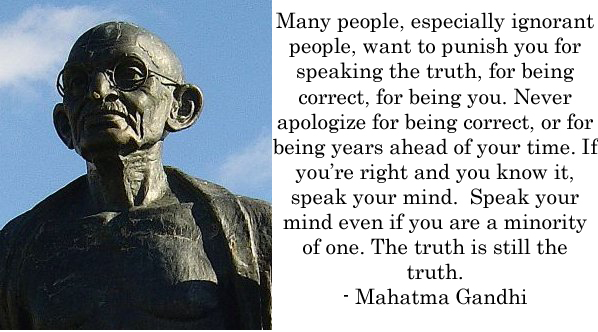
Speak your mind

Dr, Gary, Davis, Gandhi, speak up, truth, brave, courage, opinion, Clueless, Christianity, NEEDinc, Quasi anima tua?  Speak your mind! So few of us do. Those who know who they are do— cautiously, graciously. Those who are ignorant and uncouth do; usually with little thought to the effect their candor might have on others. Those who parade their arrogance about also speak their mind— what there is of it. Some, to be sure, have something to say and should speak their mind. I believe you are such a person.

But Truth, though difficult to hear or comprehend at times, especially in regard to science or religion, is oft composed of the most blatant, kindest words. To package it any other way would be to dilute it, to treat it as of little significance, or simply to dismiss it as inconsequential.

We at www.needinc.org and www.workingoutyourcrap.com, are purveyors of truth…, and Truth. We want to face the difficult issues of our time with bravery and humility, wisdom and wit, steadfastness and skepticism, openness and curiosity. WE are not afraid of what we might find: we look forward to the challenges to our beliefs and opinions. We hope you hold a few solid opinions and well thought-through beliefs as well. Listening to learn, to understand is always preferable to aiming nukes at each other, starting religious wars, or stereotypically scorning one another.

So please, PLEASE, post some comments on our WEBsites so more people can disagree with us. We don’t want to merely write BLOGS and Posts just to add to the verbosity of the WEB. Rather, we want to engage different minds, divergent opinions, and find people who are willing to make the effort to tell us how much they disagree with us. OR, it would be nice if some of you even liked us, actually agreed with us— and then commented on our sites. PLEASE!

I’m not usually a groveler; and I never suck-up to anyone to get recognition. NEVER! But I would kill to get your feedback! Not you, of course; because then how would you ever write any feedback for us. Oh, never mind! This is getting confusing.

Just SPEAK YOUR MIND! ON OUR WEBSITE! Or I’m coming to get you!

There now, don’t you feel better?  I do. J

With humility,

  Gary

Bring it!

Dr, Gary, Davis, attitude, failure, stubborn, Clueless, Christianity, NEEDinc, Really?  You want some a dis?  You want a piece of me?!? Bring it! Ah, the joys of the competitive brag! Nothing like it to spar some grand fisticuffs or a friendly challenge (or, not so friendly).

            Bring it! is also an expression used in business between definitely not-so-friendly rivals. People believe this kind of attitude will up the scales of productivity and competitive edge. Probably. Maybe. Or not.

            The point is that, for some of us, Bringing It is a way of live, an attitude of life. We like a good challenge. We rise to the occasion when someone says “We just can’t do that. It won’t work.” There is something built into our DNA that responds “Thank you.” And then we get about the business of making things work.

            But some of us have this attitude of— But what if I’m wrong? What if they’re right about me? What if I fail? Really?!? You’ll never know unless you try. As I said in my blog titled MY FAILURESIt’s taken most of my life, but I’ve finally perfected failure to an art-form. And I have learned from my failures. One of the greatest lessons I have learned is that FAILURE is simply an indication that I have not yet figured out what I am designed to DO best. So…, go for it…, again.

            The challenges we face in life span the diversity of graduating kindergarten to getting your first real job, from getting married to changing your first, ever, diaper, from discovering your passion to founding your first company. But these tests all have the same things in common— courage, risk, fear, determination, know how (except for the diaper thing) and commitment. Whether you believe in yourself or not, you will come to a point in life where you will make decisions that change everything. You will.

            If you shy away from these momentous moments you will admit defeat and settle for whatever comes your way. Do you really want to do that?

            Sometimes we all find ourselves in what is known as survival mode, survival mentality. Just get through this— the wedding, child-birth, the termination, a loss of income, the fear of being unknown. But to remain there is life-sucking suicide. You will still breathe the air and take up space; but that is about all. You will take what comes your way and remain there until you die. WOW! What a way to live!

            Might I instead suggest you look failure in the face, kick your courage into top gear, rise above your fear, and with a defiant voice cry out loud —

Bring it!

  Gary

My Failures

Dr, Gary, Davis, Clueless, Christianity, NEEDinc, failure, fail, grade Failure. “It’s taken me most of my life, but I think I have perfected FAILURE to an art form.” A great quote, isn’t it? Many of us try to hide our failures, believing that they will reveal that we are losers, incapable of finishing anything, of accomplishing anything of significance. Others have a deeply rooted fear of failure and so work themselves to death to be successful. Probably another group of us are content with being failures. It’s just too much effort to try anymore.

            The choices we make in life will determine whether we are successful, marginally successful, or, well, failures. Then again, it also depends on who is defining success, failure. Being a CEO of a Fortune 500 company with your 5th wife, with kids who don’t want to be around you is not much of a success in my book.

            Speaking of my book, I would like to reveal to my more pertinacious readers some of my failures.

1.      I failed in being a good dad to my kids when they were younger.

2.      I failed in being a good son to my dad.

3.      I failed to build the kinds of teams needed to expand the reach of NEED’s principles of communication-in-community to Christians who still do commando raids for Christ.

4.      I failed in living out the holiness God has already granted me.

5.      I failed in being a consistent, genuine Christian, often falling into being merely a nice one.

6.      I have frequently failed in humility, seeking my own ascent in place of lifting up others.

7.      I failed in resilience, settling for 2nd best, 3rd; or I’ve just given up, giving in to hopelessness.

8.      I failed in losing my temper 8-9 times in my life. Maybe that’s not too bad?

9.      I failed in admitting I was wrong too many times.

10.  I failed in many relationships, disappointing people and letting them down.

There are many more areas in which I’ve failed but I must limit this confession to one page for the sake of my readers. If you want, I can tell you more things I’ve done that are really terrible. Seriously.

If I can admit the things where I have failed, maybe you can to. Some things I’ve been able to correct and received forgiveness; others, not so much. But I do not dwell here: I press on, still failing, making colossal mistakes, and watching God make use of me nonetheless.

Pass/Fail? God have mercy,

  Gary