
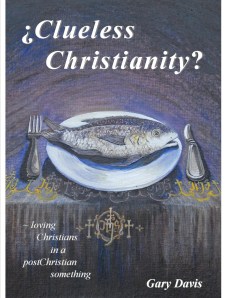
Rethinking Thinking

Clueless, Christianity, Christian, Book, Dr, Gary, DavisRethinking Thinking:

                                    the non-propositional nature of truth.

By now you’re probably thinking—

Okay, are you suggesting that the way Christians have thought about their faith for hundreds of years no longer fits this postmodern culture? And what about this non-propositional Truth stuff? This is getting more than a little weird.

Actually, Christians throughout history have articulated their faith differently, depending upon individual cultural setting. Some are more experiential than theological; some are more communally based than hierarchical; some have a minimal understanding of the theology of their faithbut hold a deep commitment to Christ in what they do know. So as we rethink the thinking about our faith in North American culture, we must to be careful to not create an historical assumption that things “have always been the same.” We must to be willing to reexamine our present-day view of the Christian faith and how it is expressed and understood. Over time I have learned to not be so attached to my words. I even joke about it— “Hey I could be wrong; I haven’t made my mistake for this year yet!” Nonetheless, to challenge the process of thinking does seem, even to me, a tad arrogant. I do so with a great sense of personal fear and large regret that a great era has gone and could be lost forever. The Modern Era has given the world so much—from consolidated nations [mostly], to incredible scientific discoveries and never imagined medical breakthroughs, to established theological constructs for our faith, to world trade, and to space exploration. During the Modern era the battle between religion and science won and lost, lost and won, on both sides.

….

Think about it—  If you updated this thinking and applied it to any religion, what you might find is a religion not entirely devoid of rational thought, but one where rational explanations of reality, took their proper place in back of actual experiences. It then interpreted them in light of religious thought, revelation, or tradition.[i]  For the past 350-500 years Western Christianity has been a reflection of modern, logical thought patterns. These thought patterns focused on “defending the faith,” debating the opposition, and developing a cohesive world-and-life view which overshadowed the vibrant work of God in our midst. We have raised the Bible to such a divine level as to virtually eclipse the God of the Bible with the words that tell us about him! The wine glass has replaced the glory of the Wine.

Please hear me out on this point. Evangelicals are “people of the Book,” we proudly proclaim. Not, mind you, that I am not a student of the Bible myself. It is the grass-roots of my faith sticking through my toes. It is the one, solely reliable source for Christians to learn about their faith, its foundations in Judaism, its founding, its history, and its implications for living before the God Who made us in this world He created. It is Truth revealed in writing. The Bible is no less, I repeat, than God telling us things He knew we would not be able to figure out from merely looking around. It sets forth the precepts, principles, and practice of what it means to truly be a follower of Jesus Christ. It is 66 individual books, letters, historical documents, collections of poetry, and future prophesies woven together over 4,000 years by 40 ± writers with one central theme— the redemption and fulfillment of the human race by the God who created us. That’s no small feat. The Bible’s internal consistencies, cohesiveness and congruency alone attest to its veracity. It is a book like no other ever written.

But as much as the Bible portrays the mighty works of God throughout history it is not the end-all of end-alls. When I was in college I majored in philosophy (duh). My specialization was language philosophy. I learned that, in any language, words have referents. That is, the word points to the object, the idea, the subject. It is NOT the object itself, it is the sign, the symbol, or the pictogram which represents the object. For example, when I say cow, your mind forms an image of the real thing. I do not know whether your mind’s cow is black, brown, Guernsey or what. That would require you to ask “What kind of cow?” But you would have the basic cow image-idea down pat. Applying this simple linguistic principle to the Bible, it can be stated that the Bible, with its historical sections, poetry, prophesies, and letters, is the tag that points us to God. It describes God for us; it clarifies His conditions for us to live on this planet, it sets forth His rules of protection for human relationships; it informs us of the consequences of our actions, here and later; it sets forth Truth as God defines it.

So, in one sense, the Bible, the Word of God, is the Truth; but in another sense it is only the Truth-Tag, the reference, the word, that points us all to the object of the Word— Jesus Christ, God Himself. “And the Word became flesh and dwelt among us.”[ii] In the modern era, with a common acceptance of logical-sequential thought, this simple observation was not particularly important; but in a postmodern era, where the logical process has moved from its basis in sequential word-tag-reference explanations of stuff to a basis in life-experience and our responses to them, this distinction becomes eminently critical. To the point, the nature of Truth itself is shifting from a rational/logical-sequential propositional-base to an individual-experience one.  Truth is moving from an exclusively propositional position to one that is far more personal, far more individualistic. NOT, as some would have us believe, a personal, individualistic rendition of reality; but, rather, a position reflective of one’s personality and preferences. Lost yet? This is important to grasp so hang on.

To keep reading, you can find the book on Amazon and Amazon Kindle.


[i] Applying postmodern thought to religion is not entirely precise. It is actually postmodern thought applied ONLY to Christianity. No other traditional religion (Islam, Hinduism, Budhism, Judism) would allow postmodern thought to be applied to it. They are not concerned with the effects postmodernism has on them as yet. They stand outside the circle of influence of the shift. Some retain their traditions fiercely; others simply hang in a sort of limbo, culturally. But their children will have some concern. There will be little difference between a postmodern Jew, Muslim, Budhist, or Hindu. Will there be that much distinction for the postmodern Christian? Hummmm.

[ii] John 1:14. NIV Bible.

Ripples

Dr, gary, Davis, Clueless, Christian, Christianity, effects, affected, relationshipsRemember sitting on a summer beach letting the water roll in— letting it wash over you in its salty brine? Did your eyes follow the surf as its ripples returned to the sea in currents and eddies? Never the same twice, but always the same ripples…, returning to the sea.

I often ponder the similarities between those ocean ripples and the effects I might have on another person. How do the ripples of my life choices affect the currents, the ebb and flow of the lives I touch? Hopefully, the way I live and relate with others builds them in their lives; hopefully, their lives start to reflect some of the same ripples that have trickled through my life.

For I am the result of countless friends, mentors, critiques, counselors, and even enemies. I have not been one to swim under the ripples that pushed toward me; rather, I have learned to flow with them, for a while, until I learn whatever lesson is carried by that ripple.

That being said, it must also be added that sometimes those ripples had to build to the level of a tsunami for me to ride along with it. We all fight the tides of life that threaten us, that want to push us off our course, and I was no exception. Now…, not so much. This has probably come from being churned up in the surf far too many times.

Whatever stage of life wherein you find yourself, whatever dire or laudable circumstance, you are making ripples for everyone you know. What kinds of ripples are you leaving in your wake? Do they buoy up a person, or just about drown them? Does your family enjoy and respect you, or fear your return from work? Do your employees see you as a hard task-master or someone who empowers them to greater performance and joyful sacrifice? As you meet passersby do you smile at them, or appear stern and even threatening?

You need to know the kinds of effects you have on the people that surround you. Is it building and uplifting, giving them the thrill of a surfer riding the waves? Or are your ripples more like the pounding surf in a hurricane, bringing destruction wherever its waves land?

The kinds of ripples you leave in your wake are your legacy to your family, your grandchildren, your community, and to this planet. Leave good ones! For what it’s worth,

  Gary

Insufficient Evidence

Dr, Gary, Davis, Needinc, Clueless, Christianity, Christian, beliefs, evidence, values, known, Let’s start by considering the opposite of insufficient evidence—namely, sufficient evidence. The question put to us is simple, “Would there be sufficient evidence to convict you of what you say you believe?” or, “What repercussions do your values have for the way you live?”

Certainly, Navy Seals can boast ample evidence that their actions bespeak of a deep belief in “God & country.”  (Their motto is Ready to lead…, ready to follow. Never quit.) People of deep religious faith generally could be convicted for their faith; there should be sufficient evidence. (If there is not…, well.) There is probably a Gallup survey that asks “To what extent do you follow through on your commitments?”

Yet in our Western, postChristian, pluralistic world there seems to be more of an inclination toward tentative commitments and cautious relationships. The fear of being known has regained unusual ground in a culture longing for safety. There has also been a rise in the fear of being wrong, or making the wrong choice or decision. Therefore, many of us never fully commit to anything. We have prenuptial agreements, escape clauses, termination parachutes, etc. We are a people who do not like to be pinned down or labeled; Christian, Republican, Conservative/Liberal, even male/female.

Part of the reason for our hesitation-to-commit is our fear of being hurt. It is our fear of being rejected from “the group,” or our insecurity stemming from our own historical observations that commitments are simply inconsequential. So why make them? We have fed this innate fear that, if we make a mistake we need to cover ourselves; we need to provide an escape route that will free us from the whole mess, the marriage, the contract, the bond. We fear being hurt so much that we don’t fully give ourselves to anything, or anyone, anymore. We always need to protect ourselves— a way OUT.

Therefore, we can never be pinned down on what we hold dear, what we value, or what we believe:  it’s just safer for us that way. Or is it?

Without sufficient evidence to hold us to any belief system or set of values we may have escaped the wrath of some other group. We may have avoided another deep heartache. But we have also demolished our own core. We have morphed its solidity for mush, its certainty for wishy-washy equivocation, which is about as inspiring as tan wallpaper.

If our leaders, and ourselves, do not hold positional beliefs and values strong and clear enough to convict us then who have we become? Insufficient evidenceis the descriptor of weaker men who do not want to be held accountable for their actions.

Let’s stand up and be counted—  even if it costs us our lives.

‘Nough said,

  Gary

I am a Christian

Dr, Gary, Davis, Clueless, Christian, Christianity, Maya Angelou, Carol, Wimmer,


While erroneously attributed to Maya Angelou, this poem speaks for itself.

When I say, “I am a Christian”
I’m not shouting, “I’ve been saved!”
I’m whispering, “I get lost sometimes
That’s why I chose this way”

When I say, “I am a Christian”
I don’t speak with human pride
I’m confessing that I stumble –
needing God to be my guide

When I say, “I am a Christian”
I’m not trying to be strong
I’m professing that I’m weak
and pray for strength to carry on

When I say, “I am a Christian”
I’m not bragging of success
I’m admitting that I’ve failed
and cannot ever pay the debt

When I say, “I am a Christian”
I don’t think I know it all
I submit to my confusion
asking humbly to be taught

When I say, “I am a Christian”
I’m not claiming to be perfect
My flaws are far too visible
but God believes I’m worth it

When I say, “I am a Christian”
I still feel the sting of pain
I have my share of heartache
which is why I seek God’s name

When I say, “I am a Christian”
I do not wish to judge
I have no authority
I only know I’m loved

Copyright 1988 Carol Wimmer

Ready-Fire-Aim

Clueless, Christianity, Christian, Book, Dr, Gary, DavisLife facts from 1902: things that make you go hummm.

  1. The average life expectancy in the US was forty-seven years.
  2. Only 14 Percent of the homes in the US had a bathtub.
  3. Only 8 percent of the homes had a telephone. A three-minute call from Denver to New York City cost eleven dollars.
  4. There were only 8,000 cars in the US and only 144 miles of paved roads.
  5. The average wage in the US was 22 cents an hour.
  6. The average US worker made between $200 and $400 per year.
  7. More than 95 percent of all births in the US took place at home.
  8. Ninety percent of all US physicians had no college education.
  9. Sugar cost four cents a pound. Eggs were fourteen cents a dozen. Coffee cost fifteen cents a pound.
  10. Most women only washed their hair once a month and used borax or egg yolks for shampoo.
  11. The five leading causes of death in the US were:

1)      Pneumonia and influenza

2)      Tuberculous

3)      Diarrhea (most likely from contaminated food)

4)      Heart Disease

5)      Stroke

  1. The population of Las Vegas, Nevada was 30 people.
  2. Crossword puzzles, canned beer, and iced tea hadn’t been invented.
  3. One in ten US adults couldn’t read or write. Only 6 percent of all Americans had graduated from high school.
  4. Marijuana, heroin, and morphine were available over the counter at corner drugstores. According to one pharmacist, “Heroin clears the complexion, gives buoyancy to the mind, regulates the stomach and the bowels, and is, in fact, a perfect guardian of health.”
  5. Eighteen percent of households in the US had at least one full-time servant or domestic.
  6. There were only about 230 reported murders in the entire US. [i]

So, given the religious fun & fancies of the last 10,000 years, not to mention the incredible innovations that have taken place in the last 100 years, the question we are facing on this postmodern/postChristian, text2text, family-redefining, iPoding, Wii-ing, touch-screen, Skyping globe is— Who are we? or— What are the definers of life and reality in a world (western culture, in this case) with so many value systems coexisting side by side?  In other words, how do we make sense of all the changes of the last years of the twentieth century and the few we have played with so far in the twenty-first?  That is what this chapter will address.

Let’s start with a metaphor from the early days of the wornderful world of computers. Can you say Ctrl+Alt+Del?[ii] You remember what that means, don’t you?  (Or not.) It’s an old computer key combination for releasing a hard drive freeze up, a crash, a lock up…, call it what you will; personally, I remember it as *&@#$ frustrating.  [Well, admit it. You feel it even if you don’t say it. It’s part of human nature to be frustrated by all things electronic.]  We’ve all experienced that irritating situation where we are working along, just like we always do, and, for whatever reason, our computer’s hard drive hits a wall, beyond which it will not work.  Ctrl+Alt+Del.  You have to REBOOT! And if you haven’t bothered to save your work, or exit your application, or backup your work, well, bye-bye!  Back to square one.

The point is that things don’t always work the way they are intended. [Perhaps Microsoft intends their operating systems to work like this, but probably not. (Why people buy Macs?] So much has changed in the world it requires a focused determination (or constant immersion) just to keep up. In the Western World (Europe, North America, parts of the Pacific Rim) the rate of change has accelerated to the point that we literally cannot keep up. For example, it used to be that if you ordered a computer from a distributor (DELL, GATEWAY, HP) by the time you paid it off it would be obsolete. Now, the joke goes (but not so far from the truth), that by the time it arrives it is obsolete. We are outpacing ourselves on a daily basis. The way we did something yesterday (made a phone call, turned on the TV, cooked dinner, “commuted” to work[iii]) is not the way we do it today.

In the mid-twentieth century products and goods were made to last; they could be counted on to be around for 5-10, even 15 years. They broke; you repaired them. Now it is use it & lose it. Material goods in the West are expendable; sometimes, so are the people. Company loyalty, holding onto your job, or having a single career for life have all been supplanted by upward mobility, “down-sizing,” farming jobs overseas, and multitalented entrepreneurialism (read “I want to do what I want to do.”).

For better or for worse, we have moved light-years past the modes of living at the turn of the nineteenth into the twentieth century. Imagine that world for a moment. Industrialization had taken over the cities, the family, and the father. Electricity was just becoming available to the masses. Most Americans used kerosene lamps for light.  The automobile was crowding out the horse and buggy. Train travel was the rapid transit of the day; subways and trolleys were uniting workplace and home with greater efficiency. Back on the farm even the earliest mechanization of planting and harvesting was revolutionizing the agricultural process. The massive expansion of North America’s roads enabled farmers to get their produce to more markets faster; the railroad transported goods and produce to yet further a-field markets, expanding trade and creating a hunger for exotic goods and tastes.  On a world scale, old tribal conflicts were replaced by a new sense of nationalism. Europe had solidified under national monarchs. And it seemed that those American states had finally made it as a world power, even after the bloodiest of Civil and territorial wars. The world seemed poised for the entry of the greatest century ever, the Twentieth Century! Most Americans were giddy with what they had been told the new century would bring— science and technology freeing ordinary people from the demands of physical labor. And what an exceptional a century it would be— both in greatness and in tragedy.


[i]  [http://www.goofball.com/jokes/facts/death_life_difference_The_Year_Is_1902

[ii] For you Mac/Apple Computer users, this is an unknown. You should be thankful you can utilize such a reliable CPU. Of course, having everything proprietary does limit one’s ability for diversification.

[iii] Commuting to work 1950-1960- take a bus. Commuting to work 1970- drive yourself. Commuting to work 1980- Car-pool it. Commuting to work 1990-2000- grab yourself a latte, sit down at your laptop, log-on… in your bunny slippers.

Christians in North America

  • Clueless, Christianity, Christian, Book, Dr, Gary, DavisHow should Christians view their fellow North Americans? Taking all this into consideration, how should Christians in North America look at their society? To start, we need to remember that a great deal of our world has changed. Christians are no longer the dominant influence forming either political platforms or societal mores, however much they would like to be. To live as if this is not so would be to deny a new reality that has overtaken the Western World. There is little understanding of genuine Christian faith. Once this hits home it must affect how we view our friends, neighbors, and work associates.

At the very least, to relate to them in any way at all, we need first to BE in their world. That may sound like stating the obvious; most of us work in the marketplaces of life 5-6 days a week. But do we work there as Christians? In general, we do not, except maybe privately, secretly hiding our faith (out of fear?) because we might not know the answers to some of their questions. If we were more transparent about our faith, I dare say Christian influence would jump exponentially. Instead, we’ve become closet Christians in the living rooms of the world.  Many of us isolate ourselves within an evangelical or main line church world, venturing into “the world” as Christians, as infrequently as possible. We may work in this world, earn a living, raise our kids, shop for food and clothes, pump gas, go on vacations and vote for the candidate of our choice; we just don’t interface with the people we meet as transparent Christians—more as non-descript Christians, with little or no Christian definition or expression to our lives. This is not good. It is almost as if we are afraid of being identified as Christians; it is almost as if being “Christian” brands us with a kind of societal stigmata. And, to a great extent, given the revelations of recent “Christian” evangelists, preachers, and other leaders, there is some truth in this.

But what if we were REAL in our Christian faith; what if we talked casually about our faith, answers to prayer, and about the difficulties we have sometimes with our faith, our lives, or our church? What if we talked about being upset over something our kids did that infuriated us, or the inner embarrassment and frustration we feel over our divorce as a bad expression of our faith? What if we were REAL in our relationships with people? What do you think; is that okay? Is it okay to, dare I use the word, fail, in our life of faith sometimes? Dare we tell people who are not Christians about our failures? I tend to think that people who are not believers in Christ will find our transparency surprisingly refreshing. Why? Because they are looking for faith to be real, to reflect the way we all deal with the issues of everyday life. They are looking for a faith that reflects a real relationship with a real God who does something for people in the real world. They are looking for TRUTH to be reflected in the joys, struggles, failures and triumphs of everyday life. If it doesn’t do that, on what level are we living our Christian faith out anyway? Does your faith hang in a sort of limbo above the struggles and successes of everyday life, only to drop down to earth when you feel that the definition of something works? Come on, now… is that really your faith? To me, that’s excluding God from life so that we can feel good about what we’ve accomplished. Then, when things don’t work out, we turn on God as if he has failed us. Not goodagain.

Frankly, I find no replacement for genuine Christians, living transparently before their friends, neighbors, work associates, and relatives. I do not mean before their Christian friends, Christian neighbors, Christian work associates, and Christian relatives:  I mean the people who never darken the door of a church, who have never had a Christian thought. Don’t believe they’re not out there; don’t kid yourself. You just can’t see them; but they are there. We need to open our eyes to see the world around us in a new light—the light of the glory of Christ, clarifying our lives and opening a window to God in the lives of those who cannot see him. Oh, bye the bye, that window is YOU. So, if you’re NOT there, in their world, what do you think they see of God the Father? Get the point? For us to have any Christian effect on any of our friends the first thing we need to do is actually have friends who are not Christians. We need to cultivate friendships with the “normal” people around us. But we need to do so not as a set up for the presentation of some gospel outline, but so they will be able to see the God we love present in us in the daily issues of life. And, frankly, with all the advances in transportation, communication, medicine, technology, and the realigning of the residential/marketplace, it still comes down to people.  It comes down to Christians, walking along side of people, normal people, so they can see with their own eyes what real Christianity is all about.

Playing God

Dr, Gary, Davis, Needinc, Clueless, Christianity, Christian, God, Playing, reality, pride, self-centered, atheist, beliefPlaying God. How many of us do this unconsciously every day of our lives. Of course, if you are an atheist, you cannot play; there is no one to impersonate. But if you are anything else you have probably wanted to be God in some situation or another. Sometimes, for the good—as in saving a life or preventing a disaster:  other times, for your own selfish control—you just want things to go your way. Everyone else be damned. This last reason is the most likely explanation why you are not God. You’re not that good at playing Him. It’s always too much all about you.

            Too many of us believe that playing God is about exerting absolute power over things. Some of the men I know try to do this in their immediate families with varying degrees of disastrous results. Fathers want to be dictators or drill sergeants, yelling out commands with unquestioned authority. Thank God He isn’t like that. To the contrary; he actually tells us what He wants from us, so there will be no question.  Psalm 51:16, 17 puts it best—

You do not delight in sacrifice, or I would bring it;

You do not take pleasure in burnt offerings.

The sacrifice you desire is a broken spirit.

You will not reject a broken and repentant heart, O God.

Basically, outward shows of worship do not compare in any way with an inner understanding of our place in the universe. But why broken?” Really?!? Do any of us truly need to ask? Our propensity to play God is only usurped by our arrogant assumption to become God, at least of our own little realm.

            So thus do we come to play God with everything and everyone around us. Our species has a natural proclivity to assert ourselves. We are restless. We cannot wait for definition or direction; we must determine our own direction with only a casual glance to the impression we may leave on this planet, in the universe, or on other creatures. It truly has become all about us.

            We become the God we reject and complain when others will not play the game our way. And so follows war, cultural degradation, family dissolution, and a re-writing (in many forms) of the internally inscribed moral-code; for there is no one left to constrain us…; but us.

            Really!

            Though I am but one man, one human, of one species among many, I do have a sense that I am part of something far greater than myself. And though I do dare to play god at times, in my own little universe, I am always mindful that I am but a small player in a grand scheme, designed by Someone much more omnipotent than myself.

            So the next time you are tempted to assert your manhood, or your womanhood, or your position or authority over another, do so from the perspective that you are no greater than the God of the Universe dares allow you: and prostrate yourself before Him. Next to me.

  Gary

paradigm blending

  • Clueless, Christianity, Christian, Book, Dr, Gary, DavisParadigm Blending— Let’s look at this era of paradigm blending[i] a bit.  One example of paradigm blending in our culture can be seen in the early 2001 movie SAVE THE LAST DANCE. Set in urban Chicago, Sarah is a young white girl who has lost her mother in a terrible auto accident.  She must now adjust to the hip-hop climate of a Black/Hispanic inner city culture. Sarah longed to be a ballerina and attend the Julliard School of Performing Arts.  Instead, she found herself struggling to learn the moves of hip-hop in a club called STEPS. Coming to her aid is Darrell, an intelligent, street-smart inner city,  black, fellow high school student who wants to be a surgeon. From Darrell, Sarah learns the intricatemoves of hip-hop. In the end, Sarah blends the moves of hip-hop with ballet training for a second Julliard audition that is truly incredible. Not surprisingly, Julliard accepts her.

Another surprise hit me in a 2003 visit to Macau, China. Once settled in my hotel room, I turned on the TV to find the Chinese (Portuguese, whatever) had their own version of MTV simply titled “V.” There, to my amazement, performed ENERGY, the hottest sensation representing American RAP music. (Again, go figure.) Paradigm blending at its finest!

  • Music ‘n Stuff— Drawing together all of the above, two strains have emerged throughout Western society that are bonding much of both genX and Millennial cultures.  They are music and consumerism. Through the rise of MTV and music videos a basic coupling, a paradigm blending, has taken place; sight and sound have joined to bring visual expression to what before was only audio. Before, people eitherread books, OR listened to music, OR watched TV.  Now, these three media resources have blended into a single image-experience that moves conscious-thought into the realm of experiential stimulation. Reading once called on the reader to create the images: TV and cinema now create them for you. Listening to music, once drew the listener to heights of glory in classical inspiration or excited the senses in a hype/jive rock ‘n roll beat.  No longer. Now, listening to music (on the radio, a CD, or through an MP3 device…, read iPOD) reminds you of the images in the video. People have begun to think in music; experiential blending has supplanted analytic thought. But Because music/visual images are beginning to replace mental assessment, it is also true that active analysis has given way to a more passive, music-reflective level of critical thinking (if you can even call it thinking); it is more like reactive thought versus proactive thought. Nonetheless, musical/visual reference points have displaced methodical, mental analysis.

Western music and video have permeated almost the entire world. All continents seem to be listening to common themes, and therefore mass-marketed ideologies, in music. Regional and national differences aside, there is now a worldwide homogeneity through music that is uniting a generation across national and even political boundaries. For example, in France, or the Netherlands, or Germany GenXers (who hate the self-definer) no longer think of themselves as French, or Dutch or German; they think of themselves as European.  Hey, the EURO, remember!?

The other glue that is uniting generations, and even continents, is stuff. STUFF, STUFF, and MORE STUFF. Our world is becoming a global village of STUFF— consumerism. What is the saying? He who dies with the most toys wins. I remember watching a man buy a Cadillac; he was smoking on a mondo-big Havana cigar while the car salesman counted out his $48,000 in $100 bills— CASH. STUFF. There is a woman whom I know is on welfare and Medicare. She lives in state subsidized housing. She goes to Florida for a month every January and has a ball. How do I know? Because she tapes it on her digital Camcorder and shows it to me on her 42” HD flat screen TV. If these two illustrations don’t convince you of western society’s lust for stuff allow me to point you to The Robb Report, December Issue. Every year it comes out with recommendations for the world’s most elaborate gifts— like a $485,000 watch, or a $1 million special edition Mercedes, or an $8 million dollar boat (boat?). But there are also items for poorer types (like me, or you); a $10,000 fountain pen, for example (ink-well included, of course).

You can find inner city “poor” teenagers in $250 Cross-Training Shoes, or a back-bush Maasai tribesmen with his iPAD wandering the bush. Australian singer Olivia Newton-John (played Sandy, opposite John Travolta in Grease) put it best in her 70s song NEVER ENOUGH…, O it’s never enough, simply never enough.  Why is all that we have simply never enough.

STUFF. Never enough. God help us all.


[i] Paradigm, paradigm blending. The terms paradigm, paradigm shift were popularized by Thomas Kuhn in his 1962 work The Structure of Scientific Revolution. A paradigm is a way of perceiving life. A paradigm shift is a change from one way of thinking or perceiving to another. A paradigm blending is a cultural phenomena where varying approaches to viewing life are intermingled to form a composite.

New maps-Old roads

New Maps-Old Roads

Clueless, Christianity, Christian, Book, Dr, Gary, DavisMy last few months as a senior in college I worked as the Athletic Director for the local YMCA. Since it was a somewhat smaller Y, I was responsible for just about everything. But it did have one perk I had not quite counted upon—the summer tour! So, the summer between college days and my first year of grad school found me working as a swimming coach for the YMCA on tour throughout North America. Our team hit national and local parks and swimming clubs across the United States, Canada, and Mexico.  We competed with local outcroppings of the Y and anybody else who wanted to swim against us. One of the places we toured was Jackson Hole, Wyoming. Now, growing up as an inner city kid in Baltimore, MD, I could never have imagined a place so majestic, so alive, so grand. Jackson Hole got to me. I fell in love with the town, the people, and, of course, Grand Teton National Park. I vowed that I would return yearly!

For the most part I was able to do so, until the onslaught of kids eight years into our marriage. But in our early marriage Starr (my dangerous wife) and I made the 2,400 mile trek from the East Coast to the Tetons an annual pilgrimage. For a couple of years we tried to see if we could find my our way to Wyoming without ever opening a road map. I was guided by my heart, by my passion for the West, by my memory, and by a small piece of paper with route numbers. Yup, you got it, never missed a turn; well, okay, maybe a few where we had to back track.

Until, one day, the Wyoming Department of Roads put in a NEW road, then redirected and renamed the old ones. I was forced into unfamiliar territory. You guessed it; we got totally lost. Old roads now had new route numbers; and there were now new roads where before there had been only buffalo and antelope. Now I’m not one of these guys who is afraid to ask directions. By humorist Dave Barry’s standards I may not be a “real guy,” but at least I don’t stay lost long, either. I ask for help.  Saves time and frustration.

You need to do the same.  When you’re lost…, ask directions.

The point of this chapter is this— unless you are consciously living your life continually immersed within contemporary culture, you need help finding your way. It is harder to find your way when new roads overrun the old ones. Simply put, you need a new map. Your cultural map is out of date; you think the old route, but find new signs that make you go “HUH?” You’re on the wrong road, even though you want it to be the right one. What happened, you think?  You’ve been buffaloed (sorry, old Wyoming joke).

Like it? You can find the rest at Amazon. Available in Kindle and Paperback.

Mystery & Mysticism


 Dr, Gary, Davis, Needinc, Clueless, Christianity, Christian, science, mystery, AweWe’re missing something in Western culture. We’ve lost a sense of awe of amazement, of wonderand reverence. We’ve settled for scientific discovery as a finding in the natural world, be they earth-bound or galactic. Though the scientists, biologists, geneticists, astronomers and medical researchers who uncovered them are far more thrilled than the rest of us, in general, outside the scientific community; we have come to accept discovery as commonplace— as if we have been doing this since the inception of the universe. Not so.

             Though the Ancients may have been visited by extra-terrestrial beings to start them along their path of technology, in more recent days, say the past 2,500 years, we have come to rely on innovation and invention. A rudimentary scientific method was initiated by Parmenides in the 5th century BCE. The “scientific method” as we know it, was formulated almost entirely by Galileo Galilei in the 16th century; his question-hypothesis-speculation provided us with an even more precise approach through which to screen and test our findings.

            Still, there is something missing. It is that sense of mystery when we gaze into the heavens. With the naked eye we cannot even see their end:  with a telescope, a little deeper; with the Hubble Telescope, deeper; a radio-telegraph, even deeper. Wouldn’t you think that measuring something 45,000,000,000,000 light years away might provoke a sense of awe onto the gazer? How far away is that, actually? Well, try this— http://scaleofuniverse.com/

If we could use the world’s largest electron microscope, the Large Hadron Collider at CERN, we would see the order and accident of the universe at a minutia level, far below the atomic level. Coupling the breadth of the universe with the order and accident at the 0.0000000001 yoctometric level (quantum foam & string theory stuff), it should be observably obvious that the universe, this earth, and our own bodies are very intricate entities.

But with these incredible measuring devices where is the mystery? Where is the awe and amazement? As science uncovers more of the complexity of our world, be it across the universe or within the electron of an atom, it seems, to this writer, that there is little probability of it all staying in balance through mere coincidence and chance. The survival of the fittest hypothesis seems just too simplistic.

Is it possible that the mystery and awe have been there all along? Just not discoverable with our measuring tools. Rather, it is within the human spirit, of which we all partake; but also for whom this universe was created. It has been said that God creates: we measure. Maybe our past mystical experiences were not merely flights of fancy after all; but rather explanations of what we had actually seen, yet not measured. Mysticism unmeasured.

If it turns out that We are what all of this is about, then there will truly be a time of celebration and rejoicing…, not to mention our great humility and contrition.

For what it’s worth,

Gary