
letting go…

So many different ingredients go into shaping our identity. Our place of origin, our class, life situation, our parents’ economic level, our peers, even our youngest memories, actions, and decisions, all blend into the mix that is us. In time they accumulate into a collective whole. For some, the God of the universe molds our clay to become a useful vessel in His hands. Yes, we do have a choice in the matter. But should we: and to what extent is it viable?

Good times become memories; friends form a part of our social fabric, another definer of our lives. Tragedies become memories too; that first girlfriend leaving you, the betrayal of a friend, the early loss of a parent. Being hit with the reality that we are not superman, not invincible, not the greatest & best at everything, not the center of the universe also goes into our collective psyche, further refining who we truly are, and not some projection of our imagination.

We hang onto these definers, both positive & negative, as a point of reference upon which we decide our future behavior, make our future decision, and define the “groove” of our lives. We settle in, based on how we arrived at this place in our journey. Ergo, we feel safe. Finally. Mostly. Sorta.

To be sure, there are some areas in our life which are best let go, we tend to hang onto those. Why? Because they provide a point of reference, a sense of safety, a history, memories. Healthy people move past the painful experiences, letting them go. They make their peace with the past. Others, not so much. Too many of us either live in the past where personal safety and happiness were part ‘n parcel to life. For them, moving forward, growing beyond, is too much of a risk.

Why do we seek to dwell in our memories and past experiences, even the great ones, when there is so much to discover around the corner, in a future full of possibilities? The good ol’ days just weren’t. We need to let go—of the hurt, the pain, and the what-could-have-been.

Letting go of anything is not often a simple matter.  But living in the past both robs us of great joy and elation in the present, and deprives us of our dreams for the future.

Let it go.

Have a nice week,

Gary
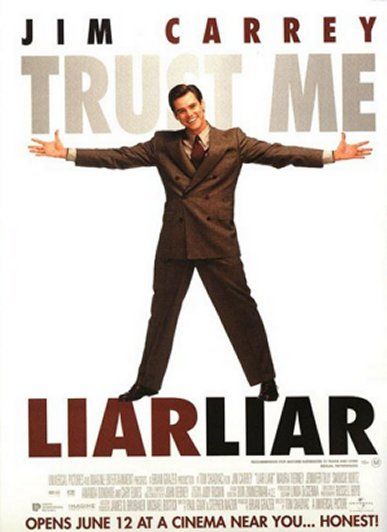
LiarLiar

Although Jim Carey may have visualized the oft repeated children’s jibe—

Liar, liar

Pants on fire;

Hangin’ on a telephone wire!

the origin of the taunt come from a paraphrased version of William Blake’s 1810 poem “The Liar.” The last stanza reads—

Deceiver, dissembler
Your trousers are alight
From what pole or gallows
Do they dangle in the night?

Nothing new under the sun? Humm.

It is both the plot of Carey’s film and Blake’s poem that are our focus today. The story line of LIARLIAR focuses on Fletcher Reede, (Carey), a defense attorney, whose son wishes on his birthday that his father can’t lie for a full day, 24 hours. Then his wish comes true. Now what problems might that create?  The focus of Blake’s poem surrounds the seriousness of lying and its consequences. The penalty being, hanging on a gallows above a bonfire…, roasting. Pleasant thought.

Both poem and play describe the difficulties created when a person lies profusely. In Blake’s six stanzas lying’s source (“…red devil of mendacity) is exposed as well as lying’s consequences (the pants on fire metaphor). Lying is, to be sure, hard to keep track of on a personal level. In the public eye, even though all of us lie on an individual basis, lying is forbidden. If disclosed, it can be a career destroyer, result in legal action, imprisonment, and, in some cases, execution.

But it is the movie LIARLIAR that poses an equally perplexing dilemma— not lying at all, even for a meager 24 hours. It confounds the mind to imagine living a life devoid of lies. Little white lies, tiny fibs, half-truths, diversions, redirecting from an uncomfortable question, distortions of truth, revealing things that enhance your position over another; variations on a theme. The odd thing is that most of us believe that our lies will never be exposed. On the simplest of levels this is both naïve and foolish.

The Lord Christ made a statement recorded in the Christian Scriptures that reads, “You shall know the truth and the truth shall set you free.” (John 8:32). In one sense that “truth” refers to Jesus himself. He is Truth. But in another sense it refers to freedom from trying to remember all the lies we have told. I realize that this may seem simplistic. Yet, forgiving unusual circumstances (hiding the innocent), might it actually make your life a tad less complicated? Isn’t it just simpler to tell the truth?

Have a nice week,

Gary

pizza…, extra cheese

Ever since this originally Greek delicacy was introduced to Italy it has shaped the world’s culinary cravings from China to South Africa. In the U.S. it became the staple food of both the American teenager and their families. Many people describe this circular meal as their personal comfort food. I am not one of them.

Still, there are times when just nothing will satiate the palate other than a piece of this chewy triangle. Sadly, having missed another lunch-time by a good three hours, I walked over to Antonio’s Pizza and stood in line to order a slice…, with extra cheese. And extra garlic sauce: and hot peppers. No one has come near me since. Hummm.

American life, in both the 20th and early 21st centuries, has become a cafeteria of choices. We can even get our pizzas with extra cheese. Yet up to one-third of our world has never even seen a pizza. They live far below the poverty level of most developed nations— Europe, Japan, Australia/New Zealand, North America, parts of South America, emerging China, and eastern Russia. Yet there are places on this planet which have never heard of pizza— nomadic China, nomadic Russia, Northern & Central Africa, the Indian Peninsula, and many isolated South Sea Islands.

So, you ask, What has this worldwide pizza-depravation to do with me? More than you might think. For starters, it raises a personal/global economic question. While we are deciding on extra cheese Why must a third of our world live on below $2.00 a day? Do the rest of the developed nations of the world need this de facto slave-population to maintain our life-style? Another question it raises is To what extent am I, individually, and our nation, corporately, responsible to raise their standard of living? Is ignorance (& poverty) really bliss? And what about the infant mortality rate? Or, the educational resources NOT made available to them? Are we no longer, proverbially, our brother’s keeper?!?

How can we turn a blind eye and do nothing to aid a third of our world’s desolation!?! To be sure, navigating the social-political landscapes, regional conflicts, the balance of world-trade, and the rights of peoples to govern themselves is a complicated mine-field. But it has to be traversed.

Let’s not leave the care of this world to the Bill Gates’ & Warren Buffets’, to the Peace Corp & the Red Cross, or to the volunteers working with Doctors without Walls, World Vision, and the countless Christian missionaries who have accomplished untold acts of heroism to bring peace, safety, and medical supplies to our world’s needy. Every one of us, who earn more than $2.00 a day, should be involved in saving our planet from systematically enslaving a third of its population.

Never mind, forget the extra cheese. Actually, forget the whole slice. I can wait ‘till dinner.

Have a nice week,

Gary

Simple Questions

Too often in life we believe there is a simple answer for everything. Some believe that the simplest answer is most probably the right one. And, in some cases, that is true. But the more we learn, as created beings, the more we discover that this created realm in which we live is far more wondrous and sophisticated than we ever could have imagined.

Take gravity, for example; before Einstein who would have imagined that is was due to the curvature of space?!? Or, that before Watson & Crick, all life is based on a double helix molecular strand, our Deoxyribonucleic acid (DNA), that encodes the development of all life? Or, that, before Howard Gardner, there were different forms of intelligence, not measurable by standardized IQ tests? (Visual Kinesthetic, for one.)

In studying human nature the jury is still out. Are we basically good, evil, or a mixture of both? Can our human nature change? Can our basic personality change? None of these are simple questions, nor do they have simple answers.

Nonetheless, we crave simple answers. Why? Because complicated, complex answers are too much work. We’ve become a people whose lives are so complicated and busy that having to deal with anymore complication is just too much! If the questions were simpleother people would already have provided the simple answers. The reality of the matter is— that for every complex, complicated question, there is a complex, complicated answer; which, sometime, can be boiled down to a v-e-r-y simple answer. Sometimes. Not all the time.

The point is that we need to face both the difficult, convoluted questions, as well as the ones that resolve simply. When we initially face them, how can we know which is which? Well, some questions scream complication. With other questions, the answer seems obvious. So do we give up when the simple answer turns out to have more facets than we originally thought? I would hope not. [Please note, though—this comes from a man who does not hesitate to ask for directions. After earning five graduate degrees I have come to understand just how little I know or understand.]

During my doctoral pursuit I was rewarded with this fortune cookie at Panda East—Nothing worthwhile is ever accomplished without passion. This seems a good axiom to follow when it comes to questions. Simple question: hard question. What difference does it make?!? It is all about discovering the riddles of life and the universe to make more sense of our own lives. What do we have to lose! Certainly not faith; faith is the energy we run on as we seek those answers we believe are out there, somewhere. Trust God. Dig in. Don’t give up.

Have a nice week,

Gary

Dante Alighieri- Vision of Hell

Dante Alighieri lived from 1265-1321. In a series of visions he penned his most serious and prestigious work- the Commedia. Fifty years later Italian author & poet Giovanni Boccaccio added the descriptor “Divina.” Dante’s work became known henceforth as The Divine Comedy: the vision of Paradise, Purgatory and Hell.

Dante penned this work somewhere between 1308 and his death in 1321. He first released it the Thursday before Good Friday, 1300. He started writing his Commedia when he was halfway through his life, 35 years old. Thus did he take stock of his life at this midway-point. His Commedia is not so much a recounting of his vision of heaven, purgatory, and hell as it is an allegory of humanity’s journey to God. He starts, quite reflectively, in Hades, Canto 1 where he observes how many of us go through phases of darkness

IN the midway of this our mortal life,
I found me in a gloomy wood, astray…

            Many of us go through phases of darkness. Some dark phases last forever, at least it seems that way. Dante Alighieri entered such a phase at mid-life as he pondered his future. He imagined himself passing through the three abodes of the dead, sequentially, from hell, through purgatory, and finally, entering his heavenly resting place. Though he was, in fact, describing all humanities spiritual journey, raising serious questions along the way.

There are many questions for which we each must find the answers. In Canto 1 Dante likens his wandering to being lost in a wildly savage forest… not far from death. He knows he needs help to find his way out of his sleepy dullness. He looks up from his valley to a mountain for someone to guide him though this phase of his life. Would we, in our postChristian mindset, even think to look for such a person? Would we recognize genuine answers to our questions if they came to us? Do we even know which phase of life we currently traverse? What looms in our future direction along this path? These are just a few of the queries for which we must discover answers.

If we do not seek these answers, we may forever wander in that forest, wild & savage. We might also not seek that One “Who leads all wanderers safe through every way.” (Canto 1, line 17)

Have a nice week,

Gary


fear of being known…, personalized

A little over three years ago I wrote an EMPulse on “Fear of Being Known.” [February 8, 2010, read it at www.needinc.org]. The original article delineated how confession is good for the soul, how placing confidence in God is a great substitute for self-confidence, and how hiding your true self from God is an absurdity. For you are known already, completely. Still, our fear of being known is nonetheless a daily reality for many of us. It roils just below the surface from deeper life experiences that cause us to cocoon, to hide within.

There are reasons, good reasons, we conceal ourselves.

  1. Catastrophe– Going through one or two cataclysmic events in our life that were so devastating that we build a wall around us for the rest of our lives. We no longer even consider the possibility of trusting certain types of people, maybe all people.
  2. Betrayal– Probably by more than one person. Betrayal is a disregard for another person’s trust and personhood. It denies me the safety I once enjoyed with you. It forges in me an a priori positioning of suspicion of any who tries to get too close. It is the loss of safety. It takes my vulnerability and uses it against me.
  3. For women, a Rejection of any Paternalistic Figure– Because of singular or repeated experiences with their father, some women fear the interest of any older man. This has been recently been reinforced in Western Culture through numerous reports of fathers using or abusing their daughters. The result in girls as they grow to womanhood is a wariness of all older men, some of whom who could have imparted healthier experiences to those who have been so deeply wounded by their fathers.  [n.b.- some women even have great difficulty thinking of GOD as “Father.” They carry too many memories of their own fathers.]
  4. For men, a constant Drive to Prove Myself– Whether because of a need-to-control father, or a absentee father, so many young boys grow to adulthood with little understanding of what true manhood is. We come to believe it is all about bravado, or sports, physical-prowess, or being strong. Within our spirits, we strive to be good enough, better than our fathers. So we repress any emotion that smacks of insecurity, uncertainty, or weakness. In essence, we live bifurcated lives— one which others see; the other, hidden deep within. The result is that, after a time, both sides of our life are diminished; we become less of a person.

In the long run, the results of these causes (there are more) are the same; a life of caution and tension that precludes professional potential and a personal sense of safety anywhere (even in marriage). Unless… unless, we face them with determined, transparent honesty. Given that these fears do not go away overnight, what can we do to lessen their effects on our growth?

  1. Living through a Catastrophe produces a kind of Post-Traumatic Stress Disorder in us. For some of us, there is no recovery. We live with the devastation our entire lives. But you could choose to attack the destruction head on: through professional counseling, talking with a deep friend (who will quickly become a deeper friend), or simply, or not so simply, by deciding to take a RISK and trust again. This is, by any understanding, no easy task. However you address the fear produced within, any external course of action will have to be pro-active. PTSD will simply not vanish on its own.
  2. Betrayal can only be overcome through, once again, a willingness to take a RISK: to put yourself out there, open up your vulnerability, and see what happens. As Charlie Brown (Peanuts comic strip) is oft quoted, “You will miss 100% of the shots you never take.” He has a point. Within your soul, you may also need to work on a deep level of personal forgiveness of those who betrayed you. They need never know of the turmoil they have caused you, but you must resolve their actions within your own heart and mind.
  3. The one characteristic women value most in the fathers is safety. Overcoming a fear of trusting older, paternalistic men can only be achieved through caution, trial & error, and facing the fears that binds you. Not all father-figures are threats; some are truly genuine and seek your best. Again, it comes down to trust and risk. You might gain more than you risk.
  4. Men, moving past a need to prove themselves is, likewise, no simple matter. You need to shift your core values. Your significance will need to come—
  5.  From the character qualities you nurture.
  6.  From the skills & interests you develop throughout your life.

Set expectations for yourself and meet them. (…and those of your employer.) Construct a measuring scale that fits your skills, gifting, and personal aspirations. Remember Charlie Brown (see above). Failure is merely an admission that you haven’t yet discovered your niche, your match of gifts & abilities with the professional and personal circumstances that surround you.

Fear of being known is just the beginning; that fear often spins off other fears within; truly, irrational fears. I am counseling a physicist in a another part of the world whose fears just keep snow-balling, one rolling off into another, and another. You need to address this fear of being known ASAP or it will eventually take over your entire being. If you have a choice between ongoing fear and fostering some degree of boldness, however small, go for the boldness.

Have a nice week,

Gary

tax day

April 15th. The Day of Reckoning. This is the day, in the United States, that government taxes are due on the last calendar year’s earnings. Of course, the real Day of Reckoning is Tax Freedom Day, the day when everything you earn is actually yours. Up until that day, everything you earn has actually been given (taken?) to the IRS. This year, that date is April 18thThree days after your taxes are due. There now, doesn’t that make you feel better?!?

In most ways taxes are good, sorta. They pave roads and build hospitals; they organize our national defense system (Army, Navy, Air Force, Marines, the Avengers). They pass judgment on what is good and right for our society and what is not good or wrong. They provide an infrastructure so our various peoples can get on with the business of their own individual, professional and family lives. And because of our belief in the basic nature of people, our government has even built in its own system of checks & balances with its Judicial, Legislative, and Executive branches, to restrain the spread of evil. Ergo…, we pay taxes.

This “Day of Reckoning” concept has been around since the dawn of time. The idea is that one day we will all have to give an account of what we have done with our time during our life-span on this earth. A societal reflection of this is seen in our laws; which are, supposedly, encoded with a higher moral code. In our present day there is little agreement on the source or nature of this “higher” moral encoding. But there remains a wide-spread corporate sense that one day, we will be held accountable for our actions, even by those who are not-sure of an afterlife or of a deity. Odd.

Personally, I prefer to err on the intentionality side-  living my life as if there actually were an afterlife and deity. Not that I am looking forward to any kind of reward for the life I have led; but I would sure like to avoid, at all costs, any kind of retribution for my actions.

I am under no illusion that I will simply run out my days on earth and that is that. Nothing more. That would be a serious, and erroneous, presupposition. Nonetheless, neither do I presume that I am somehow special and will be rewarded for my good life. That is up to God! Rather, I choose to prepare for this Day of Reckoning through a simple, action oriented maxim-

Honor God, honor people…, make a difference.

            Through this simple threefold imperative, I hope that I will bequeath to this world, my society, and my family, a better place to live.

For now, I’ve got to focus my attention on getting in my taxes and staying out of jail.

Have a nice week,

Gary

Barometer


Definition
: (Wikipedia)-

barometer is a scientific instrument used in meteorology to measure atmospheric pressure. Pressure tendency can forecast short term changes in the weather. Numerous measurements of air pressure are used within surface weather analysis to help find surface troughs, high pressure systems, and frontal boundaries.”

As a child I remember marveling at our family barometer’s magical ability to predict a change in the weather. How could it do that? What was this strange device mounted on a piece of oak right next to a nautical clock? Now, years later, I understand the principles on which these precious instruments perform their magic.

When I got my first barometer from my dad I soon learned that it was a has-been, a dead, beyond repair, beautiful brass object that I proudly hung on my wall above my dresser. I used to imagine that I could determine the weather with my own force of will. That didn’t quite work out. So at 13 I invented my own scenario that this strange device could somehow predict my future, usually involving my latest crush on some girl. That didn’t work out either.  Until later.

At 24, (yes, I still owned that shiny, wonderful barometer), I imagined that I could determine the seasons of my life with some degree of accuracy; again, through sheer force of will. Again, no cigar.

I still had not learned.

Since then, I have created my own Phasic-Barometric-Scrutinizer. It is unavailable for purchase as it is still in the initial beta-testing phase. But, to coax you into buying it when released ($19.95 + S&H), here are some of the scales it measures.

  1. Contribution– To what extent am I contributing to improvement of my fellow human being?
  2. Significance– Am I making a difference in the lives of those immediately around me? Family?
  3. Learning– to what extent have I stopped? What can I do to learn again, “to reinvent myself?”
  4. Passion– For what do I exert unrepressed passion (Besides the Red Sox.)? To what extent has my life’s lust for living gone flat?
  5. Productivity– A corollary of #1, am I making anything that matters? Writing, bridges, beautiful landscapes or works of art, life enhancing technology, or medical innovations?
  6. Spiritual Insights– To what extent do I understand God and his Universe better? Have I implemented any of his principles for living in my life?
  7. Relationships– How do I measure my inter-personal exchanges with individuals/groups? The PBS can help.
  8. Fulfillment– To what degree am I fulfilled in my life’s work, relationships and family experiences? What role does my personal happiness play?
  9. Life-Depth– How “deep” of a person am I? 1-10 scale—

Deeply contemplation————————living just on the surface?

      10.  Resurgence– To what degree am I able to recover after a fall, a disappointment, an attack on my personal self-esteem?

My goal is to have the Phasic-Barometric-Scrutinizer ready for market in the near future, providing funding. It will operate similarly to a Rubik’s Cube.

Have a nice week,

Gary

searching for eternity

Our world is such a fractured convolution of philosophies and religions. Through the catastrophes of the Twentieth Century many people have adopted a godless foundation. Amongst religious peoples factions and divisions have splintered; Islam, Christianity and Judaism. China is experiencing an expansion in both the Christian faith and animism. Science believes it is coming closer to uncovering the primal source of all life, of everything- the elusive Higgs-boson particle, the “God particle.”

Furthermore, worldwide, there is a heightened interest in finding both the source of all life, as well as verifying the existence of what comes next-eternity. To be sure, the majority of this earth’s peoples believe in an afterlife. For some, strict rules must be followed to enter eternity, the great beyond, the afterlife, heaven. For others, there is still a degree of doubt it even exists. For me, personally, proof for any life beyond this one escaped me for years. Now, not so much. Why? What follows is my list of evidence for the existence of God and His eternity.

1. The Theory of Compiled Coincidences- At one time our lawyer said to me, “You have once-in-a-lifetime experiences on a regular basis.” He was quite right. Too many things have happened to my wife and I that could only be attributed to a God in the heavens. Why? I’ll have to ask him. When I get into His heaven, that is.

2. The Existence of Death- Death just doesn’t fit life. We grow, are nurtured, learn skills, develop character, care for others, & serve our society. Then, it’s all over!?! It just doesn’t fit. There has to be something more, a life beyond this life. C.S. Lewis once commented, “If we find ourselves with a desire that nothing in this world can satisfy, the most probable explanation is that we were made for another world.” Reasonable?

3. World Religions- Humanity has gathered for worship of a deity (deities) since pre-recorded history. Archaeologists have uncovered cave drawings and artifacts of worship dating back as far as 70,000 BCE. [https://sharepoint.ocsarts.net/student/…pg 8-9] Though it was once believed clans formed for the sake of agriculture & protection, recent archaeological evidence has revealed that religious beliefs played an equal role in community formation.

4. Our sense of “something more”- This wonderment of something more comes in those times of uncertainty, maybe following the death of a loved one, a tragedy, or a near-death experience. We wonder about many things in these times; but why do we wonder about the possibility of something more…, something beyond what we can see, touch, hear, and taste?

5. Dr. Eben Alexander- Dr Alexander is a man of science, a neurosurgeon. By his own admission, though he claimed to be a Christian, it was in name only. Then, after a severe trauma in 2008, he plunged into a deep coma. There, he claims he went on a journey to heaven. Although neuroscience can explain many of the reactions of the brain while in a coma, there was no scientific explanation of Dr. Alexander’s images.http://www.thedailybeast.com/newsweek/2012/10/07/proof-of-heaven-a-doctor-s-experience-with-the-afterlife.html

Western science is a marvelous thing; but there are some realms where a scientist’s research and reasons are in over their heads. It postulates explanations with a certitude claiming, we just need a little more time. OR, might there be a totally different approach to which they are blind-sided?

In any case, I like my evidence for eternity, non-scientific though it might be. Maybe you have had experiences of eternity that science can explain away, given enough time. But I doubt it.

Have a nice week,

Gary

Lives Cut Short


Wars take a terrible toll on countries, peoples, families, and individuals. Too many young men & women sacrifice their lives for what they believe to be the right way, the way of their country and/or their God. No matter the winner of the conflict, the cost to both sides is immeasurable.

Presently, our planet finds itself in the midst of another world war; not of nation pitted abainst nation, but of beliefs pitted against beliefs, with small cells of extremists attacking established systems of governence. Lives will be lost, thousands of them, on both sides, as this war rages on. It is the kind of war that will go on for decades, leaving the victors in exhausted glory.

However, there is another kind of war that cuts short the lives of men. It is the war of identity-theft. Far too frequently we tie our identity to some acceptance matrix; to a job, to a discretionary activity (sports, parenting, music), to a particular relationship, in ownership of property (wealth, houses, cars). We define ourselves in terms of other things—a position, athleticism, intelligence, motherhood, performance, wealth, even other people.

Then something happens to rob us of the identity we tied to our job, family, friends, athletic ability, etc. It may be as minor as a broken ankle, as devastating as a divorce, or as simple as aging. And our world collapses. Whatever it was that gave us our identity is no longer there. We are at float in a sea lacking any clearly identifiable directions. Your life, as you knew it, has been cut short.

For some of us, that is it: that’s all she wrote. It’s over. Whatever comes next looms as insignificant compared to what we have just lost. How can there be any kind of future for me?!?

Some things to ponder—

  1. Consider that the original foundation for your identity may have been established on an inappropriate underpinning, be that people, place, property, wealth, or ability. Placing your self-definers in stuff, or people, is never a good idea. It all burns up in the end anyway. [FYI- I’ve grounded my identity in the God of the universe. So far, this has proven a very safe connection.]
  2. Your present “tragedy” could be just the incentive you need to re-examine your identity baseline. Don’t forgo the opportunity.
  3. Don’t stop living. Force yourself to dream about what could be next. On a personal note, there was a period in my life when I believed I had developed failure to an art-form. But I learned a lot how NOT to mess-up again.
  4. Be on the lookout for God’s little surprises. He has a way of dropping new friends into your life, of healing broken bodies, and of healing hurting hearts with new love.
  5. Try to rest. Take walks. Think out loud. Don’t give up! If you’re still breathing your life is NOT cut short yet.

Have a nice week,

Gary