I am a Christian

Dr, Gary, Davis, Clueless, Christian, Christianity, Maya Angelou, Carol, Wimmer,


While erroneously attributed to Maya Angelou, this poem speaks for itself.

When I say, “I am a Christian”
I’m not shouting, “I’ve been saved!”
I’m whispering, “I get lost sometimes
That’s why I chose this way”

When I say, “I am a Christian”
I don’t speak with human pride
I’m confessing that I stumble –
needing God to be my guide

When I say, “I am a Christian”
I’m not trying to be strong
I’m professing that I’m weak
and pray for strength to carry on

When I say, “I am a Christian”
I’m not bragging of success
I’m admitting that I’ve failed
and cannot ever pay the debt

When I say, “I am a Christian”
I don’t think I know it all
I submit to my confusion
asking humbly to be taught

When I say, “I am a Christian”
I’m not claiming to be perfect
My flaws are far too visible
but God believes I’m worth it

When I say, “I am a Christian”
I still feel the sting of pain
I have my share of heartache
which is why I seek God’s name

When I say, “I am a Christian”
I do not wish to judge
I have no authority
I only know I’m loved

Copyright 1988 Carol Wimmer

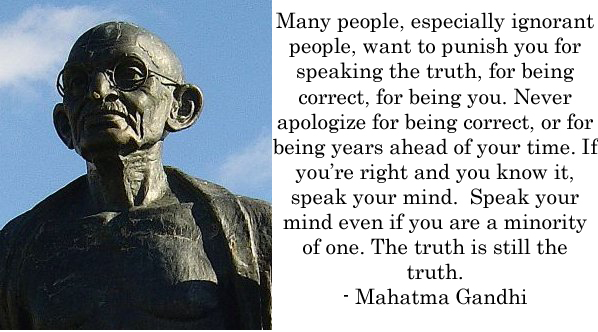
Speak your mind

Dr, Gary, Davis, Gandhi, speak up, truth, brave, courage, opinion, Clueless, Christianity, NEEDinc, Quasi anima tua?  Speak your mind! So few of us do. Those who know who they are do— cautiously, graciously. Those who are ignorant and uncouth do; usually with little thought to the effect their candor might have on others. Those who parade their arrogance about also speak their mind— what there is of it. Some, to be sure, have something to say and should speak their mind. I believe you are such a person.

But Truth, though difficult to hear or comprehend at times, especially in regard to science or religion, is oft composed of the most blatant, kindest words. To package it any other way would be to dilute it, to treat it as of little significance, or simply to dismiss it as inconsequential.

We at www.needinc.org and www.workingoutyourcrap.com, are purveyors of truth…, and Truth. We want to face the difficult issues of our time with bravery and humility, wisdom and wit, steadfastness and skepticism, openness and curiosity. WE are not afraid of what we might find: we look forward to the challenges to our beliefs and opinions. We hope you hold a few solid opinions and well thought-through beliefs as well. Listening to learn, to understand is always preferable to aiming nukes at each other, starting religious wars, or stereotypically scorning one another.

So please, PLEASE, post some comments on our WEBsites so more people can disagree with us. We don’t want to merely write BLOGS and Posts just to add to the verbosity of the WEB. Rather, we want to engage different minds, divergent opinions, and find people who are willing to make the effort to tell us how much they disagree with us. OR, it would be nice if some of you even liked us, actually agreed with us— and then commented on our sites. PLEASE!

I’m not usually a groveler; and I never suck-up to anyone to get recognition. NEVER! But I would kill to get your feedback! Not you, of course; because then how would you ever write any feedback for us. Oh, never mind! This is getting confusing.

Just SPEAK YOUR MIND! ON OUR WEBSITE! Or I’m coming to get you!

There now, don’t you feel better?  I do. J

With humility,

  Gary

Ready-Fire-Aim

Clueless, Christianity, Christian, Book, Dr, Gary, DavisLife facts from 1902: things that make you go hummm.

  1. The average life expectancy in the US was forty-seven years.
  2. Only 14 Percent of the homes in the US had a bathtub.
  3. Only 8 percent of the homes had a telephone. A three-minute call from Denver to New York City cost eleven dollars.
  4. There were only 8,000 cars in the US and only 144 miles of paved roads.
  5. The average wage in the US was 22 cents an hour.
  6. The average US worker made between $200 and $400 per year.
  7. More than 95 percent of all births in the US took place at home.
  8. Ninety percent of all US physicians had no college education.
  9. Sugar cost four cents a pound. Eggs were fourteen cents a dozen. Coffee cost fifteen cents a pound.
  10. Most women only washed their hair once a month and used borax or egg yolks for shampoo.
  11. The five leading causes of death in the US were:

1)      Pneumonia and influenza

2)      Tuberculous

3)      Diarrhea (most likely from contaminated food)

4)      Heart Disease

5)      Stroke

  1. The population of Las Vegas, Nevada was 30 people.
  2. Crossword puzzles, canned beer, and iced tea hadn’t been invented.
  3. One in ten US adults couldn’t read or write. Only 6 percent of all Americans had graduated from high school.
  4. Marijuana, heroin, and morphine were available over the counter at corner drugstores. According to one pharmacist, “Heroin clears the complexion, gives buoyancy to the mind, regulates the stomach and the bowels, and is, in fact, a perfect guardian of health.”
  5. Eighteen percent of households in the US had at least one full-time servant or domestic.
  6. There were only about 230 reported murders in the entire US. [i]

So, given the religious fun & fancies of the last 10,000 years, not to mention the incredible innovations that have taken place in the last 100 years, the question we are facing on this postmodern/postChristian, text2text, family-redefining, iPoding, Wii-ing, touch-screen, Skyping globe is— Who are we? or— What are the definers of life and reality in a world (western culture, in this case) with so many value systems coexisting side by side?  In other words, how do we make sense of all the changes of the last years of the twentieth century and the few we have played with so far in the twenty-first?  That is what this chapter will address.

Let’s start with a metaphor from the early days of the wornderful world of computers. Can you say Ctrl+Alt+Del?[ii] You remember what that means, don’t you?  (Or not.) It’s an old computer key combination for releasing a hard drive freeze up, a crash, a lock up…, call it what you will; personally, I remember it as *&@#$ frustrating.  [Well, admit it. You feel it even if you don’t say it. It’s part of human nature to be frustrated by all things electronic.]  We’ve all experienced that irritating situation where we are working along, just like we always do, and, for whatever reason, our computer’s hard drive hits a wall, beyond which it will not work.  Ctrl+Alt+Del.  You have to REBOOT! And if you haven’t bothered to save your work, or exit your application, or backup your work, well, bye-bye!  Back to square one.

The point is that things don’t always work the way they are intended. [Perhaps Microsoft intends their operating systems to work like this, but probably not. (Why people buy Macs?] So much has changed in the world it requires a focused determination (or constant immersion) just to keep up. In the Western World (Europe, North America, parts of the Pacific Rim) the rate of change has accelerated to the point that we literally cannot keep up. For example, it used to be that if you ordered a computer from a distributor (DELL, GATEWAY, HP) by the time you paid it off it would be obsolete. Now, the joke goes (but not so far from the truth), that by the time it arrives it is obsolete. We are outpacing ourselves on a daily basis. The way we did something yesterday (made a phone call, turned on the TV, cooked dinner, “commuted” to work[iii]) is not the way we do it today.

In the mid-twentieth century products and goods were made to last; they could be counted on to be around for 5-10, even 15 years. They broke; you repaired them. Now it is use it & lose it. Material goods in the West are expendable; sometimes, so are the people. Company loyalty, holding onto your job, or having a single career for life have all been supplanted by upward mobility, “down-sizing,” farming jobs overseas, and multitalented entrepreneurialism (read “I want to do what I want to do.”).

For better or for worse, we have moved light-years past the modes of living at the turn of the nineteenth into the twentieth century. Imagine that world for a moment. Industrialization had taken over the cities, the family, and the father. Electricity was just becoming available to the masses. Most Americans used kerosene lamps for light.  The automobile was crowding out the horse and buggy. Train travel was the rapid transit of the day; subways and trolleys were uniting workplace and home with greater efficiency. Back on the farm even the earliest mechanization of planting and harvesting was revolutionizing the agricultural process. The massive expansion of North America’s roads enabled farmers to get their produce to more markets faster; the railroad transported goods and produce to yet further a-field markets, expanding trade and creating a hunger for exotic goods and tastes.  On a world scale, old tribal conflicts were replaced by a new sense of nationalism. Europe had solidified under national monarchs. And it seemed that those American states had finally made it as a world power, even after the bloodiest of Civil and territorial wars. The world seemed poised for the entry of the greatest century ever, the Twentieth Century! Most Americans were giddy with what they had been told the new century would bring— science and technology freeing ordinary people from the demands of physical labor. And what an exceptional a century it would be— both in greatness and in tragedy.


[i]  [http://www.goofball.com/jokes/facts/death_life_difference_The_Year_Is_1902

[ii] For you Mac/Apple Computer users, this is an unknown. You should be thankful you can utilize such a reliable CPU. Of course, having everything proprietary does limit one’s ability for diversification.

[iii] Commuting to work 1950-1960- take a bus. Commuting to work 1970- drive yourself. Commuting to work 1980- Car-pool it. Commuting to work 1990-2000- grab yourself a latte, sit down at your laptop, log-on… in your bunny slippers.

Christians in North America

  • Clueless, Christianity, Christian, Book, Dr, Gary, DavisHow should Christians view their fellow North Americans? Taking all this into consideration, how should Christians in North America look at their society? To start, we need to remember that a great deal of our world has changed. Christians are no longer the dominant influence forming either political platforms or societal mores, however much they would like to be. To live as if this is not so would be to deny a new reality that has overtaken the Western World. There is little understanding of genuine Christian faith. Once this hits home it must affect how we view our friends, neighbors, and work associates.

At the very least, to relate to them in any way at all, we need first to BE in their world. That may sound like stating the obvious; most of us work in the marketplaces of life 5-6 days a week. But do we work there as Christians? In general, we do not, except maybe privately, secretly hiding our faith (out of fear?) because we might not know the answers to some of their questions. If we were more transparent about our faith, I dare say Christian influence would jump exponentially. Instead, we’ve become closet Christians in the living rooms of the world.  Many of us isolate ourselves within an evangelical or main line church world, venturing into “the world” as Christians, as infrequently as possible. We may work in this world, earn a living, raise our kids, shop for food and clothes, pump gas, go on vacations and vote for the candidate of our choice; we just don’t interface with the people we meet as transparent Christians—more as non-descript Christians, with little or no Christian definition or expression to our lives. This is not good. It is almost as if we are afraid of being identified as Christians; it is almost as if being “Christian” brands us with a kind of societal stigmata. And, to a great extent, given the revelations of recent “Christian” evangelists, preachers, and other leaders, there is some truth in this.

But what if we were REAL in our Christian faith; what if we talked casually about our faith, answers to prayer, and about the difficulties we have sometimes with our faith, our lives, or our church? What if we talked about being upset over something our kids did that infuriated us, or the inner embarrassment and frustration we feel over our divorce as a bad expression of our faith? What if we were REAL in our relationships with people? What do you think; is that okay? Is it okay to, dare I use the word, fail, in our life of faith sometimes? Dare we tell people who are not Christians about our failures? I tend to think that people who are not believers in Christ will find our transparency surprisingly refreshing. Why? Because they are looking for faith to be real, to reflect the way we all deal with the issues of everyday life. They are looking for a faith that reflects a real relationship with a real God who does something for people in the real world. They are looking for TRUTH to be reflected in the joys, struggles, failures and triumphs of everyday life. If it doesn’t do that, on what level are we living our Christian faith out anyway? Does your faith hang in a sort of limbo above the struggles and successes of everyday life, only to drop down to earth when you feel that the definition of something works? Come on, now… is that really your faith? To me, that’s excluding God from life so that we can feel good about what we’ve accomplished. Then, when things don’t work out, we turn on God as if he has failed us. Not goodagain.

Frankly, I find no replacement for genuine Christians, living transparently before their friends, neighbors, work associates, and relatives. I do not mean before their Christian friends, Christian neighbors, Christian work associates, and Christian relatives:  I mean the people who never darken the door of a church, who have never had a Christian thought. Don’t believe they’re not out there; don’t kid yourself. You just can’t see them; but they are there. We need to open our eyes to see the world around us in a new light—the light of the glory of Christ, clarifying our lives and opening a window to God in the lives of those who cannot see him. Oh, bye the bye, that window is YOU. So, if you’re NOT there, in their world, what do you think they see of God the Father? Get the point? For us to have any Christian effect on any of our friends the first thing we need to do is actually have friends who are not Christians. We need to cultivate friendships with the “normal” people around us. But we need to do so not as a set up for the presentation of some gospel outline, but so they will be able to see the God we love present in us in the daily issues of life. And, frankly, with all the advances in transportation, communication, medicine, technology, and the realigning of the residential/marketplace, it still comes down to people.  It comes down to Christians, walking along side of people, normal people, so they can see with their own eyes what real Christianity is all about.

paradigm blending

  • Clueless, Christianity, Christian, Book, Dr, Gary, DavisParadigm Blending— Let’s look at this era of paradigm blending[i] a bit.  One example of paradigm blending in our culture can be seen in the early 2001 movie SAVE THE LAST DANCE. Set in urban Chicago, Sarah is a young white girl who has lost her mother in a terrible auto accident.  She must now adjust to the hip-hop climate of a Black/Hispanic inner city culture. Sarah longed to be a ballerina and attend the Julliard School of Performing Arts.  Instead, she found herself struggling to learn the moves of hip-hop in a club called STEPS. Coming to her aid is Darrell, an intelligent, street-smart inner city,  black, fellow high school student who wants to be a surgeon. From Darrell, Sarah learns the intricatemoves of hip-hop. In the end, Sarah blends the moves of hip-hop with ballet training for a second Julliard audition that is truly incredible. Not surprisingly, Julliard accepts her.

Another surprise hit me in a 2003 visit to Macau, China. Once settled in my hotel room, I turned on the TV to find the Chinese (Portuguese, whatever) had their own version of MTV simply titled “V.” There, to my amazement, performed ENERGY, the hottest sensation representing American RAP music. (Again, go figure.) Paradigm blending at its finest!

  • Music ‘n Stuff— Drawing together all of the above, two strains have emerged throughout Western society that are bonding much of both genX and Millennial cultures.  They are music and consumerism. Through the rise of MTV and music videos a basic coupling, a paradigm blending, has taken place; sight and sound have joined to bring visual expression to what before was only audio. Before, people eitherread books, OR listened to music, OR watched TV.  Now, these three media resources have blended into a single image-experience that moves conscious-thought into the realm of experiential stimulation. Reading once called on the reader to create the images: TV and cinema now create them for you. Listening to music, once drew the listener to heights of glory in classical inspiration or excited the senses in a hype/jive rock ‘n roll beat.  No longer. Now, listening to music (on the radio, a CD, or through an MP3 device…, read iPOD) reminds you of the images in the video. People have begun to think in music; experiential blending has supplanted analytic thought. But Because music/visual images are beginning to replace mental assessment, it is also true that active analysis has given way to a more passive, music-reflective level of critical thinking (if you can even call it thinking); it is more like reactive thought versus proactive thought. Nonetheless, musical/visual reference points have displaced methodical, mental analysis.

Western music and video have permeated almost the entire world. All continents seem to be listening to common themes, and therefore mass-marketed ideologies, in music. Regional and national differences aside, there is now a worldwide homogeneity through music that is uniting a generation across national and even political boundaries. For example, in France, or the Netherlands, or Germany GenXers (who hate the self-definer) no longer think of themselves as French, or Dutch or German; they think of themselves as European.  Hey, the EURO, remember!?

The other glue that is uniting generations, and even continents, is stuff. STUFF, STUFF, and MORE STUFF. Our world is becoming a global village of STUFF— consumerism. What is the saying? He who dies with the most toys wins. I remember watching a man buy a Cadillac; he was smoking on a mondo-big Havana cigar while the car salesman counted out his $48,000 in $100 bills— CASH. STUFF. There is a woman whom I know is on welfare and Medicare. She lives in state subsidized housing. She goes to Florida for a month every January and has a ball. How do I know? Because she tapes it on her digital Camcorder and shows it to me on her 42” HD flat screen TV. If these two illustrations don’t convince you of western society’s lust for stuff allow me to point you to The Robb Report, December Issue. Every year it comes out with recommendations for the world’s most elaborate gifts— like a $485,000 watch, or a $1 million special edition Mercedes, or an $8 million dollar boat (boat?). But there are also items for poorer types (like me, or you); a $10,000 fountain pen, for example (ink-well included, of course).

You can find inner city “poor” teenagers in $250 Cross-Training Shoes, or a back-bush Maasai tribesmen with his iPAD wandering the bush. Australian singer Olivia Newton-John (played Sandy, opposite John Travolta in Grease) put it best in her 70s song NEVER ENOUGH…, O it’s never enough, simply never enough.  Why is all that we have simply never enough.

STUFF. Never enough. God help us all.


[i] Paradigm, paradigm blending. The terms paradigm, paradigm shift were popularized by Thomas Kuhn in his 1962 work The Structure of Scientific Revolution. A paradigm is a way of perceiving life. A paradigm shift is a change from one way of thinking or perceiving to another. A paradigm blending is a cultural phenomena where varying approaches to viewing life are intermingled to form a composite.

New maps-Old roads

New Maps-Old Roads

Clueless, Christianity, Christian, Book, Dr, Gary, DavisMy last few months as a senior in college I worked as the Athletic Director for the local YMCA. Since it was a somewhat smaller Y, I was responsible for just about everything. But it did have one perk I had not quite counted upon—the summer tour! So, the summer between college days and my first year of grad school found me working as a swimming coach for the YMCA on tour throughout North America. Our team hit national and local parks and swimming clubs across the United States, Canada, and Mexico.  We competed with local outcroppings of the Y and anybody else who wanted to swim against us. One of the places we toured was Jackson Hole, Wyoming. Now, growing up as an inner city kid in Baltimore, MD, I could never have imagined a place so majestic, so alive, so grand. Jackson Hole got to me. I fell in love with the town, the people, and, of course, Grand Teton National Park. I vowed that I would return yearly!

For the most part I was able to do so, until the onslaught of kids eight years into our marriage. But in our early marriage Starr (my dangerous wife) and I made the 2,400 mile trek from the East Coast to the Tetons an annual pilgrimage. For a couple of years we tried to see if we could find my our way to Wyoming without ever opening a road map. I was guided by my heart, by my passion for the West, by my memory, and by a small piece of paper with route numbers. Yup, you got it, never missed a turn; well, okay, maybe a few where we had to back track.

Until, one day, the Wyoming Department of Roads put in a NEW road, then redirected and renamed the old ones. I was forced into unfamiliar territory. You guessed it; we got totally lost. Old roads now had new route numbers; and there were now new roads where before there had been only buffalo and antelope. Now I’m not one of these guys who is afraid to ask directions. By humorist Dave Barry’s standards I may not be a “real guy,” but at least I don’t stay lost long, either. I ask for help.  Saves time and frustration.

You need to do the same.  When you’re lost…, ask directions.

The point of this chapter is this— unless you are consciously living your life continually immersed within contemporary culture, you need help finding your way. It is harder to find your way when new roads overrun the old ones. Simply put, you need a new map. Your cultural map is out of date; you think the old route, but find new signs that make you go “HUH?” You’re on the wrong road, even though you want it to be the right one. What happened, you think?  You’ve been buffaloed (sorry, old Wyoming joke).

Like it? You can find the rest at Amazon. Available in Kindle and Paperback.

We’re not in Kansas anymore

We’ve decided to share some of my book with you. So on Thursdays, for the next few months, you get a taste of what I’ve written. Feel free to tell me what you think. Or click the link at the bottom and get the whole thing for yourself, and your Christian friends, who really need to hear this.

Clueless, Christianity, Christian, Book, Dr, Gary, DavisWe’re not in Kansas anymore.

Now think back with me for a bit.  In the 1939 movie The Wizard of Oz, two shifts took place; one revolutionized the film industry forever. The first shift stunned audiences as a modest black-and-white Dorothy (Judy Garland) was transformed into a living color Dorothy in the magical Land of Oz. There, she met the scarecrow, the tin-man and the lion, also in living color. The second shift slipped into the movie with a bit more subtlety. Dorothy’s first words, as she scanned the horizon of this strange new land called Oz were “I don’t think we’re in Kansas anymore, Toto!”  Truer words could not have been spoken. North American audiences were wowed at the vibrancy of color movies for the first time. And Dorothy’s scripted words heralded an era that would become prophecy fulfilled some 30 years later.

Look around you today and you find a world substantially different than the one you grew up in. Whether you grew up in the 60s, 70s or the 90s, or 00s the world has taken a turn around a corner that cannot be retraced. The last century saw two of the worst wars imaginable, a flu epidemic that annihilated 30,000,000 of the world’s population in 1918-1919, the nationalizing and unification of Europe, the rise and fall of Soviet Communism, the isolation of the great sleeping giant, China (and then its reintegration into the world economy at the turn of the last century), the proliferation of the automobile, and the introduction of mobile phones to the world’s teenagers. Politically, nationalism gaveway to global commerce and communication. In the field of art, reticent Impressionists succumbed to thedada influences. The century endedwith streaming video and a questionable reality— what IS real, in a new art form, FX movies like The Matrix. And we drove to see it in vehicles that the earlier 1900s could never have imagined.

Time did not stand still. To the contrary, technology accelerated it. From its humble beginnings in the mid 1940s government enclaves, to its wide spread popularization as Macs/Apples, and PCs in the early 80s, to its utility transformation, later woven into “the World Wide Web,” the personal computer overran not only the western world, but ALL of the world. Just as the automobile changed the way we worked and lived in the first decadesof the 1900s, so computerized communications have affected everything from national defense systems to personal privacy, to interpersonal (read cyber) relationships.

It’s a different world out there.  The way people think, talk, travel, communicate, eat, and live have all changed over the past 50 years, and especially within the last 20 years. Some things have definitely gotten better; nonetheless, something has been lost—a way of living, a paradigm of living has been lost.  Therefore…, this book. The title, Clueless Christianity, came to clarity as I reflected on our continuing (if not complete) inability to integrate our beliefs, faith practices, and Christian into the ever expanding pluralistic, and often antagonistic, culture around us.

Like it? You can find the rest at Amazon. Available in Kindle and Paperback.

Chicken in a Crock Pot – Who Knew?

Dr, Gary, Davis, Lydia, Chicken, Crock pot, Disability, wheelchair, cerebral palsy, help, Guest Blog, from http://lydslookonlife.wordpress.com

“How can I help?” Did you ever ask yourself this question when someone you love and care about is hurting? For you English teachers out there who are twitching a bit right about now and thinking, “It’s ‘How MAY I help’”, I know how you feel. I experience the same kind of twitching when I hear someone use a double negative – “I DON’T got NOTHING.” I really do ask myself, “How CAN I help?” because I am a person with a disability. I am a woman with cerebral palsy, my right side is weaker than my left and I use a wheelchair to get around. In my younger days, I was able to walk and cook and do all sorts of “independent living skills” which “normal” people enjoy doing and take for granted. In fact, I used to teach “independent living skills” at a private school for disabled children and adults. However, once I hit the “magic number” 50 and beyond, I have lost my ability to walk and stand for long periods of time. But, I have not lost the desire to help others in need.


I recently asked myself, “How can I help?” when my sister had to put her beloved dog to sleep, because he had lymphoma. For almost ten years, (the good) Damon was my sister’s shadow and walking companion. My sister’s grief penetrated my heart and became my grief. I wanted to do something and I wanted to figure it out myself and not ask her to figure out what I could do for her. That would only add to her burden.


I am a person who believes in God. I also believe in talking to God and asking Him for guidance and help. Most people call what I do prayer, if you want to be more descriptive about it, I am talking with God. After I talk to Him, I then wait for Him to answer me. I believe God does talk back, maybe not in an audible voice, but He does answer my “prayers.” Some may call it a “gut feeling” or an “epiphany” or plain old “common sense.” But, I believe God gave me a great idea. Why not make a whole chicken in a crock pot? What a brilliant idea! “Thanks God! I think I can do it with your help,” I said. I had made chicken in a crock pot once before years ago, but this time it would be a little trickier. Now I am in a wheelchair and can not stand for more than ten minutes at a time. Before Jane and her husband went on a long bike ride to “get away from it all” for a while, I told her I wanted to make her and her husband a chicken dinner and I just needed her to put my crock pot on the countertop next to the sink, and I also asked her if she had an onion and stalk of celery, because I was out. My sister lives right above me, in a two family house, so she came down with the onion and celery and moved my crock pot next to the sink. Before she left, she asked me if I was sure I wanted to do this. I said “Yes.” While she and her husband went biking, I “prayerfully” made “CHICKEN IN A POT” with the aid of a rolling cart. I was able to stand long enough to cut up the onion and celery, with a break in between, and I was able to get the chicken from the refrigerator to the sink and stand long enough to wash it and plop it in the crock pot. I used the “gizzards” to make chicken broth and used the rolling cart to get the broth from stove to the crock pot and the same with the “rustic” cut-up onion and celery. Everything went into the crock pot without any spillage, except for a few pieces of onion and celery. I turned on the crock pot and it was good to go. When my work was done, with “a wing and a prayer” (Actually, it was “a leg and a prayer, since I lifted the chicken by the leg from sink to pot). I thanked the Lord for His help and treated myself to the gizzards (I know. For some, eating boiled chicken gizzards is gross, but they are quite tasty.)


“CHICKEN IN A POT” Recipe


1 to 2 carrots, sliced (I didn’t have carrots)

1 to 2 onions, sliced

1 to 2 celery stocks, sliced

2 ½ to 3-pound whole broiler/fryer chicken

1  teaspoon salt [optional]

½ teaspoon course black pepper [or more]

½ cup water, chicken broth or white wine [save the wine to drink with the meal]

½ to 1 teaspoon basil


Put vegetables in bottom of CROCK POT. Add whole chicken. Top with salt, pepper, liquid. Sprinkle basil over top [I also added a few shakes of garlic powder]. Cover and cook on Low 8 to 10 hours. (High: 3 ½ to 5 hours, using 1 cup of liquid).


When Jane and Mark came home from their long bike ride, they came home to the pleasant aroma of chicken (comfort food) cooking downstairs. Jane cooked some rice and green beans and we all enjoyed eating a delicious chicken dinner. We had enough leftovers to make chicken soup and chicken salad.


After work the next day, Jane came down to see me and gave me a big hug. She told me that what I did for her, making that chicken, meant so much to her. She knew how much effort and energy it took for me to do what I did for her. She knew that her “good old sister” was back. You see, last year I suffered with clinical depression for about nine months, partly because of losing so much of my physical abilities and independence. After months of trying different medications and treatments and, yes, much prayer, I finally “found the old Lydia” again. My sister told me, when I made the chicken dinner for her, she knew her fun loving, caring sister was back, and that made her very happy.


Who knew? Personally, I believe God did.


“Do to others as you would have them do to you” (Luke 6:31, The Christian Bible).


(If you want to read more of my writing, check out http://lydslookonlife.wordpress.com.)



St. Patrick, the man, not the myth


Sr, Gary, Davis, Clueless, Christian, St PatrickSaint Patrick
 (Latin: Patricius, Irish: Naomh Pádraig) was a Roman Britain-born Christian missionary and is the patron saint of Ireland along with Brigid of Kildare and Columba. When he was about sixteen he was captured by Irish raiders and taken as a slave to Ireland, where he lived for six years before escaping and returning to his family.

“He entered the church, as his father and grandfather had before him, becoming a deacon and a bishop. He later returned to Ireland as a missionary in the north and west of the island, but little is known about the places where he worked and no link can be made between Patrick and any [particular] church. By the eighth century he had become the patron saint of Ireland. The Irish monastery system evolved after the time of Patrick; but the Irish church did not develop the diocesan model that Patrick and other early missionaries had tried to establish. Uncritical acceptance of the Annals of Ulster would imply that he lived from 378 to 493, dying on March 17th, and ministered in modern day northern Ireland from 433 onwards.” (Wikipedia)

Patrick understood people; he understood Ireland. Instead of confronting the native Druid religion, Patrick incorporated their worship of the sun into the Christian faith as worship of the Son. He used their bonfire celebrations as part of the Easter celebrations. He used the ancient Druid symbol of Spring, the Shamrock, to explain the three Persons of the Trinity— Father, Son, and Holy Spirit. He endeavored to build a community of believers, a parish structure, rather than the pyramid hierarchical structure he had experienced in Rome.

Patrick knew the importance of blending the worship of Jesus Christ with the warp ‘n woof of daily life. He understood people have roots in their culture and communities…, and needed roots that would reach far deeper to the God who made them. So he brought Christ to them in a language and culture that they already knew.

So, when, and if, you reach out to God, try to do so in a way that is fitting with your culture, your language, in your community. You’ll be amazed at how well Jesus understands you already. You’ll still be Irish, or Ghanian, or Jewish…, but different.

Er-in go bragh (look it up.)

Gary

Giving up God for Lent

We are now 6 days into the Christian season of Lent. Coming down to us through the Greek “Tessarakoste,” meaning “fortieth,” it signifies the time of Christ’s 40 days of fasting in the wilderness. For Christians, it is supposed to be a time preparation through prayer, repentance, increased giving, and self-denial for the coming of Resurrection Sunday. Following the debauchery of what Mardi Gras (French for Fat Tuesday) has become, a time of fasting and sacrifice seems quite appropriate to prepare for the remembrance of Christ’s Passion. In the late Middle Ages the word Lent (meaning Spring) replaced the longer “fortieth” recollection, melding it with the heralding of approaching Spring.

Today, nominal Christians make token gestures at giving up something, usually trivial, to signify their sacrifice for Lent. Chocolate comes to mind. We certainly would not seriously sacrifice anything that would draw us closer to Christ; let alone further from this world’s pleasures.

Here’s a suggestion— Why not give up God for Lent?!?

If you are a casual Christian, one who maybe attends church at Christmas and/or Easter, the occasional wedding or mandatory funeral, this suggestion is easily grasped. For you, the Christian life is an addendum to the one you live out on this earth. Your faith has little to do with your life. You practice a convenient-faith, one that fits your needs and your priorities. What the God of the Universe offers you seems to come at too high a cost. When He says to you, “Give me everything you have; and I will give you everything I have.” you wonder if it is a fair trade.

Now, if you are a genuine Christian, with a deep faith, rooted in Christian community and the Holy Scriptures, this will prove most difficult. It will be veritably impossible. For you could no more think of turning your back on your Savior than serving another god. This suggestion should be most repugnant to you, if not near blasphemous. For true followers of Christ, the idea of sacrifice is already imbedded as a core value. Lent should be no different than any other time of the year.

So, if you are not a genuine follower of Christ, why not give up God for Lent?!? Frankly, why not give up on God altogether? It will affect your life neither one way nor another. OR…, you could use this Lenten Season to begin a new faith in God and humbly seek His favor. Sounds odd, doesn’t it? That we should seek the forgiveness and favor of One beyond ourselves.

What do you do to celebrate Christ’s crucifixion and resurrection?

For what it’s worth,

Gary