
“…-ish”

EmPulse for Week of November 8, 2010

“…-ish”

“He seemed a stately elderly man, 60ish.:” “The time? Oh, 2:30ish.” “No, we’re not together anymore. Really—I’m kind of single…ish.” “At his first day on the job he wore a suit that was quite stylish…, but not exactly.”

Isn’t it funny that we seem to have grown comfortable with a lack of precision in our common everyday exchanges?!? We certainly wouldn’t stand for that in the airline industry—“The plane is now refitted and basically safe(ish) for travel.” Auto safety is another area where we would not stand for –ish standards. Nuclear physicists, heart surgeons, architects, and astronauts are among some other people who would not base their work on –ish criterion. And the train system in the UK!?! There is no such thing as late, let alone late-ish : yet some of us settle for a lack of specificity in our lives and relationships with others. Why is that?

Too much work?     Lazy?     Mental down time?

Not important enough?      Safer?    Muddles definitions?

This –ishness has also come to permeate our critical thinking. Precision in thought, in formulating ideas, in constructing a philosophy of life (weltanschauung) seems more like a photograph of London in a deep midnight fog. Or is that morning fog in LA? Too many of us are content with never implementing an idea, resolving a relationship, or finishing a thought-sequence. It’s just too much work. Thus, over time, we become less(ish) by default.

ish now runs through every area of our culture— kinda-for-saleish, judgmentalish, sexually activeish, business savyish, politically cooperativeish. The suffix isn’t actually there, but it is implied. Even in defining our relationship with the God who made us, there is an –ishness to our description. We redefine how we want to relate to God in our terms rather, properly, on His terms. Since when did we set the perimeters and definers of how God Almighty is allowed to relate to the human race?!? This seems more than a sprinkling of arrogance of the dictum- man is the measure of all things. [Protagoras, pre-Socratic agnostic (490-420 bce)].

There is something to be said for tighter precision in our critical thinking, life philosophies, religious faith, business ethic, and personal moral choices, let alone in our airplanes and autos.

Hope you have a nice(ish) week.

Gary
inconsequential convictions

EmPulse for Week of November 1, 2010


inconsequential convictions

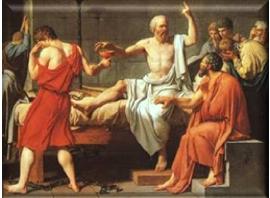
-Greek philosopher Socrates, age 70, abiding by the jury’s decision, carrying out his own execution for refusing to recognize the gods recognized by the State and for “corrupting” her youth (399 bce)

Why is it that so many of us commit our lives to a set of beliefs, a course of action, or a rich relationship and then act in a manner that absolutely cuts across the foundation of our commitments and convictions?!? We compromise, hedge a little, cut corners, shade the full truth, or cover the truth altogether. At other times some of us completely deny our basic life principles entirely. We pretend to be something we are not—rich, single, married, younger, older, confident, educated, smooth, players, etc. our so-called convictions bear little consequential weight when they are so glibly discarded.

Sticking to your convictions is very costly in a society where the bottom line and personal indulgences seem to govern so many of our decisions. Teen moral fiber is compromised throughout high school. Religious beliefs are strongly confronted during our college days. Honesty is called into question in the business world. Commitment is tempted in most marriages, even Christian ones. No matter who you are, what your faith or moral persuasion, you can count on everything you stand for being lured to the dark side in this society-without-consequence. Unless, of course, you give yourself over to the dark side freely; for you, then, convictions are merely momentary conventions. Truly, an intentional self-destructiveness.

What does it take to stick to your convictions in a post-moral culture?

1.      Being as certain of who you are as you can be, with the accompanying ability to adapt to the changing cultural climate without compromise of your convictions.

2.      The willingness to engage your critical thinking when investigating new ideas, emerging trends, or new life-narratives, without bias or prejudice. If your convictions are founded in real-reality they will stand firm. Being unwilling to consider new ideas or challenges to your convictions invariably weakens them. Do not be afraid.

3.      An openness to being wrong. If you must be right all the time you reveal an insecurity that will gnaw away at your soul and eventually consume your energies in proving yourself right. If you are right, it will become plain to all.

4.      A cohesive manifestation of your convictions throughout every aspect of your life. Convictions of consequence pervade a person’s character from dawn ‘till dusk, and then some. There is a unanimity to that person’s life that defies corruption and compromise all the way through.

5.      Intentional actions that make a difference. An intriguing quote is oft misattributed to Irish political philosopher, Edmund Burke (1729-1797) [More likely from Sergei Bondarchuk’s Russian film adaptation of Leo Tolstoy’s WAR AND PEACE.]  “All that is necessary for the triumph of evil is that good men do nothing.” Yet the bell rings true for anyone who has put their neck on the line to genuinely live by their convictions and contribute to the needs of others, the improvement of their society, and to the victims of injustice and neglect of this world.

6.      Wisdom to know what is worth fighting for and what is not, when to fight and when to retreat, when to stand firm and when to walk away.

Please, live by your convictions, consistently, honestly and as openly as is safe. Inconsequential convictions will only lead to your untrustworthiness and eventual marginalization from your society.


Have a nice week.

Gary

coffee

Dr, Gary, Davis, Needinc, Clueless, Christianity, Christian, coffee, I don’t need coffee. Really, I don’t. I like coffee—good coffee, that is; but I don’t need it. I merely enjoy a mug of good coffee every day. Usually two. JUST WHAT DON’T YOU UNDERSTAND ABOUT WHAT I AM SAYING!?! Ok, so I fear to talk with God (or anyone else) without at least two mugs in me, that doesn’t mean that I’m dependent on it! Does it?

The caffeine in coffee is a stimulant. Surprisingly, there are 115-175 mg of caffeine in every cup of drip coffee, versus 100 mg in a cup of espresso. Hum. There are also antioxidants that aid in preventing liver cancer and other diseases. The coffee bean (or seed) is grown in over 175 countries around the world, making coffee one of the most traded commodities in the world. Most people drink coffee for the quick energy boost it provides. Others, drink it as a cultural practice, or as a moral responsibility. However you see it, coffee seems here to stay as both a stimulant and as a means for social networking.

In recent years there have been a number of spin-offs from coffee to further enhance our stimulation. Ice coffee, lattes, espressos, caramel macchiatos, and even coffee lozenges; stimulation without the social dynamic, as it were. But our need for external stimulation doesn’t end there. We also have Gatorade, Red Bull, and Power drinks, all loaded with enough salt and/or sugars to fuel your adrenalin-rush to reach earth orbit. Exercise (running especially) does the trick for others. But most of us just chug down yet another mug o’ joe to keep going for yet another hour.

It’s almost as if we have all become addicted to adrenalin-rush. Do our lives feel so flat that we need that little extra “umph” to lift our spirits and improve our performance? So, other than coffee (the elixir of the gods), what kinds of things stimulate you to that enhanced life you crave? Sex, drugs, rock ‘n roll? Extreme sports? Speed (automotive)? Compassion for our world’s dismissed peoples? The will to win, to be the best you can be? To please God? To serve your country, your family, your faith? Or just to be independent and depend on no one else… ever.

After a time, many of us slowly seep into a kind of unconscious humdrum of life’s responsibilities. We are blind to the vibrant colors of the sunset over the deep green of a forest. All we see are all the trees that need to be cleared. It becomes simpler to look down at what we’re doing than to lift our eyes to the road ahead; and so we lose our way in the everyday. Stimulation, therefore, plays an important role in our lives…, but maybe from a different class. JOY lifts our hearts. LOVE makes us fly. TRAGEDY teaches us the importance of the little things— of caring, of spending time, of reexamining our priorities and interpersonal relationships. PRAISE kindles our resolve…, & pats us on the back a little. GOING FOR IT teaches us endurance and perseverance. PAIN reminds us or our frailty. FAILURE reminds us we need others. FEAR reminds us we need God.

So after you’ve had your third cup of java today, try one of the other kinds of stimulant in your life. I use PRAYER to realign focus. And MUSIC.  But right now I could really use another Latte.

Have a nice week.

Gary

Why not go out on a limb…

Why not go out on a limb…

One of the most clever insights I’ve ever heard comes from the usually sardonic lips of one Samuel Clemens (a.k.a.- Mark Twain). Why not go out on a limb!?! That’s where the fruit is. It truly speaks to the human dilemma— anything of value in life involves some risk. Similar to Nothing ventured; nothing gained. Too many of us in this entitlement culture have grown used to things being handed to us. Actually, we expect things to be handed to us. No need to work for something. Nothing ventured; it will be given to you. So we learn to live in the expectancy that everything will work out in our favor. Striving, sweating, burning the midnight oil, or going out on a limb are all just asking too much of us. So we go down, and down, and down…, and expect rescue from…? Maybe the fruit doesn’t hold the same appeal for all of us.

When I was in college there was this tree that had been blown over by a wind storm so that its branches hung partly into the Hudson River. It had not died in the fall; rather, it had fought to grow in the new situation in which it found itself. That tree was an inspiration to me. I would often climb out on its trunk, lie back against a branch and ponder and plot my future. The tree became a place of solace in times of pain, a seat of learning as I formulated my life-philosophy, and, just as often, a place to feel the warmth of the sun on my face on a cold winter’s day. That tree is gone now, taken out to sea by an ice flow. But not before it had taught me that I, too, need to learn to go out on a limb if I am ever to accomplish anything of worth.

Granted, some of us are “high risk,” while others are “low risk.” But if we never make a move toward the fruit, we hazard the possibility of breaking the limb by merely staying in one place and gaining stagnant weight. Thus the question arises about our individual foundation, our inner core, our ability to desire, to trust, and to take a risk. Do I have such a solid base within that I can risk going out on a limb externally, for all to see, to go for the fruit? And to what extent does maintaining a healthy relationship with the God who made you make a difference? Might it solidify your foundation, or provide you with a reference point in the core of your being, or effect your ability to desire something, another, anything, or even to trust in yourself, and/or God? Call it risk, call it taking a chance, call it faith— just do something other than sit there.

So why not go out on a limb? That is where the fruit is!  Personally, I prefer to go for the peaches.


Have a nice week.

Gary

afterlife

Dr, Gary, Davis, Needinc, Clueless, Christianity, Christian, afterlife, heaven, death, What will you be like when you are dead? People have been obsessed with this question for millennia. Ancient Egypt established the afterlife as a destination, a passing over to another realm, at least for the worthy (or wealthy). Emperor Qin Shi Huang (259 BCE – 210 BCE) did take it with him— 8,000 soldiers, 130 chariots with 520 horses and 150 cavalry horses, all in earthy terracotta. Dante Alighieri’s 14th century Divine Comedy describes for us the Nine Circles of Hell (Dante’s Inferno)— Limbo, Lust, Gluttony, Avarice, Wrath, Heresy, Violence, Fraud, and Treachery; as well as a depiction of Heaven as the Four Cardinal Virtures— Justice, Fortitude, Prudence, and Temperance, coupled with the Three Theological Virtues— Faith, Hope and Love. Hinduism offers us Reincarnation, Islam— Paradise, Christianity— Heaven (or Hell, depending). And postmodern scientific uncertainty— well, uncertainty, or nothingness, or, just the end. Then there are those Near Death Experiences, when people seemingly return from beyond and tell us of visions of light, a tunnel, even Jesus. Hum. Oddly, they report that it is the little things in life, kindness, caring, touch, forgiveness, that truly matter.

What seems amazing, though, is how much energy we expend on preparing for death, or at least for retirement. It’s all about protecting ourselves, isn’t it. Nothing wrong with that, of course; but history reveals just how obsessive we can become with it. On the other end of the spectrum are those who live for the moment. Future be damned! Live for NOW. This disregard for the consequences of our actions, though oft pleasurable, has its own built in self-destruct machinery. Obviously, we need to establish a happier, more sensible middle arrangement.

Though most religions offer us some revelations of the afterlife, most can be considered to be speculative, metaphorical, or at best, scant. Even within my own faith, Biblical Christianity, the descriptions of the afterlife usually describe encounters with God the Father, Throne Rooms, Judgment, etc. Even if these descriptions are merely metaphorical, versus actual, they are enough to give me pause about my own position before a Holy God. Shouldn’t we be giving our energies to making a difference in this life, on this planet, in the lives of some of those we know, and some we don’t know— quite yet! I’m not living my life, being good, to avoid Hell, or to gain a reward in Heaven. I live my life as honorably as I know how, as compassionately as I can be, and as in line with the principles set-up by God at Creation for this world to run smoothly.

As long as I am alive, I want to be someone who makes a difference in other people’s lives. (I’ll probably drive God crazy when I’m dead.) How ‘bout you?

Have a nice week.

Gary

weebles wobble

EmPulse for Week of Oct 4, 2010

weebles wobble… .

Weebles is a trademark for several lines of children’s roly-poly toys designed by Hasbro‘s Playskool Division, premiering, July, 1971. Shaped like eggs with a weight at the fat, or bottom end, they wobble when pushed, but never fall completely over, hence the name and the slogan “weebles wobble, but they don’t fall down.” Weebles were re-introduced to our society in 2000 and have continued to wrap themselves around toddlers’ hearts, not to mention their not-as-steady parents.

My kids loved Weebles. They would teeter-totter, roll over, flip upside down… almost, or bounce down-stairs, and never, NEVER fall down. They always landed right-side up. Eventually our kids caught on to the idea or righting themselves and kept their balance as well, thus leading to adulthood (minus the wobbly teenage years) and, in due course, productive, creative lives.

Many of us are like Weebles. We bounce around in life, flip over, and somehow manage to land upright, resilient, no matter what we do. This is a gift; don’t mess with it. Others of us aren’t quite as Weeble-like. We, too, wobble around in life…, but we never seem to land upright. Why is that? With Weebles, it is because they are weighted at their bottoms. (And no, I’m not going there.) It is because their center of gravity is such that it stabilizes them to always upright themselves. With we homo erectus types it is much the same. If we have a center, a foundational weight that anchors us in life, we tend to right ourselves more readily than those who have no such center or foundational grounding.

So, as you begin your daily foray into the fray ask yourself some questions.

  • Am I aware of my foundational center? To what extent does it influence my behavior, work attitude, and relationships with those around me?
  • How do I know (epistemology) my center is grounded in real-reality, versus wishful fantasy?
  • Does my faith in my foundational center work for me, really? Will it work for others? Why? How?
  • On a 1-10 scale, to what extent do I wobble in life? How can I find sure-footing, stability, Weeble-like re-righting?
  • Is there some spiritual substance, some sacred reality I need to plug into to make more sense of where I am right now?
  • Does my faith carry me through dark waters? Is it based in enough concrete history and present-day demonstration to be truly real ?

Sorting through the Weeble-wobble of daily decisions and life challenging events is no simple matter. Having a central core, founded in real-reality, integrated into the simple and complex traffic of our lives is essential, these days, just to get by. None of us have the luxury of going off to work, to household management, or into silent hibernation without a deep, rich core of confidence in something that will carry us through.

Have a nice week.

Gary

“You must be the change you wish to see in the world.” -Gandhi

EmPulse for Week of September 27, 2010

“You must be the change you wish to see in the world.” -Gandhi

Mohandas Karamchand Gandhi, [2 October 1869 – 30 January 1948], educated at the University College London, Gandhi left London immediately after finishing his exams, the day after he was called to the High Court (12 October 1891). He became the pre-eminent political and spiritual leader of India during the Indian independence movement. He pioneered satyagraha— literally “Soul Force,” nonviolent/passive resistance to government suppression. Through this, he won India’s self-determination from British rule & domination. As a practitioner of ahimsa, Gandhi swore to speak the truth and advocated that others do the same.

During Gandhi’s second year in England, two English brothers asked him to study the Bhagavad Gita, a part of the sacred Hindu scriptures, with them. Written several hundred years before Christ was born, the Gita is a dialogue between the Hindu god Krishna and Arjuna, a warrior about to go into battle. It glorifies action, renunciation, and worldly detachment, and its message seared Gandhi’s soul.

At about the same time he was searching through the Gita, a Christian friend persuaded Gandhi to read the Bible. The Old Testament set him dozing, but the New Testament, particularly Christ’s Sermon on the Mount, evoked a spiritual recognition. “Whosoever shall smite thee on thy right cheek, turn to him the other also. And if any man take away thy coat let him have thy cloak too.” The seeds of Gandhi’s philosophy of renunciation and nonviolence were thus planted almost simultaneously by sacred Hindu and Christian texts.  [http://www.progress.org/gandhi/gandhi02.htm]

________________________________________

It is amazing what influences us as we formulate the principles that will guide our lives. Most of us do it when we are in our late teens through our mid-twenties; others, much later. For many of us our life-principles grow out of some incredible life-experience— a tragic event, a betrayal, or a great accomplishment, like conquering a 14,000’+ mountain. Whatever the event it changes our perspective on life from that point on. We see things differently: we become something other than who we were. For Gandhi, it was his search for meaning. For me, it was a confrontation with Jesus Christ, late one night (3:00 a.m. to be precise) in New York City. It is different for all of us.

That is, if you are even trying to live by some over-arching life-principle. Purveyors of the postmodern mindset tell us that the only absolute truth is that there are no absolute truths. Which, in the real world, leads to self-absorbed, self-aggrandizing, personal and cultural arrogance. For the long haul, in families, in businesses, social networks, and especially in the sciences, postmodernism’s presupposition fails miserably. But, what does work? (… always the pragmatist.)

Do we join the masses and go along with group-belief? Not possible: there are too many large masses that believe quite different things about reality. Or should we strike out on our own and construct a belief system that works for us…, forget everybody else! Back to personal arrogance. No, we need to carefully consider why we are in whatever life situation we find ourselves and not in some other. What do I need to do to make a difference HERE?

In truth, Gandhi was right on the mark— we do need to be the change we wish to see in this world. It starts with me, personally; with all of us. In my faith, I try to follow the axiom the Apostle James laid down in his letter; chapter 1 verse 27—

Religion that God our Father accepts as pure and faultless is this: to look after orphans and widows in their distress and to keep oneself from being polluted by the world.

Gandhi would have done well to have kept on reading.

Have a nice week.

Gary

flying

EmPulse for Week of September 20, 2010

flying

Wouldn’t it be great if we could fly?! When I was maybe 7 or 8 I used to tie a blanket around my neck, pretend I was Superman, and jump off my neighbor’s second story porch. Hoping…, always hoping; maybe next time; if I concentrate r-e-a-l hard. No, I never broke anything; I did limp a lot though. I didn’t care: I really wanted to FLY !

Putting aside all the philosophical/theological discourse that might ensue from a personal desire to be superman, it would still be great to fly. Simply to walk outside and gently lift off, in full control of your body, directing it to move this way or that. Imagine! Not for everybody, though; just for a select few. Otherwise, it wouldn’t be that special. And think of the rush hour gridlock; people coming at you from every which-way. At any rate, capes are still cool!

When it comes to our lives most of us still want to FLY. We want to matter, to make a difference, to be successful. No one starts out dreaming of being a loser, a failure, a nobody; that’s beat into us by other people. Some of us actually listen to them and come to believe it. Some of us rise above the negativity and fight back; we overcome the naysayers with a spirit of positive energy & drive. We get to FLY!  [Why do some people become failures, down-&-outers, victims, and lose their dreams, and others don’t? Another time, another time.]

Of course, flying…, just stepping outside and taking off, doesn’t seem to be in my near future, and most likely not yours either. If we want to fly we use airplanes, pay extra for our bags (God bless Southwest), and then take off. Boeings, Learjets, McDonald-Douglas, Airbus, and the rest all have at least two things in common— a lot of forethought & design work, and a lot of maintenance. Were it otherwise most of us would be averse to flying altogether. The first flyers, Orville & Wilbur, were truly out of their minds; but they did it anyway.

It’s the same with us. If we truly want to FLY in life, to take off and make a difference, we have to be a little out of our minds: but we also have to put in the time on forethought, design, & definitely on life-maintenance. To neglect these time & effort consuming endeavors is to assure the probability of a crash ‘n burn. So take heed, lest you jump off a second story porch without a well designed cape…, which, in a pinch, I guess, could double as a parachute. Or, for those of us who are less visual—

1.       THINK. Think some more. Keep thinking, whether ½ day of ½ a year. Then commit! There comes a time when thinking just gets in the way of action. FLYI
NG

2.       Listen to the advice of friends, experts, those who have gone before. But remember where the buck stops.

3.       Refine, adjust, add, delete, modify, scrap— whatever you need to do to stay in the air.

4.       Remember to sacrifice for others; it will lighten your flight and keep things in perspective.

5.       More ideas- ___________________________________________ (Your turn! Write me.)

Have a nice week.

Gary

flirting

EmPulse for Week of September 13, 2010

flirting

Do you really want to go there? The eyes…, the smile…, the delicate drop of the head? It feels great, but it could be trouble. Real trouble. You’re attracted, yes. But is it worth it? If you’re 14, or 16, or 18-21, sure it is! If you’re over 30, or married, or divorced, well, it’s a little more “complicated,” isn’t it!? Maybe you should rethink this move.

The fact is we all flirt with the edge every day; we trifle within a fantasy life— get the girl, get the promotion, buy that Jaguar, or, man, those great shoes! Day dreams on the edge of a bad idea. Expensive imaginings drawing us, ever drawing us to pretend a life we do not lead. Don’t get me wrong, dreaming is great! Art, science, creativity, and exuberance for life all flow from within our inner playgrounds. I still dream of standing on top of Mt Everest, of driving that Jaguar XJL, of guiding people to discover who they are and who they need to become, of building that sprawling log lodge in the Tetons & providing our society’s leadership with some rest, reflection, and godly insight; I dream about growing old with my wife (but not too old), of taking my grandchildren on their first climb up Long’s Peak in Colorado (and, yes, the Wall). I dream…, therefore I am.

All of our dreams and aspirations can come crashing down around us if we persist in flirting— flirting at the edge of personal disaster, professional corruption, moral compromise, or spiritual negligence. Flirting may be a wonderful game in our youth but it is a matter of serious consequence as we mature (or not). The genuinely mature individual takes responsibility not only for his actions, but for his heart’s desires as well. Sure, she may be pretty; sure, my husband will never know. I’m only going to do it this once. Don’t kid yourself. Moral, professional, spiritual integrity does not compromise itself; rather, it struggles daily to gain even small victories, to overcome flirtatious abandon with confident integrity. We are on a expedition, in this life, seeking to discover a successful route between putting ourselves first, and putting others before us; anything else will lead, eventually, to inhuman debauchery.

Does all this sound like a warning of impending peril? It is. For, on the one hand, we often take ourselves too seriously and thus take every occasion to stretch society’s rules and regulations that hem us in. On the other hand, we toy with God’s principles for living wisely and safely in this universe and thus flirt with our own demise. To play this game, in either direction, will ultimately compromise us as disreputable human beings.

Flirtation in our youth is a wonderful, fanciful past-time; flirtation with life is a double edged sword. You are going to get cut—deeply.

So, continue to dream, imagine, and scheme wondrous adventures and what ifs. Not to dream is to die. Fantasy can become reality…, as long as it plays by the principles (yea, verily, not guidelines) that God the Creator has deliberately designed for our protection and prosperity, for our safety and successes, for our relationships and our resolutions to differences as we inhabit this world of His.

Have a nice week.

Gary

lemmings

lemmings

Lemmings are small rodents, usually found in or near the Arctic, in tundra biomes. Lemmings weigh from 1.1 to 4.0 oz. and are about 2.8” to 5.9” long. They generally have long, soft fur, and very short tails. They are herbivorous, feeding mostly on leaves and shoots, grasses, and sedges in particular, but also on roots and bulbs. Lemmings do not hibernate through the harsh northern winters. Misconceptions about lemmings go back many centuries. In the 1530s, the geographer Zeigler of Strasbourg proposed the theory that the creatures fell out of the sky during stormy weather and then died suddenly when the grass grew in spring. This myth was refuted by the natural historian Ole Worm, who accepted that the lemmings could fall out of the sky but that they had been brought over by the wind rather than created by spontaneous generation.

Lemmings became notorious in popular culture because of a myth that they commit mass suicide when they migrate. Driven by strong biological urges, some species of lemmings may migrate in large groups when population density becomes too great; but Lemmings swim quite well and may choose to cross a body of water in search of a new habitat. In such cases, some may drown. This fact combined with the unexplained fluctuations in the population of Norwegian Lemmings gave rise to the development of the mass suicide myth, which we now know just isn’t so. [http://en.wikipedia.org/wiki/Lemming]

People will believe what they want to believe, no matter the reality. When masses of people believe in something it becomes more difficult to contest their position. Yet the reality is that we all conform to mass behavior patterns of one sort or another. It’s a natural part of the enculturation process. For things to work smoothly in a culture, a business, a family or an army, various degrees of conformity must be sanctioned by all. Not to do so would result in conflict & chaos. But every culture, nation, family etc. needs some individuals, who do not accept what is, to step outside of the pack, and dream what is to come. Then there are a select few, paradigm pioneers we call them, who make it happen. They envision a future for the rest of us; they forge pathways through thick confusion and a seemingly deadlocked worldwide quagmire.

Some are inventors, who bring us mobile phones, iPads, secure Internet connections, new sources of renewable energy or intelligent diplomacy to end the misery of third world hunger. Others are spiritual leaders who make a major difference in their respective cultures— Mohandas “Mahatma” Gandhi, Mother Teresa (born Agnes Gonxhe Bojaxhiu), William Wilberforce, Nee Shu- Nee Tsu (Watchman Nee), William & Catherine Booth, Isabella Baumfree (Sojourner Truth). Still others are behind the scenes, #2s, VPs, COOs, making sure the wheels of industry and commerce turn smoothly. And still another category we might describe simply as lovers; people whose love motivates, inspires, and sustains the efforts of so many. We know them as mothers, fathers, mentors, a band of brothers, comrades in arms, confidantes, friends, etc.

Ask yourself these three questions—

1.    Do you compromise your life-principles to run with the majority, to be “like everybody else?”

2.    Are you fulfilling your design to be different, possibly a paradigm pioneer, leading the rest of us?

3.    What are you inventing? Who are you leading, spiritually? Who knows you love them?

Lemmings are such common creatures, with almost predictable behavior patterns. Who knows…, that may be your role in life— to keep the wheels of industry, of society running smoothly. But if you’ve been designed to think outside the box, to initiate rather than re-create, to forge new frontiers of science, medicine, technology, or even loving relationships, then you had better step up to the plate and take a shot. So help you God!  (And you will need all the help you can get!)

Have a nice week.

Gary