Truth troubles

EmPulse for Week of May 16, 2011

Truth troubles

Ever since Immanuel Kant (1724—1804) laid the groundwork for the development of Phenomenology (dichotomizing Truth into upper and lower stories, subjective truth and objective truth) our world has been plagued by the false assumption that religious beliefs and moral choices are a matter of personal preference. This thinking expresses itself in today’s culture as “Well, as long as it works for you.” Which is tantamount to saying some truth is as capricious as personal whim or personality difference. One culture’s truth is no longer applicable to another’s. Thus has relativism overtaken us all to believe that much truth is a matter of individual rendering of reality. [Right now I’m praying the builders of this Airbus A380 didn’t believe that.]

But of course, they couldn’t believe that. Their Truth has a basis in real life. Thus, I must be mistaken—my Truth (beliefs) is not as valid as theirs as it rests in Kant’s upper story. You see the quandary we’ve created? Of course, we meet the same dilemma if we attempt to verify history. You weren’t there; I wasn’t there. The events were recorded and reported to us by media, online, or in ancient documents. How can we deem them reliable? Even scientific postulations beg some faith. The evidence seems to point to a Big Bang. Ok. But WHAT banged? Where did it come from? I wasn’t there; you weren’t there. It is as if science and religion coalesce as history traces itself back to that initial burst of energy. My best guess is that, as we move forward, we will be very surprised to find discovery and revelation once again come together.

Maybe it’s time we reconsidered the idea of Truth as one unified whole, as it actually is. Science hopes, one day, to be able to explain everything. Good luck with that. Religion may already offer explanations that boggle the mind. It’s called faith— trust in something beyond understanding that deserves our allegiance. The more we seek the God of Creation, the more we will discover the complexity of this Creation to be beyond science…, yet, someday, discoverable by science. Not a surprise. Jesus Christ, the surprise magician!

So whatever your belief, in science or faith, remember that they have been intrinsically entwined from the beginning. It is only our feeble minds that need the separation for the sake of understanding. Maybe it is not reconciliation between the two that is necessary. Maybe it is the humble admission that we have had it wrong for too long. TRUTH, all truth, is One. God’s Revelation and our Discovery are the rubric around which we need to wrap our minds and our hearts to make sense of this wondrous world of ours. Get to it.

Have a nice week,

Gary

It was a dark & stormy night…

Dr, Gary, Davis, Needinc, Clueless, Christianity, Christian, It was a dark & stormy night…

It was a dark & stormy night… .” So the mystery begins, drawing us into its furtive intrigue. For some of us reading such a mystery is an escape, an alternate realm wherein we leave our realities behind. For others, their lives are already dark & stormy; there is no solace in such an escape. Or so it seems. They need the exhaustion that extreme sports or exercise drains from their body. Still others carry their darkness & storms within, never finding relief or rest. Their souls are devoured in  secret isolation.

There is an evil that lurks on the edges of all of our lives. For some, it creeps inside barely noticed; one day we awake to find it has taken over every aspect of our lives— our loving, our caring, giving, peacefulness, and sense of nobility. We succumb to this evil unwittingly, because it is so pervasive across our postChristian culture. At other times we cooperate with it wholeheartedly; giving sway seems the only way to survive in this shark infested economy, the only way to get ahead. We give over our integrity to this evil because it doesn’t seem to matter as much as our own need for self-preservation.

His raises some core questions about life— Upon what is my personal integrity based? How valuable is my own sense of nobility among men? How will I know evil when I see it? When those dark & stormy times come, what will I let go first? My faith? My ethics? My trustworthiness? Conversely, what principles will I never relinquish? These are NOT questions to raise in the midst of life’s twists & turns. They are issues to be settled well beforehand, when your soul is alive and your mind clear of corruption. For, of a surety, corruption will come upon you. How will you respond? Who will you Be in the muck and filth as it presses in on all sides? How will you maintain clarity within your heart and soul as depression sucks you down?

Some thoughts—

  1. Steel your soul through weekly (if not daily) times of silence, before God, and give your soul a rest.
  2. Give yourself over to those novels, those athletic challenges that bring you enervation & exhaustion.
  3. Serve your employer with integrity. Go beyond what is required of you.
  4. Allow people to love you. You were designed to be loved…, and to love.
  5. Consider getting ahead by empowering others.
  6. Re-evaluate the whole question of God. How well do you know Him? Has He given you any clues about who you are or who you need to Be in order to make a difference in this world?
  7. In writing, describe your own sense of nobility.
  8. FEAR is normal; get used to it. Get used to becoming a HERO, too. Rise to the occasion.
  9. FAILURE is also normal: get used to it. It is the context for successful humility.
  10. Never try to hide from God or your friends. Somehow, they will both know exactly what’s up.

In the long run how you walk through those dark & stormy nights will provide the context for your sunnier days.

Have a nice week,

Gary

Insignificant significance

Dr, Gary, Davis, Needinc, Clueless, Christianity, Christian, A theme that continues to pop up both in counseling and business these days is that of significance. Am I significant? What does it mean to be significant? How will I know if I am significant? There seems to be an inherent fear of being insignificant in all of us. We dread living lives of mediocre existence, of humdrum sameness, of being no more than background noise in the grand symphony of life.

Yet few of us who live seemingly insignificant lives realize the significant roles we play in the journeys of those around us. Many years ago I gave a lecture at Middlebury College on the importance of blending ones scholarly worldview with everyday practicalities— like taking out the trash. Eight years later I ran into a successful businessman in Mad Martha’s Ice Cream on Martha’s Vineyard who reiterated the eight points of my talk back to me; and then he thanked me for changing the course of his life. I didn’t even remember speaking at Middlebury College, let alone what I had said. What I deemed an insignificant lecture was quite significant for someone else.

Often, what we consider an insignificant act is used by God as something of great significance. “God is in the details.” once said Ludwig Mies van der Rohe (1886-1969), a German born American architect. It’s the little things that one does in life that are the ultimate contribution. Only a few are designated to discover the great mysteries of our God. [And you may yet be one of them.]

But there is a flip side to this coin too. There are hundreds of thousands of people whom the leaders of our society deem insignificant. The “little people,” the hoi-polloi, the middle class, the lower class; the people who matter not a grain of salt until the next election. If you believe you fit into this category, do not disdain your status in life; for you are truly mistaken. You are higher than the rulers of this world. The little acts of kindness, your heart of forgiveness and graciousness, add to your measure more than anyone with the power to govern a nation with a hand of might. Do not think of yourself as insignificant, a stay-at-home-mom, or a dad working far below his educational level; you are giving to others what you can to the best of your ability. You are of little insignificance; you are, rather, quite significant, beyond what you imagine.

Life should not be about the pursuit of trophies. To be sure, in sports, trophies are appropriate, as are markers through rites-of-passage, and awards for great achievement (like graduating from elementary school or receiving the Nobel Prize). But our significance, no matter our station in life, should come within— from the humbling realization that whether we like it or not, we are mirror reflections of the God of the universe. This alone should elicit a desire in us to contribute to the significance of others. Is this what you are about? Is it part of your company’s ethos and core values? Does your church seek to serve those outside its walls or only the faithful? (We already have Country Clubs doing just that.)

Significance, like beauty, is found in the eye of the beholder. You cannot make yourself significant. You can only BE significant. Your significance lies within the core of your Being. Rest assured in that. What you DO may never be noticed; but it will never be insignificant. We are all made of greater stuff.

Have a nice week,

Gary

You don’t know that you don’t know

EmPulse for Week of April 25, 2011

You don’t know that you don’t know

We are living through one of the most trying times I have ever known— watching the slow deterioration of my mother’s mind. Dementia. At 96 years old, her body is in incredible shape. Physical therapists say she is the strongest person, at this age, they have ever tested. Orthopedists tell me her bones test at the same density as a healthy 26 year old. Physically, she is in great shape. But she doesn’t always remember who I am, or my sister, or my wife…, or even who she is, or where she is, or the time, or the day. Her only life-markers are the daily newspaper and meal times; and she gets them confused constantly.

She doesn’t know that she doesn’t know.

In the study of the brain, medicine has created a schema for measuring a person’s ability to grasp and retain information— The Four Levels of Cognition.

  • You know that you know.
  • You know that you don’t know.
  • You don’t know that you know.
  • You don’t know that you don’t know.

There are far too many of us glibly gliding along, oblivious to or avoiding the existence of certain realities that someday will overtake us. We do this, conscious of our actions, as a form of self-preservation, self-protection. We hide our insecurities from ourselves and from others. Not that we should lead with our left foot, displaying our weaknesses as a means to gain sympathy; but because we do have some responsibility to be true to ourselves and others.

Some of us know that we are living conflicting private/public lives…, but we have no idea of how to break the bonds of the apposition. So we remain in bondage within the façade. This is a serious, life-threatening condition. Talking with a close friend may not be sufficient, especially if you have carried on the charade for a long time. You should find someone totally outside your network of friends in whom you can confide— completely. Not a lover or a drinking buddy, but a well-balanced psychologist, a spiritual director, or a seasoned life coach. (Like me.)

Still others of us have been so beaten up by life that we are now afraid to risk anything that might put our heart or livelihood in jeopardy. We cannot stand the idea of being hurt even one more time: we cannot fail at one more job. We don’t realize that we have more assets built into us than we can conceive. In the immortalized words of Yoda, (The Empire Strikes Back), Do, or do not. There is no try. You can do more than you think.

Finally, there are some of us, too many of us, who live convoluted, deep-surface lives. We are ignorant of our failings, our offense to others, and even of our own self-esteem. We think too highly of ourselves because we never think to ask anyone else how we interact. Conversely, some of us crawl through our days under a black cloud, never sensing the gifts that God has bestowed upon us; thus, we never try. Anything. We are unaware of who we are and of the capabilities we have been given. We think we have a grasp on life, on everything about life; but we are self-deceived. There is no more frightening thing in life than a person who has no idea about what he/she is talking about, or doing, and is cock-sure they are right.

Please, take time to connect with yourself, with the people around you, and with the God who made you. There is no more critical knowledge in life than to gain an accurate perception of who you are, where you fit, and where you stand before your Creator.  Know that you know. You know.

Have a nice week.

Gary

Trust me all in all…, or not at all

EmPulse for Week of April 18, 2011

Trust me all in all…, or not at all   -Alfred, Lord Tennyson (1809-1892)

Alfred Tennyson, Baron I of Tennyson, was Britain’s Poet Laureate during much of Queen Victoria’s reign (1837-1901). He is best known for his heroic poem The Charge of the Light Brigade, and numerous other quips that remain to this day.

“‘Tis better to have loved and lost…, than never to have loved at all.”

            “Theirs not to reason why; theirs but to do and die.”

            “The old order changeth, yielding place to new.”

Though not of noble birth, Tennyson, fourth of 12 children, was educated well by his father, a country Rector in the Church of England. When just 17, Alfred and two of his older brothers, Charles and Frederick, published their first collection of poetry. At Cambridge, Alfred was awarded the Chancellor’s Gold Medal for one of his first pieces, “Timbuctoo.” Quite an accomplishment for a young man of twenty.

The quote I’ve chosen, Trust me all in all, or not at all. bears some scrutiny. Is it possible to trust someone partially? Obviously, trusting someone to perform open-heart surgery on you does not make her/him just as reliable when it comes to valve stem replacement on your car’s engine. Nor does a good lawyer necessarily make an equally good confidant or counselor; though we often use them as such. Trust is restrained within the relationships of expertise and proficiency. We do NOT buy our gasoline from the Good Humor Man—so far. In a world where peace negotiations are channeled through arms dealers, who knows!?!

No, Lord Tennyson’s challenge concerns the nature, breadth, and depth of trust between individuals. When you are asked “Do you trust me?” what runs through your mind? He has to ask? Are you kidding? I don’t know you that well yet. Or, of course I trust you. Trust is not blind, oft referenced as blind-trust, where the character of one individual elicits implicit trust from the other with little hesitancy. That kind of trust is best reserved for our relationship with the God who made us. Amid human interactions, trust comes after a significant period of observation, of experiences of follow-through, a track-record of trust, etc. To be sure, trust often is instantaneous in a crisis (you’re hanging to a limb in a raging flood) or on a battlefield (another soldier drags you, wounded, across a mine-field to safety). But generally, trust must be earned. And earned again. And again. Betrayal is no small matter when a trust relationship is broken. It is a knife to the heart.

As you move through your days, weeks, and life…, through family relationships, business associations, supervising subordinates and inspiring those around you, remember Tennyson’s clever witticism. Trust me all in all, or not at all.  It simply comes down to— Am I trustworthy? and, Do I know how to trust another… all in all?

Have a nice week.

Gary

leading in isolation

EmPulse for Week of April 11, 2011

leading in isolation

Most of the leaders I know express the sentiment that it is quite lonely at the top. Though they are entrusted with the most critical of decisions, they feel isolated from both those who have decreed their directives and those who must implement them. They have few confidants. They have few trusted friends in the workplace, or in parallel endeavors. Sadly, the patterns of isolation they have established at work are brought home: they are evident in remoteness from family responsibilities, events, and relationships. Wives become work: children seem an additional demand on time and energy. There is no rest anywhere in sight. Somber introspection, or alcohol, or an obsession with sports, ensues. Or worse. [These descriptors are not as true of female leaders: they face quite a different set of issues.]

For some, this isolation can result in suicide. For most, it means a life of silent fears and covert alliances, calculated relationships and constant, constant secretiveness. It eats away at a person’s soul to the point of despair, death, and a forlornness that overshadows all other activities. These are truly the living dead of our society—the six-figure shells who are the corpses of our corporations, governmental committees, and churches.

We have killed ourselves.

How is a leader to break the bondage of such insidious isolation? My list—

1.      Try Trusting—yes, it is dangerous. You have been betrayed. Try again anyway. Choose your confidants carefully.

2.      Feed your Soul regularly—no one on earth is going to care about you. Start with that assumption. Then find resources (books, people, mountain retreats, ocean houses) that both provide you with a relief from the daily grind and refortifies the spiritual/emotional/psychic bolstering of your soul. NOT once a year! Monthly, even weekly for a while, if necessary. You are useless to others ‘till you do this.

3.      Be Yourself—the time for acting in the role of leadership is over. BE the man God made you to be—no more, no less. This is so freeing I cannot tell you what it has done for me! NO MORE GAMES!

4.      Set REALISTIC GOALS—do not set grandiose goals because they look, well, grandiose. People want realistic leaders who live in the real world. Board members want CEOs who will tell them the world is their oyster. They are dreaming. DO NOT lie to them; tell them to get real. The same goes for shareholders.

5.      Inspire People—these are not the best of days. Don’t count on them getting better any time soon. You want a team who know you are on their side. They will work their fingers to the bone—because they believe in you, not the job, not the company (or church), but you. Even Jesus dwelt among us.

6.      Lead from the Heart and the Head—our society needs leaders, not managers. What’s the axiom? Managers do things right. Leaders do the right things. ‘Nough said.

7.      Do NOT be afraid to admit you are Wrong: Do NOT be afraid to admit you are Right, either. FIGHT for what you believe in!

Leadership can be very, very lonely. Sometimes I feel like it is just me and God against the world. How naïvely stupid of me! God would never leave me out there alone. How ‘bout you!?!

Have a nice week.

Gary

____________

What’s Wrong with the World?

EmPulse for Week of April 4, 2011

What’s Wrong with the World?

In mid-1907, the Times of London invited a number of eminent philosophers and writers of the day to contribute their thoughts on the question—“What’s Wrong with the World?” A brief contribution was quickly penned by one of the most celebrated writers of the day—

Dear Sir:

Regarding your article ‘What’s Wrong with the World?’

I am.

Yours truly,

G.K. Chesterton

What a bold, all-encompassing admission. He did not try to pass the buck, deflect, skirt the issue, shade the truth, or place the blame somewhere else. He merely admitted his culpability in the collective corruption of the moral conscience of his culture. He was to blame. Of course, the inference extended far beyond his terse retort. Chesterton implied quite clearly that we all are at the core of what’s wrong. Either through inaction or passive aggressive behavior, we all stand in the dock for our role in the wretchedness of our civilization.

Understand that this undoing of our social order is not merely about a loss of moral consciousness. It encompasses a span from the loss of manners, courtesy, simple decorum, and civility to a respect for basic human decency, an honorable regard for human life, and the understanding that we each have a responsibility to make this small planet a better, safer place for future generations.

So why is it that so many of us have such a difficult time acknowledging our own botch-ups in life? Are we so insecure that we must be right all the time? Are we not allowed to forget something important a little too often? When was the last time you remember being perfect? My last time was in late April, 1987. Since then, not so perfect. But I have honed my skilled in apologizing, in admitting when I am wrong. Not to my surprise, people have been actually appreciative of these endeavors. Maybe I’ve learned something?

Still, our world feels like it’s going to hell in a hand-basket. Social niceties, like opening a door for a lady, have been supplanted by some dumb idea of equality. [Although why women would ever want to be equal to men still eludes me. What a step down!] The world at large seems torn into rifts of East & West, intentional racial/ethnic inequity, Islamic tribal rivalries (Sunni/Shiite/Sufi), and conflicting terrorist ideologies; not to mention the inevitable decline of Western economic rule giving way to emerging Chinese supremacy. These early decades of the Twenty-first Century are not witness to mere paradigm shifts: we are reshaping the future before it has yet to be formed.

You can view these times as catastrophic, calamitous, collapses of the world as we’ve know it. For so it is. But it is also a time for us to rise to the occasion to make a difference. We do not have to be perfect; we just have to act on our convictions of what is right, and good, and decent. I leave you with a quote from one of G. K Chesterton’s most collegial adversaries—

This is the – true joy in life, the being used for a purpose… being a force of nature instead of a feverish, selfish little clod of ailments and grievances complaining that the world will not devote itself to making you happy.

– George Bernard Shaw

Have a nice week.

Gary

Affordable accountability?

EmPulse for Week of March 28, 2011

Affordable accountability?

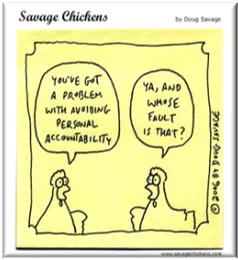
One of the distinguishing marks of leadership is accountability. First, a leader is accountable to those who follow him/her. A leader’s responsibility is to raise their vision and productivity and to provide for their sustenance and safety. Second, leaders are accountable to those in authority over them; whether it be a military chain of command or a corporate structure, leaders are accountable to someone higher up, VP to President to CEO to Chairman of the Board to shareholders. We all live within the autonomy of accountable. Free to act within boundaries.

But the core of accountability is to one’s self. Invariably, accountability begins within a person as they set their own aspirations and boundaries. Those who live without ambitions or borders rarely amount to much; for they have given into the belief that license equals true liberty. Such is not the case. Instead of liberty, license leads to a lurid irresponsibility that affects not only one’s self-image, but also a person’s relationships with others. Even God Almighty granted us perimeters of protection that would clarify for us how we were to live in this world and be responsible for all therein.

Accountability does not come cheap. It always costs someone something on both ends of the relationship. For the one in submission it implies obedience, trust, compliance and regimen within the boundaries of commitments made. For the one in authority it means trustworthiness, nobility and honor, clarity of vision, and a passion to inspire others to work together toward a common end. It involves both parties laying aside personality differences (nay, even utilizing those differences), disregarding minor variances in procedure or even mentoring philosophy, and putting the goal to be accomplished as pinnacle.

If that goal is the nurturing, the maturing, the refining of the other individual, then cost becomes secondary to all other considerations. What is your education worth? What are your children worth? What would you not sacrifice to help them find fulfillment in life? Let’s move further— What are you passionate about? What would you not give to fulfill your dream? Or are you seriously willing to live in the doldrums of ship with no sail, no destination? You see, accountability is often seen as the bondage of one individual to another, of a servant to a master, a rank & file soldier to their chain of command. The reality is significantly differently. True accountability is costly for all involved; in a sense, it is never quite affordable…, for at least one person in the equation, and often, for both. Quite simply, accountability costs.

So the next time you find yourself in an accountability relationship, know that someone has, and will, pay a great price. And it you are asked to be accountable to God…, well, think of the cost, His, and yours.


Have a nice week.

Gary

sunday morning pancakes

Dr, Gary, Davis, Needinc, Clueless, Christianity, Christian, It’s no wonder so few people go to church. With our weekday jam-packed schedules, Saturdays running kids around to sports practices, home repair, grocery shopping, lawn (or snow) maintenance, finishing up some office work (shame on you), and, if we’re lucky, a college ball game thrown in; then maybe a dinner out with friends?!? Yeah, Sunday morning pancakes sound really good— leisurely, with blueberries, recently tapped AA grade New England Maple syrup, with fresh squeezed orange juice, Columbian Supremo coffee, Canadian bacon…, on the deck, or around the fire place. Either way it carries us to a time of refreshment and rest; whether with friends or family, Sunday mornings draws us into a place of peace & restoration. Now if churches would only serve pancakes… . O, never mind.

We live a pace of life that allows for few periods of rest, few times for revival for our bodies, of refreshment for our souls. Weekends often leave us exhausted for another week of work or family responsibilities. Vacations find us so tired from work that we need a minimum of 2 weeks off just to detach from the speed of our daily lives. The probability of sequential mini-breakdowns increases with each passing year. And high blood-pressure…, you probably already have it.

Ergo, we return to Sunday morning pancakes. Sunday morning is probably the only time in your week that you have to STOP and feed your spirit. What I’m talking about is pancakes! Heaps of ‘em! With friends. Sharing the joys and woes of the previous week. (Pass the Maple Syrup again, please. O, and some more coffee!) And if you find yourself in Jackson Hole, WY, drop into Jedediah’s. You’ll feel right at home as you’re served a breakfast like you’ve never imagined!

The point is simple. Each of us needs to set aside some time during our week when we put off the busyness of life to renew our spirits and restore our souls. Pancakes drenched in whipped cream & smothered with blueberries will go a long way towards renewing our spirits. But to refresh our soul, well, only the God who made us can do that properly. And there is no substitute, just like “genuine maple Syrup.” You need to find a church with a community of fellow (exhausted) travelers, just like you, who need a reminder from God about who you are. Jesus Christ came to redeem sinners.  Like you: like me.

Let the God who made you minister to your body & soul Sunday mornings. Then hit the blueberries & whipped cream.


Have a nice week,

Gary

Reverse engineering

EmPulse for Week of March 14, 2011

Reverse engineering

It was after I was abducted by aliens that I started to see things differently, think differently, and act peculiarly.  Or so I’m told.  I feel no different…, basically. I think. Although, NASA has asked me to sit in on a Hi-Tech Table Team to discuss reverse engineering; and I never even studied how to drive a train. [I do seem to know a lot about gravity-modified space-folding and mass/variable polar fusion.]

But that’s not was we’re talking about, is it? And, no, we’re not talking about retro-fitting alien technology to produce our own spacecraft or super-weapons either. Our reverse engineering has more to do with a deep desire to journey back in time to relive some of our worst moments, our worst decisions, our most inappropriate actions, and to make things right. We each have past experiences that have been very painful—some, of our own making. We have flown off into a rage and said things that deeply hurt another. We want to make that right. We have done other things that hurt someone physically; maybe crippling them for life. We want to make that right.

Seeking forgiveness for wrongs we have inflicted on others is a good thing. If those people are still alive, forgiveness may, possibly, be granted. If they are dead, you live with your pain. But you cannot deconstruct the past to read an alternate history. What’s done is done. Whereas it might be possible to rectify the injustices of your past, they remain in your soul as tight, dark specters. In many instances your only solace will come from the God Who created you, from His forgiveness for all you’ve done or left undone. To seek His forgiveness is no small matter. It demands that you take your place as a creature among His creation: it demands you acknowledge the God Who created you as such and none other. It is to know your place in the cosmos and to assume your rightful responsibilities.

Most of us will always dream of reverse engineering—being able to change some of the things we’ve done in our past. But we cannot. The most we can do is to take steps to rectify our actions through corrective actions in the present; and to seek forgiveness for the things we have done—from those we have wounded, and from the God who made us to be otherwise. Thus, we can change the future and bring some resolution and healing to deeds done wrongly.

We’ll be watching,

Gary