

certum est quia impossible est

Dr, Gary, Davis, Needinc, Clueless, Christianity, Christian,


Quintus Septimius Florens Tertullianus, or, anglicized as Tertullian, (ca. 160 – ca. 220 A.D.) was a prolific early Christian Berber author and the first to write Christian Latin literature. He coined concepts like TRINITY, “Three Persons, One Substance,” and this phrase—

certum est quia impossible est— It is certain because it is impossible

It is certain because it is impossible. What an intriguing approach to problems. Whether resolving the dilemma of the Triune nature of God or determining the primary substantial nature of mercury or H2O, Tertullian’s attitude was to conclude certainty in the probability of the impossible. Could he have been so confident of his resolution today, with scientific method at such a pinnacle of detailed observation and explanation?!? “Science” asserts that it is only a matter of time before it can explain everything. This does not leave little room for faith—it leaves no room for faith. [Albeit, science itself is fraught with assumptions about the nature of the universe and presuppositions that craft their own conclusions.]


But certainty because of impossibility!?! How does that work?!? Could it be that a thing seems impossible from one vantage point but obvious and simple from another? That impossible or not from either vantage point, from its own self-perception, it is, in fact, TRUE? (Okay, I’m coming out! I was a philosophy major in college.)
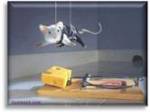
Let’s bring it down to earth again. Suppose you were assigned a task that seems virtually impossible. IMPOSSIBLE. Cannot be done, cannot work, under any circumstances! No way! Because of its impossible nature, why bother to even start it!?! Yet Tertullian presumed the inverse stance— its impossibility made it certain. If we were to assume that posture at work, in our home, in our relationships with difficult people (certainly impossible!), how might it affect our words, our actions and responses, or our emotions and attitudes? Not that the impossible isn’t difficult; but our attitude toward it might carry us closer to resolution than we might imagine. (Personally, I’ve long relished the reactions I evoke when I talk about how we intend to meet the challenges we face at NEEDinc. “That’s impossible!” Outwardly I respond with “Hummm. How so?” but inwardly I’m chuckling.)

When your confidence and source of strength lies within yourself, within your own well of intellectual/emotional capital, you, invariably/eventually, wear down/dry up, or simply quit trying. But if your certainty and strength lay outside yourself, say, in the God who created you, and you are consistently tapped into that source of strength, aren’t the possibilities… endless?

To accomplish what is possible takes time and tenacity: to do what is impossible takes a little longer…  and just maybe a closer connection with the God who made you.

Have a nice week.

Gary

… and the band played on

EmPulse for Week of February 15, 2010

… and the band played on


The Band Played On, also known as Casey would waltz with a strawberry blonde, was a popular song, with lyrics by John F. Palmer and music by Charles B. Ward, written in 1895. The lyrics of the refrain are:

.

.

Casey would waltz with a strawberry blonde

As the band played on;

He’d glide ‘cross the floor with the girl he adored

As the band played on;

Well, his brain was so loaded

It nearly exploded

The poor girl would shake with alarm;

He’d ne’er leave the girl with the strawberry curl

As the band played on.

Almost a century later, in 1987, it was used as part of a book title to represent an attitude of governmental indifference and political infighting in the United States over what was perceived to be a specifically gay disease—  And the Band Played On: Politics, People, and the AIDS Epidemic written by San Francisco Chronicle journalist Randy Shilts.

In this first decade of the 21st century the music and lyrics are all but forgotten; or are they? It still pops up as muzak in elevators, WalMart, art-films, and Titanic movies. Invariably, it finds its way into every Guy Lombardo classic. And I have no idea why it’s been running through my head these past couple days.

and the band played on brings to mind the safety of sameness, of settling into a life-pattern, the regularity of a schedule, and the reliability of cohesive-consistency in life-style and demeanor. It raises an image in the mind of placid peacefulness that is not pale, but solid, serene, secure. D-e-p-e-n-d-a-b-i-l-i-t-y ! A quality of significant merit in our present social structure.

For many people it is their simple, reliant contribution to the stability of family and workplace. For others, it is a façade; for they are enraged within, a boiling caldron of conflicting emotions & life-philosophies. And still, for others, establishing this cohesive-consistency to life shields them from having to confront the conflicts that surround them— at work, at home, within themselves, even in the oddities of governmental directives. They hide within the safety and complacency of their well-ordered lives, trying as best they can to stay unruffled by any external assaults to their protected patterns.

This is not living.

Living is more like managing chaos and hoping for the best. Whether you are performing surgery, planning a mission to Mars (whoops, forgot budget cuts), or the annual spring cleaning, you know full well that it all gets messy. Life is not neat. If you are in complete control of your life then you either have a very small life or you harbor a secret fear of stepping out of your comfort-zone. In short, you have trapped yourself within, and are falling short of the greatness God holds out to you.

Picture yourself in a ballroom, with people whirling all around— beautiful paintings on the walls, crystal chandeliers above giving off a sunset warmth, and the most enchanting music playing. “and the band played on.” You— pressed against the wall in a corner.

Wouldn’t you rather be dancing?

Have a nice week.

Gary

fear of being known

EmPulse for Week of February 8, 2010

fear of being known

Ten years ago I lost one of the best Executive Assistants I have ever had—  to marriage. It was a bitter-sweet parting. I was excited for her to begin her new life while dreading the thought of the immense effort it would take to teach someone all the intricacies of NEEDinc. Just before she left we had our debriefing, our exit-interview. As I reviewed her incredible services to NEED, and to me, her somewhat scattered, visionary, prophetic, CEO, she rehearsed what I needed to do to make sure her replacement understood both the good and the bad of working with me. [Was I really that clueless a boss?]

As we wound down I asked her what she most looked forward to in being married. She answered with the usual young bride-to-be responses—the safety, the love, the end to the hunt for the right one, etc. Then I asked her if she had any concerns about getting married; with little hesitancy she replied “Being known.” The thought of living 24/7 with the same person for the rest of her life terrified her. I tried to assure her that that was actually the best part of marriage. She was not assuaged. Of course, today, she looks back at herself and wonders at her needless anxiety…, and laughs.

Still, there are many leaders, Christian, political, and business, who wear a mask, a persona—who fear being uncovered, found-out, exposed for who they really are if their façade of bravado, or pseudo-confidence were to be ripped asunder. Some, with good reason: because they are pretentious manipulators, users of others; but not all. Many leaders are genuinely…, well, genuine. Of a truth, degrees of transparency are still tied intrinsically and socially to degrees of intimacy and propriety. But for some, the very idea of anyone else knowing who they truly are horrifies them. What if they find out my fears? My failures? What if my wife discovers I was unfaithful once…, twice? What if those under my charge learn I don’t always know what to do, that I fake it? What if that perpetual underlying struggle I have with sin emerges? What if… ? What if… ? Their fear seethes just below the surface, binding them ever more tightly to their artificial avatar.

But it doesn’t have to be this way. Confession is good for the soul, is still true. True to God, for sure. We ALL need His forgiveness and mercy. But also to those we’ve wronged. Saying something that is not true is not to misspeak; it is a lie.

Overcoming a fear of being known is not a simple matter. It starts with little revelations, small disclosures that test the worthiness, the trustworthiness, of another. This often takes years. It helps if you have skills in reading people; you can weed out those who care and those who don’t much more easily when you have these abilities. But the key ingredient to overcoming a fear of being known is to realign the foundation of who you are, your core values, that which makes you…, YOU, to come into line with the very God who made you. If you are not comfortable with the people around you knowing you, then you can be sure that being known by the God of the Universe is a terrifying, absolutely petrifying matter.

Even here there is good news and bad news. First, the good news— He already knows you; He knows everything you think, do, plan to do, etc. The good and the bad. And He accepts you the way you are. Now the bad news— He already knows you. The good and the bad. He accepts you the way you are; but He will not leave you the way you are. He needs you to represent Him and accomplish His MISSION on this earth. For that, you must change, be different, less self confident, more confident in Him. He needs you not to fear being known, but to rest in the reality that He knows you, all of us, intimately. And He wants all of us to enter into His Kingdom and to live by the principles He has set down for our protection. He wants us to enter His Heaven…, on His terms, not on ours. In the mean time, we should be making a difference in the here-and-now with who we are, rather than expending a great deal of energy pretending to be someone we are not.

So if you are afraid of being known…, give it up. It’s too late. You already ARE known. “Fear not… !”

Have a nice week.

Gary

use things…, love people.

EmPulse for Week of February 1, 2010

Use things…, love people. Of course we all subscribe to this dictum. But when push comes to shove, when budgets are crunched and tensions are high, management tends to flip the using and loving (if there ever was any loving). Fortunately, your everyday guy would never use people…, right?!? Husbands always love their wives: wives always love their husbands. James Redfield’s CELESTINE PROPHESY (1993) aside, perish the thought that anyone in this postmodern world would use another person.

We live in a society where using people and loving things seems to be the modus operandi. Accomplish the TASK, even if you exhaust people to the point of exasperation; they can be replaced. In the same way that computers become sluggish and obsolete, wives are replaced by younger, fresher models, and matured, wizened leaders are supplanted by younger cheaper versions, so the pattern of using people follows the archetype of using, and abusing, things. People have become as expendable as last month’s mobile phone model.

These practices, found in business, in our courts, our banks, and even in our charitable institutions (where only 60% on the dollar actually goes to fulfilling their mission), have decimated the spirits of the North American worker, the fathers & mothers of families, and the leaders of our churches. I expect usury & abuse in business, banking, & governments, but it is not acceptable among those who claim the name of Jesus. Nonetheless, the church is as guilty of loving things and using people as is the rest of our society. Elders grow disillusioned by the ends of their terms, feeling they have affected little; Sunday school teachers burn out because there is no one to fill their shoes; and pastors (or priests) lose heart, switching to auto-pilot; they become firemen, constantly putting out fires, rather than lighting them in people’s hearts.

Should this practice continue, we will, like the preceding three generations, be left with beautiful buildings, well-run programs, and people who have lost heart for serving, any energy to care, and maybe their very faith.

The correction to this predicament is simple—use THINGS…, LOVE PEOPLE. There is nothing you are doing that is worth the life of someone in your care. That is theirs to give, not yours to take. GIVE your life, nourish theirs. In a word—

FEED YOUR LEADERS

Give them something to live for. Make them feel essential to the tasks to which they give themselves. Compliment them on a job well done; offer new ideas on how to be more creative (or, maybe you could learn from them). Listen to them in family conversations. Or, simply, take them out to lunch, for beer, or just drop by their office with some truly great coffee. Learn to love people, genuinely love them, and they will follow you to the ends of the earth. But don’t let them. Guide them to teach others to use things…, and to love people.

‘Nough said.

Have a nice week.

Gary

[Please note: We get to love a brand new person as of last Saturday night. Our daughter Bethany and son-in-law Jeffery gave us James Robert Costigan at 9:15 p.m.]