Pocket Watch

 It was almost 35 years ago that my father died. If you’ve lost a parent, no matter how recent or in distant memory, you know how you never quite lose those special moments you had with them. Recently, I came across my father’s pocket watch, a Waltham. It had been given to him by his father. Now I have it. And it still works.

Pocket watches were used to time everything in their day; but mostly for determining train departures and arrivals in the rail industry. Their accuracy was extremely important. If a train left the station or yard too early if could find itself on a collision course with another train coming in on the same track.

Timing is just as critical in our technological era. From picking up the kids from daycare, to traffic signals, to being on time for a flight, to space craft launches, TIMING is critical.

Timing is critical in relationships as well. Simple Punctuality is a sign of respect. Knowing when to speak, and when not to, is a sign of wisdom & intuition. Words spoken are difficult to retract; some people remember things said to them all their lives. Some forgive; some do not.

Being truthful is a necessity in conversations. You never want to be caught in a lie, or a half-truth. End of credibility. But timing is critical when considering the difference between HONESTY and OPENNESS. Honesty should be required to direct questions. Openness is more a matter of perception, timing, and sensibility. For example, frank, honest discussion within a relationship is always good for the soul and for all those involved. Openness, laying out all your concerns on another in one single exchange, may be too much for them to bear.

Think.

Consider the import and ramifications of your words. What effect might your openness have on the other person? Are they at a good place to accept them, to ponder your perspective?

This is a kind of timing that is unavailable on the face of a pocket watch, or any other timepiece, for that matter. But it is an art we would all do well to learn.

Someone has said, “There is enough time in each day to do all God has assigned you.” So use your time wisely. Use your words wisely too. Timing is everything.

For what it’s worth,

Gary

They have Pulled Down Deep Heaven on their Heads

“They have Pulled Deep Heaven on their Heads.” So titled is chapter 13 in C S Lewis’ third book in his prophetic science fiction series. In this book, That Hideous Strength, Lewis recounts the efforts of a seemingly civil society of philanthropists to simultaneously enhance the buildings and grounds of a Private British College while they furtively seek to unearth the remains of Merlyn, the Medieval Wizard said to possess mysterious powers. It was those powers that they would harness and wield to their own purposes.

What they unearthed was not exactly what they had intended: quite the opposite in fact. In resurrecting Merlyn and his powers they inadvertently pulled down deep heaven on their heads.

How often do our plans and motivations pull down deep heaven on our heads? A desire for revenge certainly takes its toll on the begrudged, consuming both resources and creativity. Rage and a bitter spirit do likewise gnaw away at our souls, leaving us less than who we might have been.

But the one that does the most damage is that seething inner hatred of some other group or individual that is never assuaged; rather, it intentionally feeds exclusively on the meat that reinforces its ire, ignoring anything contrary. It’s not just that some of us need to be more right than anyone else. We also have to be able to rub it into those whom we’ve just proven wrong. This is an evil hatred that disdains the other and wishes their utter annihilation. This is the kind of arrogance that will pull down deep heaven, the wrath of God, if you will, on their own heads.

They must believe that their actions will have no consequences; that there is no God in the heavens with whom a reckoning must come. Can their resentment and fury be so unquenchable?!? What realities will bring them contentment, resolution, mercy, or grace? Will they ever be able to forgive those who have done so much wrong to them? Is retribution the only way?

Or is there another? Let me assure you that there is. But it will cost you your soul. You will come out the better man, the better woman for it. But the price is not cheap. Then again, anything of great worth never comes without disproportionate sacrifice.

Maybe it is simply better for things to go on as is, with your spirit seething within, seeking gross retaliation on others. What a glorious existence!

Personally, I would rather sacrifice my soul to be rid of such seething, crazed lunacy.

For what it’s worth,

Gary

sexy

  A quarter of this world’s population is situated in North America, Europe, and Japan. If you live in any of these regions you are subjected to a constant barrage of extreme sexuality from print media, to the internet, to the local high school, or merely walking outside your home. If Middle Eastern cultures have any apprehensions that we have sold out to evil, they need merely watch our TV or peruse our magazines.

Of course, at the turn of the Twentieth Century, the sight of a woman’s ankle, even cloaked in a stocking, was enough to send a suitor into a delirious tizzy. But by the turn of the Twenty-first Century…, good grief! Do teenage girls want to be assaulted?!? Do teenage boys think that wearing their pants below their butt is attractive, let alone appropriate?!? Really!

Fashion today, at least among teenagers, is a degradation of the female and male bodies. Among Twentysomethings, it’s a little better…unless their goal is to get picked up, laid, or merely to look sluty. Casual sex is in vogue. “Hooking up” it’s called:  no other context, just sex. O joy. Granted, this is not true of every teen, or every Twentysomething; but it is all around us, all the time.

Everything sexy in our society, in our culture, has lost any context connecting it to marriage and commitment. It is sex for sex’s sake, and nothing more. Tina Turner’s song, “What’s Love Got to Do With It (1984).” was prophetic. Why would anyone have to pay for sex again?

Physical/sexual attraction among the young, and the old, is a normal part of life; a quite enjoyable one, I might add. But must sexuality dominate our media to the extent that it does? I recall a 1950s auto parts magazine cover, picturing a girl in a bikini holding a 3’ long wrench. My mind was baffled. The connection between the wrench & the bikini was supposed to be…, what? Even though I was not yet 20 this made no sense. But this was merely a portent of things to come.

Western culture, and any culture seeking to be like us, will fall to this sexualization of their young. It is the inevitable result of any society that dismisses a moral code based outside its own plurality. The questions raised by this process are serious and numerous and must be addressed. Otherwise, Caligula’s Rome awaits us.

So how do we instill a moral conscience in the next generation when the definition is left up to the individual who is assailed 24/7 with the images & messages of sex? Ideas please!

Sweet dreams,

Gary

hamlet


Immanuel Giel

hamlet– def.

1. a small village in Medieval Europe; 2. the Crown Prince of Denmark in William Shakespeare’s play; 3. future bacon.

So…, what’s in a name?!? Words are funny things. In latter medieval days the Oxford English Dictionary recorded more than 21,800 Old English words in use, many of them amalgamations of Norse, Old English, and Latin. Between 1576 & 1650 an additional 44,500 were included, bringing the total close to 70,000. By the late Renaissance, the number of words had risen above 100,000. By the turn of the 2nd Millennium (1900) the total was closer to half a million. A Millennium later, by January 1, 2012, the OED listed 1,019,729.6 words, excluding scientific, technological, and medical terminologies.

So…, what is in a word? Putting aside prefixes, suffixes, tenses, homonyms, and nuances English is a convoluted language. Chinese may hold the record for number of characters (106,230 in the 2004 Yitizi Zidian Dictionary) but English takes the trophy for confusion. Add to that our postmodern propensity to invent meanings for conventional words on the basis of individual, personal preference and you have one “mell of a hess!”

For one, take cursing. Our media bleeps-out words like f*#k and s@%t, but uses the Name of God and Jesus Christ in profane manners. Our culture can’t even get cursing right! We extricate vulgar language and gloss over genuine blasphemy! Not worth a comment.

Aweful is another example, totally flipped in meaning in just 300 years. Once it referred to the glory and greatness of our God: today, it’s just Awful, meaning really terrible! Diddo.

George Bernard Shaw, (1856-1950) the Irish playwright, once quoted “God created man in His image and then man returned the favor.” The quote is not original with Shaw but his point is palatable. It is also transferable to language—Words evolve imbued with history & meaning; then we change their meanings to suit our fancy. Stephen Colbert’s idea of truthiness comes to mind.

Words do evolve and change in their usage over time, be it 300 years (aweful) or 2 years, “Tweet me.” Redefining words for personal pleasure should not be endured in civil society. Yet, in our postmodern/postChristian societies, we actually encourage the re-defining of words to fit our penchants. When we talk about sin the meaning should be clear. A lie is a lie, not a mis-speaking. Contracts should be written clearly, with NO questions about the meaning of its words.

Sometimes it feels like we’re dredging up the Tower of Babel because it suits our predilections.

For what it’s worth, [Whatever that means to you.]

Gary

that ringing in my ears

Stop! Listen! You can hear it if you think about it— that delicate ringing in your ears just below the surface of your conscious thought. Normally, most of us tune out its persistent ringing (although some of us are unable to silence it). Most of the time it is a background noise; that is all. But it can be a distraction. And in those quiet moments of self-conscious thought, it can be heard below the din of our ruminations.

Our ears tune into all kinds of ambient distractions. For some, music beckons like the Sirens of ancient lore, disrupting us from completely engaging in present conversations. For others, music provides a soothing underscore enabling us to focus more fully on the tasks at hand. For still others any ambient noise, the whirling of a fan, the clicking of a keypad, the laughter of children playing, distracts us from focused engagement. Distractions all!

So why is it, then, that too often we choose to focus on the distraction rather than the present undertaking? Could it be that some tasks put to us are too complex or immense? Then, the distraction becomes so much more appealing, drawing us to its fancy. Or might it be that we simply choose to not think too deeply, too hard, about anything. It’s just too much work. We’d rather tune into anything else, even that ringing in our ears, than give ourselves to proactive, difficult thought.

Dare it be said? The modern mind is no more. It has been supplanted by a simple mind, a lazy mind, for a mind poised for mediocrity. Rather than rising to the occasion we choose to wait to see what happens. Easier to respond; more difficult to initiate. So?!?

If a majority of us continue along this path we will be absorbed by the postmodern mindset of rejecting past wisdom simply because it is from the past. Instead, we will grasp the dribble of postmodern/postChristian philosophies that merely reflect majority sentiment and leaning. Brilliant!

For example, do we really believe that human nature and morality are mere societal constructs for the safe perpetuation of the human species?!? REALLY!?! Then evolutionary theory has degenerated into mere human mechanics. Human decency has descended into no more than what each individual thinks they can get away with. Individual commitments become mere conveniences.

You can believe whatever you want. I choose to learn from the past, live graciously in the present, and risk our futures on faith in a personal God and human integrity rather than on a closed universe and humanistic mechanizations. There may be ringing in my ears, but I still choose to think.

For what it’s worth,

Gary

pretending to be dead

“… he’s in the bedroom pretending to be dead.” was the declaration a 6 year old ‘Bekah announced to her parents when they inquired as to the whereabouts of her 3 year old brother, Duke. Kids say the darndest things. Of course, he emerged a few moments later, very alive, seeking a treat.

Not unexpectedly, there are a lot of us who pretend to be dead when we want to avoid certain uncomfortable situations; a drop-by at the office, unexpected relatives, a former boyfriend who wants to stay in touch, a boss coming down on you when you’ve screwed up, getting caught hedging on your tax return, being seen out with another woman.

Personal hide-outs & fantasies start to look quite appealing when we want to get out from under a potentially itchy predicament. Kids play at being dead all the time. The problem comes when this playing dead continues into adulthood. We don’t like what we see coming, so we hide, find our schedules suddenly over-booked, have another commitment, etc. In essence, we play dead; just for the sake of avoidance. Inevitably, however, there will come a day when we must face the Grim Reaper of personal accountability… in this life or the next.

So what can be done to avoid those special situations where we’d rather pretend to be dead?

  1. Prudent Transparency is a good place to start. Wisdom dictates our honesty at all times: caution guards our degree of openness and trust.
  2. Taking Responsibility is another initial posture we should practice. Most cover-ups and side-steps are eventually discovered. Don’t waste the energy.
  3. Placing Character before Compromise is also a good idea. There is nothing like a consistent trait of integrity that will encourage another person to criticize you with friendly impunity. Character builds both community and comradery, not to mention open lines of communication.
  4. Confession is good for the soul, it is said. It also expedites a return to sincere relationships. Clearing the air early-on always avoids further complication and hesitancy.
  5. NEVER pass the buck!

We have arrived at that stage in our cultural development where a man, a woman, of integrity is a rare commodity. Some even believe they can be a detriment to an organization. But in the long view this has not proven so. It is people who face their fears, or the consequences of their actions (or inaction), who lead us all into a more God-honoring, people-honoring world community.

Have a nice week,

Gary

letting go…

So many different ingredients go into shaping our identity. Our place of origin, our class, life situation, our parents’ economic level, our peers, even our youngest memories, actions, and decisions, all blend into the mix that is us. In time they accumulate into a collective whole. For some, the God of the universe molds our clay to become a useful vessel in His hands. Yes, we do have a choice in the matter. But should we: and to what extent is it viable?

Good times become memories; friends form a part of our social fabric, another definer of our lives. Tragedies become memories too; that first girlfriend leaving you, the betrayal of a friend, the early loss of a parent. Being hit with the reality that we are not superman, not invincible, not the greatest & best at everything, not the center of the universe also goes into our collective psyche, further refining who we truly are, and not some projection of our imagination.

We hang onto these definers, both positive & negative, as a point of reference upon which we decide our future behavior, make our future decision, and define the “groove” of our lives. We settle in, based on how we arrived at this place in our journey. Ergo, we feel safe. Finally. Mostly. Sorta.

To be sure, there are some areas in our life which are best let go, we tend to hang onto those. Why? Because they provide a point of reference, a sense of safety, a history, memories. Healthy people move past the painful experiences, letting them go. They make their peace with the past. Others, not so much. Too many of us either live in the past where personal safety and happiness were part ‘n parcel to life. For them, moving forward, growing beyond, is too much of a risk.

Why do we seek to dwell in our memories and past experiences, even the great ones, when there is so much to discover around the corner, in a future full of possibilities? The good ol’ days just weren’t. We need to let go—of the hurt, the pain, and the what-could-have-been.

Letting go of anything is not often a simple matter.  But living in the past both robs us of great joy and elation in the present, and deprives us of our dreams for the future.

Let it go.

Have a nice week,

Gary

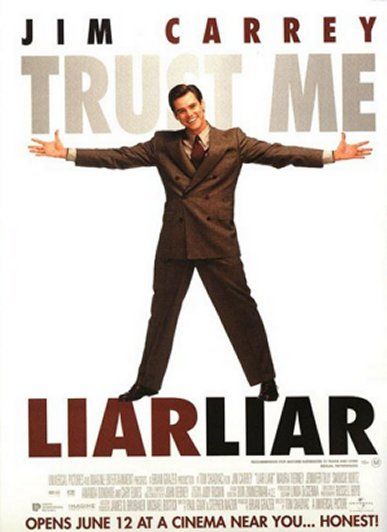
LiarLiar

Although Jim Carey may have visualized the oft repeated children’s jibe—

Liar, liar

Pants on fire;

Hangin’ on a telephone wire!

the origin of the taunt come from a paraphrased version of William Blake’s 1810 poem “The Liar.” The last stanza reads—

Deceiver, dissembler
Your trousers are alight
From what pole or gallows
Do they dangle in the night?

Nothing new under the sun? Humm.

It is both the plot of Carey’s film and Blake’s poem that are our focus today. The story line of LIARLIAR focuses on Fletcher Reede, (Carey), a defense attorney, whose son wishes on his birthday that his father can’t lie for a full day, 24 hours. Then his wish comes true. Now what problems might that create?  The focus of Blake’s poem surrounds the seriousness of lying and its consequences. The penalty being, hanging on a gallows above a bonfire…, roasting. Pleasant thought.

Both poem and play describe the difficulties created when a person lies profusely. In Blake’s six stanzas lying’s source (“…red devil of mendacity) is exposed as well as lying’s consequences (the pants on fire metaphor). Lying is, to be sure, hard to keep track of on a personal level. In the public eye, even though all of us lie on an individual basis, lying is forbidden. If disclosed, it can be a career destroyer, result in legal action, imprisonment, and, in some cases, execution.

But it is the movie LIARLIAR that poses an equally perplexing dilemma— not lying at all, even for a meager 24 hours. It confounds the mind to imagine living a life devoid of lies. Little white lies, tiny fibs, half-truths, diversions, redirecting from an uncomfortable question, distortions of truth, revealing things that enhance your position over another; variations on a theme. The odd thing is that most of us believe that our lies will never be exposed. On the simplest of levels this is both naïve and foolish.

The Lord Christ made a statement recorded in the Christian Scriptures that reads, “You shall know the truth and the truth shall set you free.” (John 8:32). In one sense that “truth” refers to Jesus himself. He is Truth. But in another sense it refers to freedom from trying to remember all the lies we have told. I realize that this may seem simplistic. Yet, forgiving unusual circumstances (hiding the innocent), might it actually make your life a tad less complicated? Isn’t it just simpler to tell the truth?

Have a nice week,

Gary

pizza…, extra cheese

Ever since this originally Greek delicacy was introduced to Italy it has shaped the world’s culinary cravings from China to South Africa. In the U.S. it became the staple food of both the American teenager and their families. Many people describe this circular meal as their personal comfort food. I am not one of them.

Still, there are times when just nothing will satiate the palate other than a piece of this chewy triangle. Sadly, having missed another lunch-time by a good three hours, I walked over to Antonio’s Pizza and stood in line to order a slice…, with extra cheese. And extra garlic sauce: and hot peppers. No one has come near me since. Hummm.

American life, in both the 20th and early 21st centuries, has become a cafeteria of choices. We can even get our pizzas with extra cheese. Yet up to one-third of our world has never even seen a pizza. They live far below the poverty level of most developed nations— Europe, Japan, Australia/New Zealand, North America, parts of South America, emerging China, and eastern Russia. Yet there are places on this planet which have never heard of pizza— nomadic China, nomadic Russia, Northern & Central Africa, the Indian Peninsula, and many isolated South Sea Islands.

So, you ask, What has this worldwide pizza-depravation to do with me? More than you might think. For starters, it raises a personal/global economic question. While we are deciding on extra cheese Why must a third of our world live on below $2.00 a day? Do the rest of the developed nations of the world need this de facto slave-population to maintain our life-style? Another question it raises is To what extent am I, individually, and our nation, corporately, responsible to raise their standard of living? Is ignorance (& poverty) really bliss? And what about the infant mortality rate? Or, the educational resources NOT made available to them? Are we no longer, proverbially, our brother’s keeper?!?

How can we turn a blind eye and do nothing to aid a third of our world’s desolation!?! To be sure, navigating the social-political landscapes, regional conflicts, the balance of world-trade, and the rights of peoples to govern themselves is a complicated mine-field. But it has to be traversed.

Let’s not leave the care of this world to the Bill Gates’ & Warren Buffets’, to the Peace Corp & the Red Cross, or to the volunteers working with Doctors without Walls, World Vision, and the countless Christian missionaries who have accomplished untold acts of heroism to bring peace, safety, and medical supplies to our world’s needy. Every one of us, who earn more than $2.00 a day, should be involved in saving our planet from systematically enslaving a third of its population.

Never mind, forget the extra cheese. Actually, forget the whole slice. I can wait ‘till dinner.

Have a nice week,

Gary

Simple Questions

Too often in life we believe there is a simple answer for everything. Some believe that the simplest answer is most probably the right one. And, in some cases, that is true. But the more we learn, as created beings, the more we discover that this created realm in which we live is far more wondrous and sophisticated than we ever could have imagined.

Take gravity, for example; before Einstein who would have imagined that is was due to the curvature of space?!? Or, that before Watson & Crick, all life is based on a double helix molecular strand, our Deoxyribonucleic acid (DNA), that encodes the development of all life? Or, that, before Howard Gardner, there were different forms of intelligence, not measurable by standardized IQ tests? (Visual Kinesthetic, for one.)

In studying human nature the jury is still out. Are we basically good, evil, or a mixture of both? Can our human nature change? Can our basic personality change? None of these are simple questions, nor do they have simple answers.

Nonetheless, we crave simple answers. Why? Because complicated, complex answers are too much work. We’ve become a people whose lives are so complicated and busy that having to deal with anymore complication is just too much! If the questions were simpleother people would already have provided the simple answers. The reality of the matter is— that for every complex, complicated question, there is a complex, complicated answer; which, sometime, can be boiled down to a v-e-r-y simple answer. Sometimes. Not all the time.

The point is that we need to face both the difficult, convoluted questions, as well as the ones that resolve simply. When we initially face them, how can we know which is which? Well, some questions scream complication. With other questions, the answer seems obvious. So do we give up when the simple answer turns out to have more facets than we originally thought? I would hope not. [Please note, though—this comes from a man who does not hesitate to ask for directions. After earning five graduate degrees I have come to understand just how little I know or understand.]

During my doctoral pursuit I was rewarded with this fortune cookie at Panda East—Nothing worthwhile is ever accomplished without passion. This seems a good axiom to follow when it comes to questions. Simple question: hard question. What difference does it make?!? It is all about discovering the riddles of life and the universe to make more sense of our own lives. What do we have to lose! Certainly not faith; faith is the energy we run on as we seek those answers we believe are out there, somewhere. Trust God. Dig in. Don’t give up.

Have a nice week,

Gary