
letting go…

So many different ingredients go into shaping our identity. Our place of origin, our class, life situation, our parents’ economic level, our peers, even our youngest memories, actions, and decisions, all blend into the mix that is us. In time they accumulate into a collective whole. For some, the God of the universe molds our clay to become a useful vessel in His hands. Yes, we do have a choice in the matter. But should we: and to what extent is it viable?

Good times become memories; friends form a part of our social fabric, another definer of our lives. Tragedies become memories too; that first girlfriend leaving you, the betrayal of a friend, the early loss of a parent. Being hit with the reality that we are not superman, not invincible, not the greatest & best at everything, not the center of the universe also goes into our collective psyche, further refining who we truly are, and not some projection of our imagination.

We hang onto these definers, both positive & negative, as a point of reference upon which we decide our future behavior, make our future decision, and define the “groove” of our lives. We settle in, based on how we arrived at this place in our journey. Ergo, we feel safe. Finally. Mostly. Sorta.

To be sure, there are some areas in our life which are best let go, we tend to hang onto those. Why? Because they provide a point of reference, a sense of safety, a history, memories. Healthy people move past the painful experiences, letting them go. They make their peace with the past. Others, not so much. Too many of us either live in the past where personal safety and happiness were part ‘n parcel to life. For them, moving forward, growing beyond, is too much of a risk.

Why do we seek to dwell in our memories and past experiences, even the great ones, when there is so much to discover around the corner, in a future full of possibilities? The good ol’ days just weren’t. We need to let go—of the hurt, the pain, and the what-could-have-been.

Letting go of anything is not often a simple matter.  But living in the past both robs us of great joy and elation in the present, and deprives us of our dreams for the future.

Let it go.

Have a nice week,

Gary
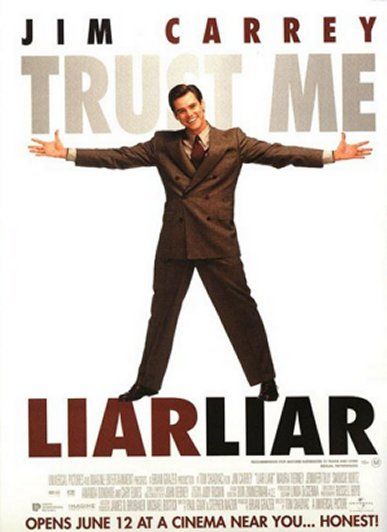
LiarLiar

Although Jim Carey may have visualized the oft repeated children’s jibe—

Liar, liar

Pants on fire;

Hangin’ on a telephone wire!

the origin of the taunt come from a paraphrased version of William Blake’s 1810 poem “The Liar.” The last stanza reads—

Deceiver, dissembler
Your trousers are alight
From what pole or gallows
Do they dangle in the night?

Nothing new under the sun? Humm.

It is both the plot of Carey’s film and Blake’s poem that are our focus today. The story line of LIARLIAR focuses on Fletcher Reede, (Carey), a defense attorney, whose son wishes on his birthday that his father can’t lie for a full day, 24 hours. Then his wish comes true. Now what problems might that create?  The focus of Blake’s poem surrounds the seriousness of lying and its consequences. The penalty being, hanging on a gallows above a bonfire…, roasting. Pleasant thought.

Both poem and play describe the difficulties created when a person lies profusely. In Blake’s six stanzas lying’s source (“…red devil of mendacity) is exposed as well as lying’s consequences (the pants on fire metaphor). Lying is, to be sure, hard to keep track of on a personal level. In the public eye, even though all of us lie on an individual basis, lying is forbidden. If disclosed, it can be a career destroyer, result in legal action, imprisonment, and, in some cases, execution.

But it is the movie LIARLIAR that poses an equally perplexing dilemma— not lying at all, even for a meager 24 hours. It confounds the mind to imagine living a life devoid of lies. Little white lies, tiny fibs, half-truths, diversions, redirecting from an uncomfortable question, distortions of truth, revealing things that enhance your position over another; variations on a theme. The odd thing is that most of us believe that our lies will never be exposed. On the simplest of levels this is both naïve and foolish.

The Lord Christ made a statement recorded in the Christian Scriptures that reads, “You shall know the truth and the truth shall set you free.” (John 8:32). In one sense that “truth” refers to Jesus himself. He is Truth. But in another sense it refers to freedom from trying to remember all the lies we have told. I realize that this may seem simplistic. Yet, forgiving unusual circumstances (hiding the innocent), might it actually make your life a tad less complicated? Isn’t it just simpler to tell the truth?

Have a nice week,

Gary

pizza…, extra cheese

Ever since this originally Greek delicacy was introduced to Italy it has shaped the world’s culinary cravings from China to South Africa. In the U.S. it became the staple food of both the American teenager and their families. Many people describe this circular meal as their personal comfort food. I am not one of them.

Still, there are times when just nothing will satiate the palate other than a piece of this chewy triangle. Sadly, having missed another lunch-time by a good three hours, I walked over to Antonio’s Pizza and stood in line to order a slice…, with extra cheese. And extra garlic sauce: and hot peppers. No one has come near me since. Hummm.

American life, in both the 20th and early 21st centuries, has become a cafeteria of choices. We can even get our pizzas with extra cheese. Yet up to one-third of our world has never even seen a pizza. They live far below the poverty level of most developed nations— Europe, Japan, Australia/New Zealand, North America, parts of South America, emerging China, and eastern Russia. Yet there are places on this planet which have never heard of pizza— nomadic China, nomadic Russia, Northern & Central Africa, the Indian Peninsula, and many isolated South Sea Islands.

So, you ask, What has this worldwide pizza-depravation to do with me? More than you might think. For starters, it raises a personal/global economic question. While we are deciding on extra cheese Why must a third of our world live on below $2.00 a day? Do the rest of the developed nations of the world need this de facto slave-population to maintain our life-style? Another question it raises is To what extent am I, individually, and our nation, corporately, responsible to raise their standard of living? Is ignorance (& poverty) really bliss? And what about the infant mortality rate? Or, the educational resources NOT made available to them? Are we no longer, proverbially, our brother’s keeper?!?

How can we turn a blind eye and do nothing to aid a third of our world’s desolation!?! To be sure, navigating the social-political landscapes, regional conflicts, the balance of world-trade, and the rights of peoples to govern themselves is a complicated mine-field. But it has to be traversed.

Let’s not leave the care of this world to the Bill Gates’ & Warren Buffets’, to the Peace Corp & the Red Cross, or to the volunteers working with Doctors without Walls, World Vision, and the countless Christian missionaries who have accomplished untold acts of heroism to bring peace, safety, and medical supplies to our world’s needy. Every one of us, who earn more than $2.00 a day, should be involved in saving our planet from systematically enslaving a third of its population.

Never mind, forget the extra cheese. Actually, forget the whole slice. I can wait ‘till dinner.

Have a nice week,

Gary

Simple Questions

Too often in life we believe there is a simple answer for everything. Some believe that the simplest answer is most probably the right one. And, in some cases, that is true. But the more we learn, as created beings, the more we discover that this created realm in which we live is far more wondrous and sophisticated than we ever could have imagined.

Take gravity, for example; before Einstein who would have imagined that is was due to the curvature of space?!? Or, that before Watson & Crick, all life is based on a double helix molecular strand, our Deoxyribonucleic acid (DNA), that encodes the development of all life? Or, that, before Howard Gardner, there were different forms of intelligence, not measurable by standardized IQ tests? (Visual Kinesthetic, for one.)

In studying human nature the jury is still out. Are we basically good, evil, or a mixture of both? Can our human nature change? Can our basic personality change? None of these are simple questions, nor do they have simple answers.

Nonetheless, we crave simple answers. Why? Because complicated, complex answers are too much work. We’ve become a people whose lives are so complicated and busy that having to deal with anymore complication is just too much! If the questions were simpleother people would already have provided the simple answers. The reality of the matter is— that for every complex, complicated question, there is a complex, complicated answer; which, sometime, can be boiled down to a v-e-r-y simple answer. Sometimes. Not all the time.

The point is that we need to face both the difficult, convoluted questions, as well as the ones that resolve simply. When we initially face them, how can we know which is which? Well, some questions scream complication. With other questions, the answer seems obvious. So do we give up when the simple answer turns out to have more facets than we originally thought? I would hope not. [Please note, though—this comes from a man who does not hesitate to ask for directions. After earning five graduate degrees I have come to understand just how little I know or understand.]

During my doctoral pursuit I was rewarded with this fortune cookie at Panda East—Nothing worthwhile is ever accomplished without passion. This seems a good axiom to follow when it comes to questions. Simple question: hard question. What difference does it make?!? It is all about discovering the riddles of life and the universe to make more sense of our own lives. What do we have to lose! Certainly not faith; faith is the energy we run on as we seek those answers we believe are out there, somewhere. Trust God. Dig in. Don’t give up.

Have a nice week,

Gary

Dante Alighieri- Vision of Hell

Dante Alighieri lived from 1265-1321. In a series of visions he penned his most serious and prestigious work- the Commedia. Fifty years later Italian author & poet Giovanni Boccaccio added the descriptor “Divina.” Dante’s work became known henceforth as The Divine Comedy: the vision of Paradise, Purgatory and Hell.

Dante penned this work somewhere between 1308 and his death in 1321. He first released it the Thursday before Good Friday, 1300. He started writing his Commedia when he was halfway through his life, 35 years old. Thus did he take stock of his life at this midway-point. His Commedia is not so much a recounting of his vision of heaven, purgatory, and hell as it is an allegory of humanity’s journey to God. He starts, quite reflectively, in Hades, Canto 1 where he observes how many of us go through phases of darkness

IN the midway of this our mortal life,
I found me in a gloomy wood, astray…

            Many of us go through phases of darkness. Some dark phases last forever, at least it seems that way. Dante Alighieri entered such a phase at mid-life as he pondered his future. He imagined himself passing through the three abodes of the dead, sequentially, from hell, through purgatory, and finally, entering his heavenly resting place. Though he was, in fact, describing all humanities spiritual journey, raising serious questions along the way.

There are many questions for which we each must find the answers. In Canto 1 Dante likens his wandering to being lost in a wildly savage forest… not far from death. He knows he needs help to find his way out of his sleepy dullness. He looks up from his valley to a mountain for someone to guide him though this phase of his life. Would we, in our postChristian mindset, even think to look for such a person? Would we recognize genuine answers to our questions if they came to us? Do we even know which phase of life we currently traverse? What looms in our future direction along this path? These are just a few of the queries for which we must discover answers.

If we do not seek these answers, we may forever wander in that forest, wild & savage. We might also not seek that One “Who leads all wanderers safe through every way.” (Canto 1, line 17)

Have a nice week,

Gary